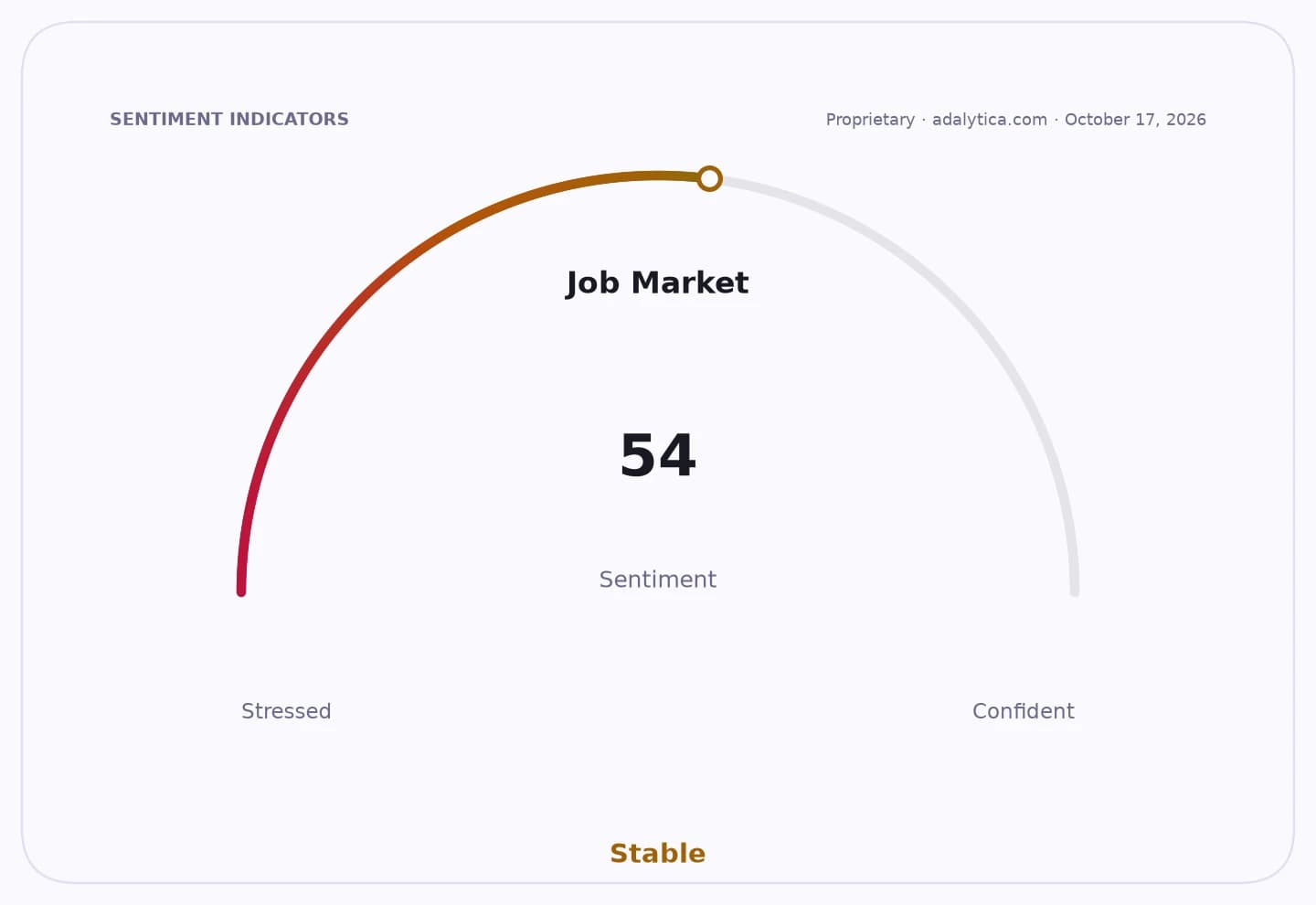
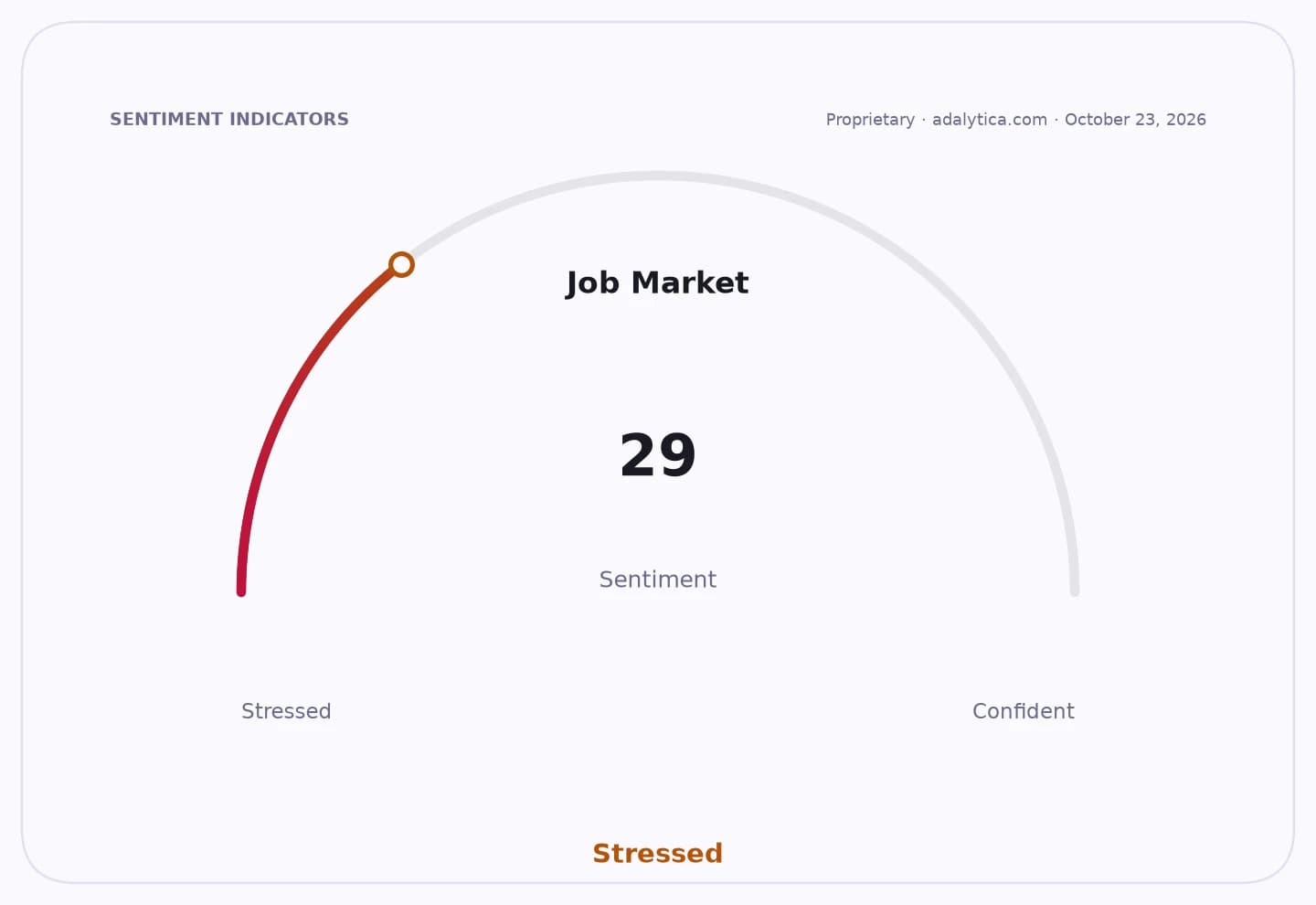
Employees in Russia are staying put more often as a cooling labour market weakens their leverage, with top managers now far less willing to even discuss new job offers and mid-level staff increasingly refusing unpaid overtime or additional tasks.
Russia Workers Stay Put as Labor Market Cools
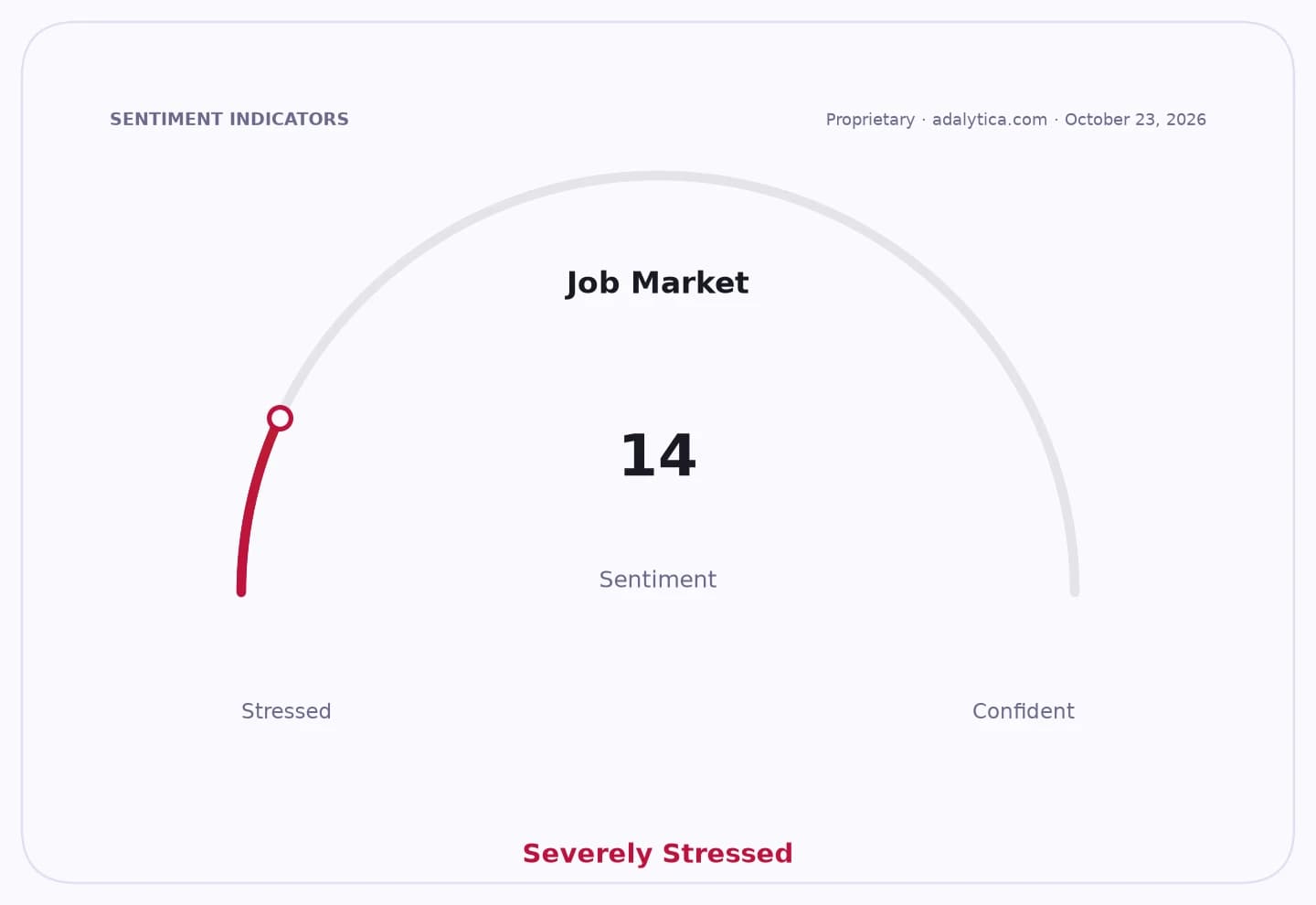
The shift matters because it marks a change from the wage-chasing labour market of 2022-2025 to one in which workers feel they have less room to negotiate pay, conditions or promotions. For employers, that can reduce turnover and recruitment pressure in the short term, but it also risks lower mobility, weaker wage growth and a workforce that is present but less engaged. For investors, the trend points to easing labour churn across consumer, services and industrial companies, while also signalling that earnings growth built on aggressive hiring and compensation inflation may be fading.
Sentiment IndicatorsⓘProprietary · adalytica.com · October 23, 2026
This is a snapshot — live sentiment, awareness and momentum for 130+ markets update continuously in the dashboard.Open AlphaPulse
Consulting firm The Edgers said only about half of executives were prepared to discuss a new offer this year, down from roughly eight in 10 in 2025, according to Russian daily Rossiyskaya Gazeta. That is a sharp retreat in willingness to move and fits a broader pattern the article describes as “job hugging” — employees holding on to existing roles because a switch looks riskier than staying.
The behaviour is partly rational. After a period of rapid wage increases, companies are no longer offering comparable uplifts to lure senior staff away, making a move less attractive on a risk-reward basis. In that environment, workers are also trying to hedge their income in other ways: some are taking freelance work, consulting or small business projects on the side, a pattern the piece calls “quiet monetisation.”
That matters economically because a labour market in which people cling to jobs rather than switch them tends to cool wage competition. For Russia, where companies have already spent years coping with labour shortages and rising pay bills, less mobility could help ease inflationary pressure at the margin. But it may also slow the reallocation of talent, leaving firms with employees who are less likely to leave but not necessarily more productive.
The same caution is showing up lower down the pay scale. Fix Price said 8% of employees made horizontal moves within the company in 2026 as workers showed greater interest in internal advancement rather than jumping to another employer. Separately, the share of middle managers in one communications group who stop replying after 7 p.m. rose to 45% from 20% over two years, underscoring how workers are drawing firmer boundaries around unpaid labour.
That makes the trend relevant for investors in staffing, payroll and human-resources services as well as for employers exposed to turnover costs. Firms such as ADP, Paychex and Korn Ferry are tied to workforce planning, compensation, retention and hiring cycles, and a less fluid labour market can change demand for those services. It may also pressure companies to invest more in internal development and succession planning rather than relying on external recruitment.
The longer-term risk for employers is that “forced loyalty” can conceal dissatisfaction rather than solve it. Workers may stay because the market looks uncertain, not because they are committed. If growth improves or compensation starts widening again, pent-up movement could return quickly. For now, though, the immediate story is one of labour-market caution: fewer quits, more side income and a workforce that is increasingly choosing security over mobility.
| Entity | Gains | Losses |
|---|---|---|
| Employers in Russia | ▲Lower turnover | ▼Less flexible workforce |
| Workers/staff | ▲Job security | ▼Bargaining power |
| HR and staffing firms | ▲Steadier retention services | ▼Fewer external moves |
| Companies with weak pay offers | ▲Lower immediate wage pressure | ▼Harder to attract talent |