Sabra Health Care REIT’s 10% surge on Tuesday reflected a market that is rewarding operational clarity and balance-sheet execution in a sector still searching for durable growth and lower financing risk.
Sabra Surge Signals Improved REIT Outlook
The shares closed at $22.04, up from $20.00 a day earlier, after the company issued a fresh operational and financial update via a Regulation FD filing. Trading volume jumped to 6.69 million shares, more than double the recent average in the stock’s own tape, suggesting the move was driven by new fundamental information rather than passive sector flow.
Sentiment IndicatorsⓘProprietary · adalytica.com · July 21, 2026
This is a snapshot — live sentiment, awareness and momentum for 130+ markets update continuously in the dashboard.Open AlphaPulse
For investors, the significance goes beyond a one-day pop. Healthcare REITs live and die by the spread between rental income growth and the cost of capital, and by how quickly operators can translate occupancy, reimbursements and debt management into reliable funds from operations. When a name like Sabra re-prices this sharply on an update, it usually means the market believes the company has narrowed one or more of those uncertainties.
The stock’s technical backdrop also underscores the shift in sentiment. Sabra is trading well above its 50-day and 200-day moving averages, now at $19.65 and $19.02, respectively, after spending much of late spring and early summer repairing a sharp selloff. The relative strength index at 75.0 points to strong momentum, while the MACD remains positive, indicating the rally has not yet fully exhausted itself. That said, the stock’s move has been fast enough to leave it vulnerable to a pullback if the update fails to support a durable earnings or guidance improvement.
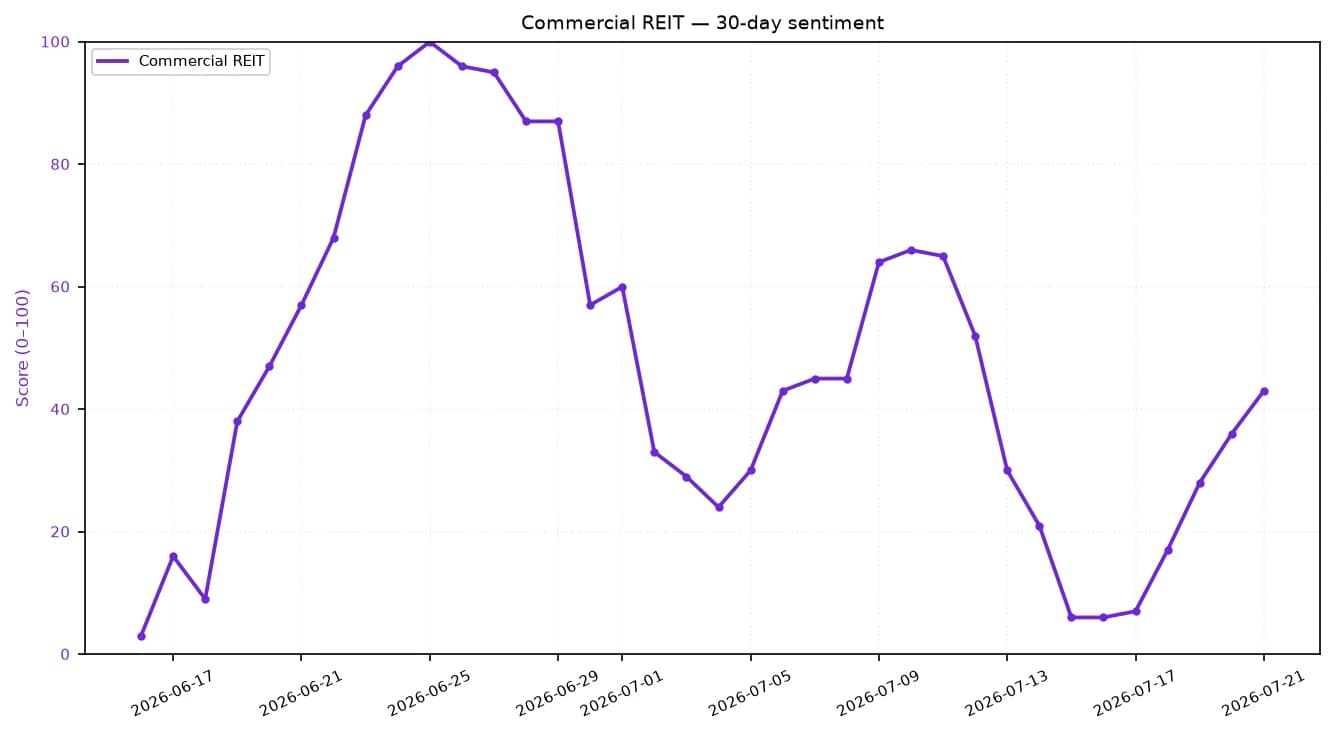
The broader REIT backdrop has turned more constructive but remains uneven. Adalytica’s Commercial REIT Sentiment gauge on VNQ improved to neutral at 43, with awareness at a greedy 85, suggesting attention is rising even as conviction is still guarded. By contrast, the S&P 500 signal showed fear, while Treasury bonds flashed extreme fear, a combination that can help income-producing real estate if it points to lower long-end yields and a more forgiving funding environment. But it can also reflect an unsettled macro backdrop in which investors demand clearer evidence of cash flow resilience before paying up for leverage-heavy balance sheets.
That is why Sabra’s update matters economically. Healthcare REITs depend on stable tenant health, disciplined acquisitions and manageable refinancing needs. Any operational improvement that bolsters same-property cash flow, occupancy or leverage metrics can quickly feed into valuation because the sector is often priced on the sustainability of dividends and the credibility of FFO growth. The market’s reaction suggests investors think Tuesday’s disclosure improved that picture.
The move also stands out against peers. American Healthcare REIT, which has been similarly strong on the tape, finished at $57.60, but Sabra’s percentage gain was the more dramatic signal because its valuation base is smaller and its investor base more sensitive to changes in operating momentum. Brookfield’s recently announced venture with Healthpeak Properties has also reinforced the idea that healthcare real estate remains a strategic battleground for capital, with larger players looking to extract value from specialized property portfolios. That backdrop tends to lift the entire sub-sector when it improves confidence in asset quality and capital allocation.
The bull case is straightforward: if Sabra’s update points to firmer operating trends and better financing visibility, the shares may deserve a higher multiple than the one investors assigned after the spring drawdown. The bear case is that the move already prices in a favorable read-through, leaving the stock exposed if the update proves incremental rather than transformative.
For now, Tuesday’s surge says the market is willing to pay for evidence that Sabra’s turnaround is real. The next catalyst will be whether the company can turn this burst of enthusiasm into sustained FFO support and a dividend narrative that holds up under higher-for-longer rate pressure.
| Entity | Gains | Losses |
|---|---|---|
| Sabra Health Care REIT | ▲Higher valuation | ▼Short sellers |
| Existing shareholders | ▲Mark-to-market gains | ▼Late buyers if momentum fades |
| Healthcare REIT peers | ▲Sector re-rating | ▼Relative underperformers |
| Bondholders / yield buyers | ▲Lower perceived credit risk | ▼If cap rates stay compressed |