Food prices in São Paulo are falling for a third straight four-week period, a sign that Brazil’s cost-of-living squeeze is easing in the country’s biggest consumer market even as the broader spending backdrop remains fragile.
São Paulo Food Deflation Signals Uneven Brazil Recovery
That matters because food is the most visible line item in household budgets, and when it deflates, it can quickly change how much room consumers have for non-essentials, how retailers manage promotions and margins, and how quickly inflation pressure fades into the rest of the economy. For investors, the message is more nuanced: softer food prices can support discretionary spending over time, but in the near term they also reinforce the idea that Brazil’s consumer recovery is still uneven and highly sensitive to income and credit conditions.
The market is already telling two different stories. Brazil’s ETF EWZ has held near the top of its recent range, with the fund closing at 35.87 on July 27 versus 35.73 the prior session, while Petrobras preferred shares, PBR, ended at $18.00 after a volatile run that has left the stock well above its 200-day moving average at 15.96. PBR’s latest close sits just under its 50-day average of 17.94, and the stock’s recent climb shows how quickly investors are still willing to bid for Brazilian assets when macro conditions look less threatening.
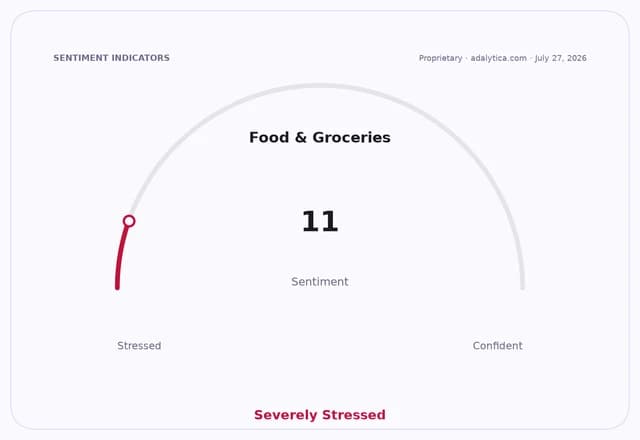
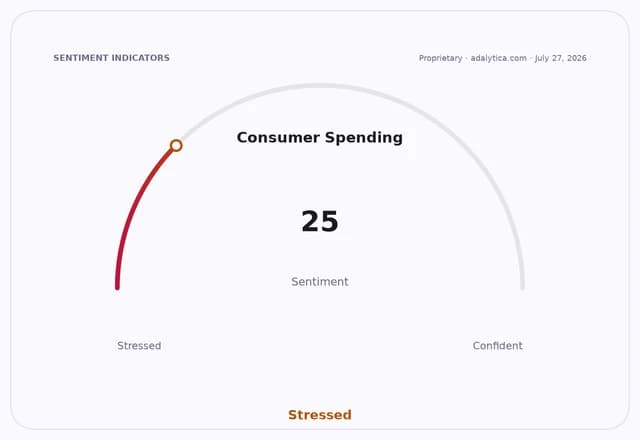
The trouble is that the consumer side is not flashing the same confidence. Adalytica’s Consumer Spending Sentiment gauge sits at 25, in fear territory, while its Food and Grocery Spending Sentiment has collapsed to 11, labeled extreme fear. That is a sharp warning that even as food inflation cools, households are not yet behaving like a market ready to reaccelerate. In other words, lower prices may be relieving pressure more than they are unleashing demand.
For food retailers, packaged-goods makers and grocers, that is the next critical trade-off. Deflation may help households, but it can also compress pricing power and force companies to lean harder on volume, mix and efficiency. For commodity-linked names, the same trend can work in the opposite direction, easing input costs and improving margins if demand holds up. Investors should expect a second-order effect: the winners will be the operators that can absorb price pressure without sacrificing traffic, while the laggards will be those still dependent on nominal price increases to protect earnings.
The bigger narrative is that Brazil’s inflation story is moving from outright pressure to selective relief, and that tends to reshuffle capital flows before it changes headlines. When food prices cool in São Paulo, the knock-on effect is not just happier shoppers; it is a potential change in how investors price Brazilian consumption, central-bank patience and the durability of defensive positioning in stocks tied to staples, energy and the broader domestic economy.
For now, this is a market that still underestimates how important food deflation can be as an early signal. If the decline persists, it could open the door to better real incomes, stronger retail volumes and more room for Brazilian risk assets. But until spending sentiment turns with it, the cleaner thesis is not a broad consumer recovery — it is selective positioning in businesses that benefit from lower inflation without needing a boom to deliver returns.
| Entity | Gains | Losses |
|---|---|---|
| Brazilian households | ▲Lower grocery bills | ▼None immediate |
| Grocers and packaged-food makers | ▲Potential volume support | ▼Pricing power |
| Petrobras / commodity exporters | ▲Softer domestic inflation backdrop | ▼Less direct benefit from consumer relief |
| EWZ / Brazil equities | ▲Easier macro narrative | ▼Demand remains fragile |