Saudi Arabia’s stock market ended lower on Tuesday as geopolitical nerves kept traders defensive, a reminder that in this region, politics can still overpower fundamentals in the short run.
Saudi Stocks Slip on Geopolitical Risk

For long-term investors, the move matters because Saudi shares sit at the center of the Gulf’s risk appetite. When tensions rise across the Middle East, money tends to rotate away from cyclical, domestic-growth names and toward cash, defensives and the biggest liquid names. That can create pain for day traders, but it can also open up opportunities for patient investors who are willing to look through the noise and focus on earnings power, dividends and balance-sheet strength.
Sentiment IndicatorsⓘProprietary · adalytica.com · July 15, 2026
This is a snapshot — live sentiment, awareness and momentum for 130+ markets update continuously in the dashboard.Open AlphaPulse

The market’s weakness came against a backdrop of mixed regional trading, with Kuwait and the United Arab Emirates also digesting the same uncertainty. That tells investors this was not a stock-specific story so much as a broad risk-off response to geopolitical headlines. The fact that some names still managed gains, including Red Sea and Intaj, shows that even in a weak tape, capital continues to hunt selectively for relative strength.
Volumes were heavy in Americana, Petro Rabigh and Export shares, a sign that investors were actively repositioning rather than simply standing aside. That kind of turnover often shows up when uncertainty is high: some investors trim exposure, others buy into weakness, and the market becomes more about liquidity than conviction. For anyone building wealth over years, that is exactly when discipline matters most.
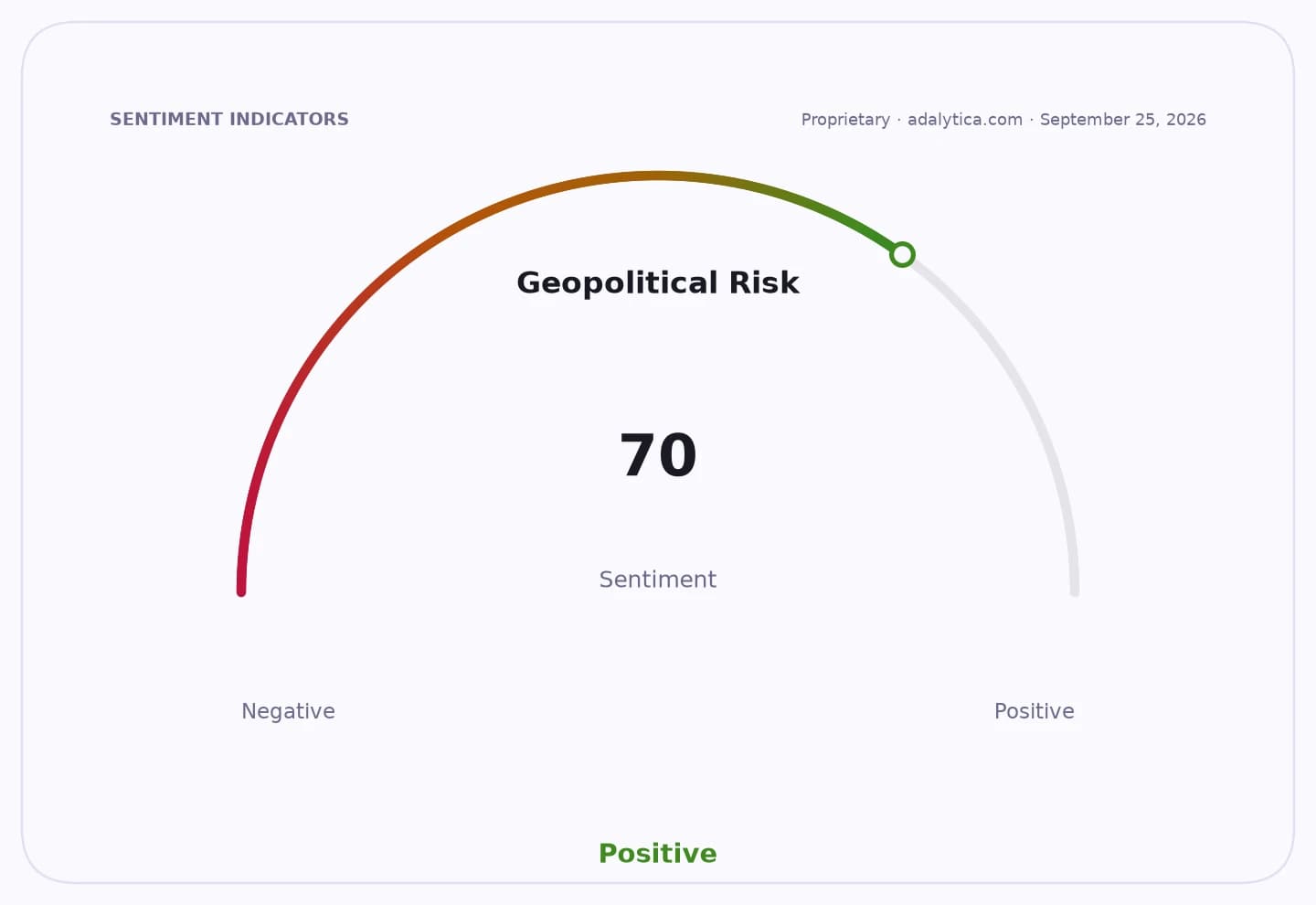
Geopolitical Risk — 30-day sentimentadalytica.com
Explore this data interactively — full history, time series and cross-market comparisons.Open AlphaPulse

The broader backdrop is important too. Adalytica’s Global Stability Sentiment gauge points to extreme fear even as awareness remains elevated, which is another way of saying investors are highly alert to risk but still hypersensitive to new developments. Oil also remains a key swing factor for Saudi assets. Brent’s U.S. benchmark proxy has recently hovered around the high-$60s to low-$70s a barrel, levels that are comfortable enough for consumers but not so low that they undermine the region’s fiscal and energy story. In other words, energy is not flashing crisis, but it is still a source of macro support for the kingdom.
That matters for investors because Saudi equities are tied to a handful of powerful long-term themes: oil revenue, domestic reform, infrastructure spending and growing private-sector depth. When geopolitics rattles the market, those themes do not disappear. They just get overshadowed by near-term fear. The strongest businesses — especially those with pricing power, recurring cash flow and room to grow beyond the local cycle — can use these dips to widen their long-term lead.
The risk, of course, is that tensions can deepen and keep valuations under pressure longer than bulls expect. But for diversified investors, volatility in Saudi stocks is not a reason to abandon the market. It is a reminder to own quality, stay diversified across sectors and think in multi-year horizons, not sessions.
For investors, the takeaway is simple: the Saudi market’s decline reflects geopolitical caution more than a structural break in the story. Worth watching for further weakness, but for long-term portfolios, this is the kind of market that rewards patience and selectivity.
| Entity | Gains | Losses |
|---|---|---|
| Defensive buyers | ▲Lower entry points | ▼Short-term momentum |
| Saudi exporters/energy-linked firms | ▲Oil-linked support | ▼Risk-off multiples |
| Traders reducing risk | ▲Capital preservation | ▼Upside if markets rebound |
| Geopolitical hawks | ▲Higher caution premium | ▼Risk assets and equities |