SK Hynix’s planned $45 billion buildout in the United States is running into the reality of Washington’s China restrictions, underscoring how the semiconductor boom is increasingly being shaped by geopolitics as much as demand.
SK Hynix $45 Billion U.S. Buildout Faces China Rules
CCP Policy Direction
The issue matters because the company’s US expansion is meant to anchor advanced memory production inside a more secure supply chain, yet the same export controls designed to limit China’s access to leading-edge chips can also complicate equipment choices, customer access and investment returns. For investors, that creates a familiar but expensive tension: capital spending tied to AI demand remains a long-term positive, but policy risk is now baked into the timing, profitability and flexibility of that spending.
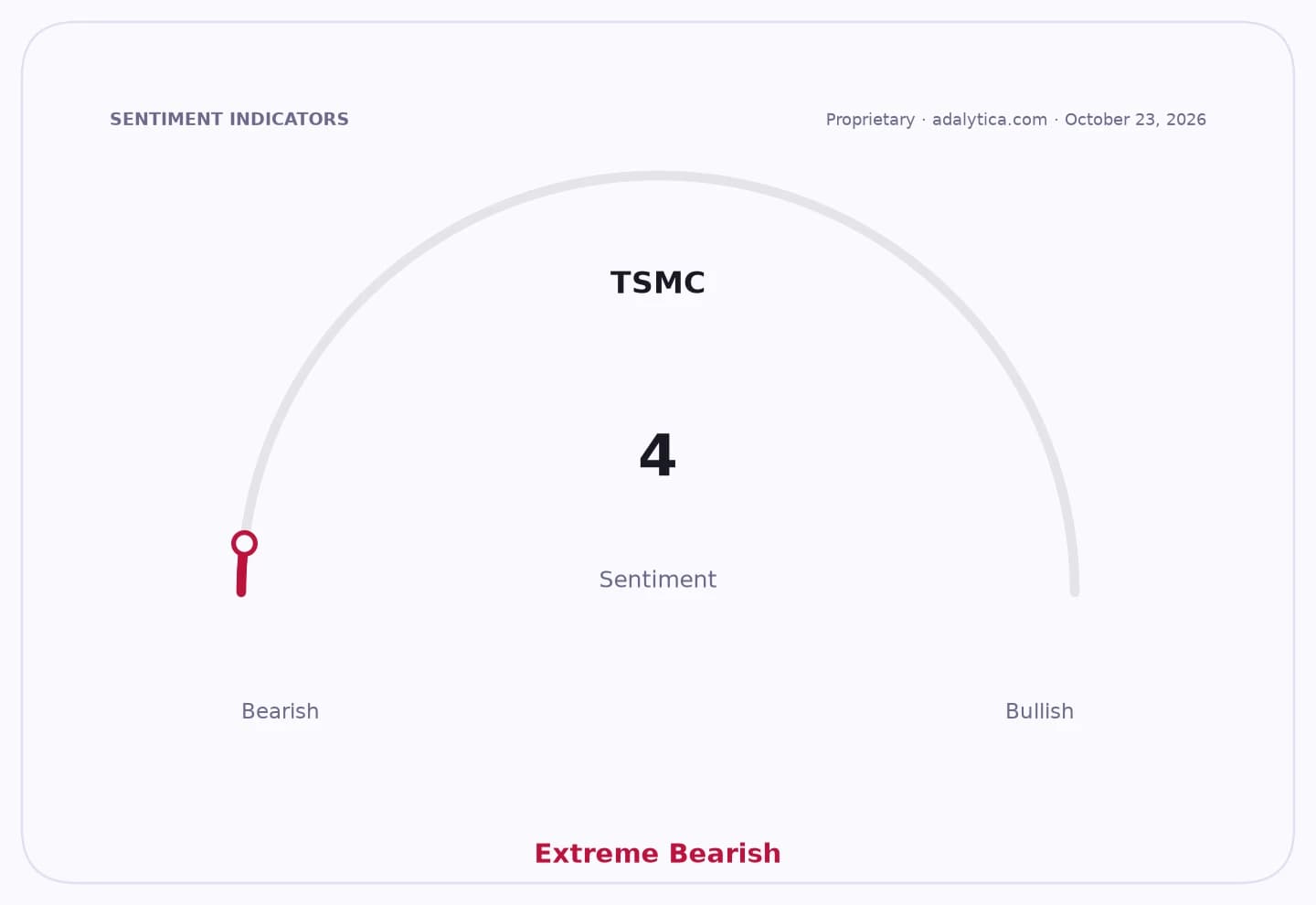
Sentiment Indicators
Semiconductor equities have already been whipsawed by that mix of enthusiasm and constraint. The SOXX ETF has swung from a March low of 102.91 to 465.00 on Nov. 3 before dropping to 131.90 a day later, while SMH fell from 518.52 on Nov. 3 to 447.73 on Nov. 5. Both moves left the funds with stretched technical readings earlier in the week, including elevated RSI levels and sharply positive MACD readings, before the pullback signaled how quickly sentiment can unwind when policy risk reasserts itself.
That backdrop is especially relevant for SK Hynix because memory makers sit at the center of the AI supply chain. Demand for high-bandwidth memory and advanced DRAM remains strong, and broader industry indicators still point to a structural upgrade cycle. But the next phase of that cycle is no longer just about building more capacity; it is about where that capacity is located, which tools can be used, and how much exposure suppliers retain to China, still one of the industry’s largest end markets.
CCP Policy Direction vs SOXXadalytica.com
Explore this data interactively — full history, time series and cross-market comparisons.
Adalytica’s China CCP Policy Direction Sentiment currently sits at 71, with awareness at 82, reflecting an elevated focus on policy direction even after a slight daily pullback. That matters for SK Hynix and its peers because it suggests the market is not treating export controls as a one-off headline risk but as a continuing feature of the operating environment. A similar pattern is visible in the broader global backdrop, where geopolitical stability sentiment remains positive but has eased from recent highs.
For SK Hynix, the upside case is straightforward: a US footprint can reduce supply-chain concentration risk, improve access to US customers and align the company with government-backed efforts to localize advanced chip production. The bearish case is just as clear: if restrictions on China narrow the addressable market or limit technology transfer, the economics of a $45 billion project could be less attractive than they appear on paper, especially if the company cannot fully monetize output across its global customer base.
Investors will be watching whether the company can preserve flexibility in sourcing, financing and customer mix while the US-China technology split deepens. The key question is not whether AI-driven chip demand remains strong; it is whether the industry can keep investing at scale without having policy constraints erode the returns on that investment.
| Entity | Gains | Losses |
|---|---|---|
| SK Hynix | ▲US supply-chain access | ▼China-linked flexibility |
| US chipmakers | ▲Local capacity buildout | ▼None immediate |
| Chinese buyers | ▲— | ▼Access to advanced supply |
| Semiconductor ETF investors | ▲AI growth exposure | ▼Policy-driven volatility |