Small business owners are increasingly using AI to do more with less, and that makes this trend far more than a feel-good tech story.
Small Businesses Adopt AI Across Routine Work
It is a broad economic shift with real stakes for productivity, hiring and margins. In the U.S., more than 33 million small businesses were operating as of 2025, accounting for about 99% of all businesses and nearly half of the workforce, according to the U.S. Chamber of Commerce. If even a fraction of those firms successfully automate routine work, the payoff could ripple through the economy in the form of faster scaling, leaner operations and better survival rates for companies that typically run with thin staffing and tight cash flow.
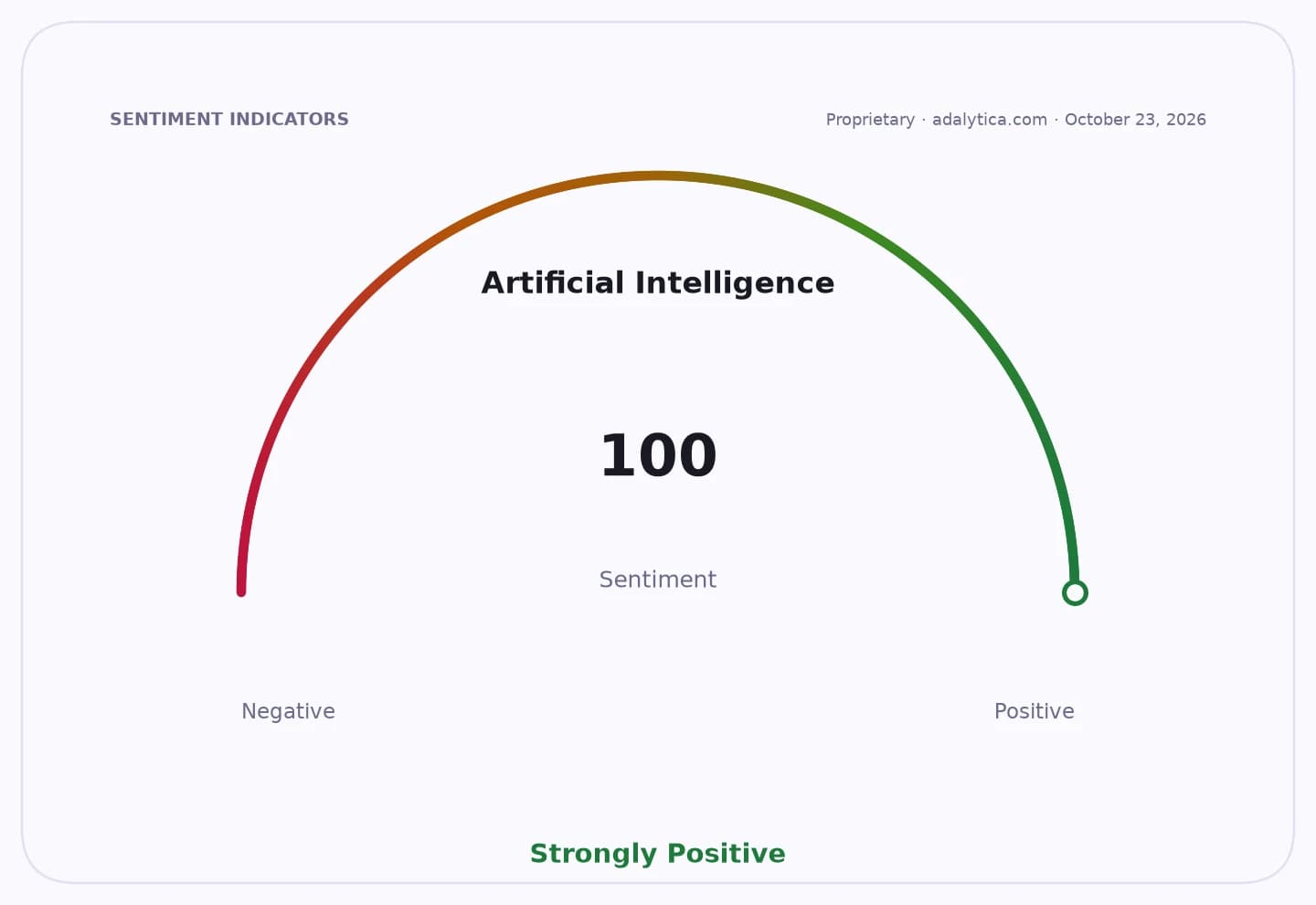
Sentiment IndicatorsⓘProprietary · adalytica.com · October 23, 2026
This is a snapshot — live sentiment, awareness and momentum for 130+ markets update continuously in the dashboard.Open AlphaPulse
That is why AI is becoming less of a novelty and more of a liferaft. For a small business, the biggest headaches are often the least glamorous ones: customer acquisition, hiring, advertising, bookkeeping and day-to-day administration. AI tools can help with all of that, from drafting marketing copy and answering customers to organizing schedules and simplifying back-office work. The payoff is not just convenience. It is time, and time is one of the scarcest assets for a small owner trying to compete with bigger rivals.
For investors, that matters because small businesses are a huge end market for the companies trying to sell the AI stack. Microsoft, Nvidia and Salesforce all stand to benefit if AI moves deeper into everyday business workflows. Microsoft has been leaning into enterprise AI across its cloud and productivity software, while Nvidia remains the picks-and-shovels leader powering the infrastructure underneath it. Salesforce, meanwhile, is positioning AI as part of the customer relationship management and sales process. If small companies adopt these tools at scale, the addressable market for subscription software, cloud computing and AI hardware gets larger and more durable.
The market is already telling part of that story. Microsoft shares have climbed above their 50-day and 200-day moving averages in recent months, a sign of strong longer-term momentum, even if the stock has pulled back from its highs. Nvidia has also remained a central beneficiary of AI spending, though its shares have been volatile as investors weigh huge demand against lofty expectations. Salesforce, after a rougher stretch earlier this year, has rebounded sharply and is now trading above its long-term moving average again, reflecting renewed confidence in software companies that can turn AI features into revenue growth.
There is still a practical catch: adoption does not automatically equal value. AI can create mistakes, security headaches and governance problems if businesses move too fast or use the tools without clear rules. That is why the smartest small-business users are not treating AI as a magic wand. They are using it to support human judgment, not replace it. IBM has also warned that companies need discipline and guardrails as they scale AI, and that caution applies even more to small firms with limited resources.
But the long-term investment case is hard to ignore. If AI helps small businesses become more productive, then the benefits should flow to the vendors selling software, cloud services, chips and business applications. For investors, the key question is not whether AI will be used — it already is — but which companies can turn that adoption into durable cash flow. That is the story worth watching over the next several years, and it is one reason AI winners remain worth holding on dips.
| Entity | Gains | Losses |
|---|---|---|
| Small businesses | ▲Higher productivity | ▼Manual busywork |
| Microsoft | ▲More cloud/software demand | ▼Slower AI monetization if adoption stalls |
| Nvidia | ▲More AI infrastructure demand | ▼Hardware demand if spending cools |
| Salesforce | ▲Deeper CRM automation usage | ▼Share of workflows if rivals win mindshare |