South Africa’s inflation rate edged up to 4.5% in September, lifted by a sharp jump in transport costs, but the latest reading still came in below economists’ expectations and leaves the Reserve Bank with room to stay cautious rather than hawkish.
South Africa inflation rises to 4.5% in September

The annual consumer price index rose from 4.4% in August, according to Statistics South Africa, with transport adding 1.5 percentage points to the monthly inflation reading. Transport prices climbed 10.8% from a year earlier as fuel costs surged, after petrol prices rose by R6.13 a litre between January and September and 500ppm diesel jumped by R10.66 following the Middle East conflict’s impact on oil markets.
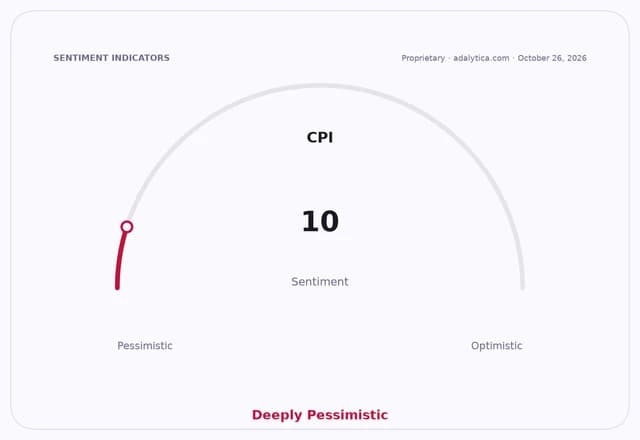
Sentiment IndicatorsⓘProprietary · adalytica.com · October 26, 2026
This is a snapshot — live sentiment, awareness and momentum for 130+ markets update continuously in the dashboard.Open AlphaPulse
That matters for the economy because transport costs feed directly into household budgets, business logistics and broader price formation. The increase in inflation is being driven by a narrow set of administered and energy-linked costs rather than a broad-based acceleration, which helps explain why economists see little sign yet of second-round inflation pressure.
The softer-than-expected print is the key market takeaway. Many analysts had looked for inflation closer to 4.6% to 4.7%, and the lower outcome supports the view that the South African Reserve Bank can keep policy steady for now instead of leaning harder against price growth. Johann Els, senior economist at PSG, said there was “very little evidence of second-round inflationary pressure” and that the reading would be welcomed by the central bank.
There was also some relief in the consumer basket. Food and non-alcoholic beverages rose just 1.2% from a year earlier and slipped 0.1% on the month, while rental inflation slowed to 3.9% from 4.1%. Health costs increased 3.2%, insurance and financial services 5.4%, and housing and utilities 5.2%, but those moves did not offset the limited breadth of the inflation pick-up.
For investors, the mix is constructive for South African rate-sensitive assets because it reduces the risk of a near-term policy surprise, even as the transport shock keeps pressure on consumers and corporates exposed to fuel and distribution costs. The read-across is more negative for retailers, transport users and logistics-heavy businesses, while lenders and domestic-rate plays benefit from the prospect of a steadier policy path.
Els expects inflation to move slightly above 5% in October and November before base effects pull it down again from around April next year. The next test for markets will be whether oil prices retreat enough to ease fuel inflation and whether the Reserve Bank sees the current spike as temporary rather than the start of a broader price cycle.
| Entity | Gains | Losses |
|---|---|---|
| South African Reserve Bank | ▲More room to hold rates steady | ▼Less urgency to tighten |
| Consumers | ▲Softer food inflation | ▼Higher transport and fuel bills |
| Rate-sensitive assets | ▲Lower policy-shock risk | ▼Limited upside if inflation rises again |
| Logistics and retailers | ▲None | ▼Higher operating and distribution costs |