Father’s Day spending in South Carolina is expected to rise this year, reflecting a consumer still willing to spend on gifts even as broader confidence remains shaky and retailers keep chasing traffic with promotions and merchandise tied to the holiday.
South Carolina Father’s Day spending rises in 2026

That matters because seasonal events like Father’s Day are a useful read on discretionary demand, especially in an environment where households are more selective and retailers are leaning harder on short bursts of spending to protect sales. A stronger holiday outing would help confirm that consumers are still allocating money to nonessential purchases, even if they are increasingly price sensitive.
Sentiment IndicatorsⓘProprietary · adalytica.com · August 5, 2026
This is a snapshot — live sentiment, awareness and momentum for 130+ markets update continuously in the dashboard.Open AlphaPulse
Statewide retail sales data also points to an industry that has been steadily recovering from earlier volatility. The RSXFS retail-sales series for South Carolina stands at 666,056 in June 2026, up 0.24% from the prior month and near a forecast 674,837.9 in July. That follows a 5.56% increase in December and a 6.7% gain in April, suggesting underlying demand has been resilient enough to support incremental spending into the summer shopping season.
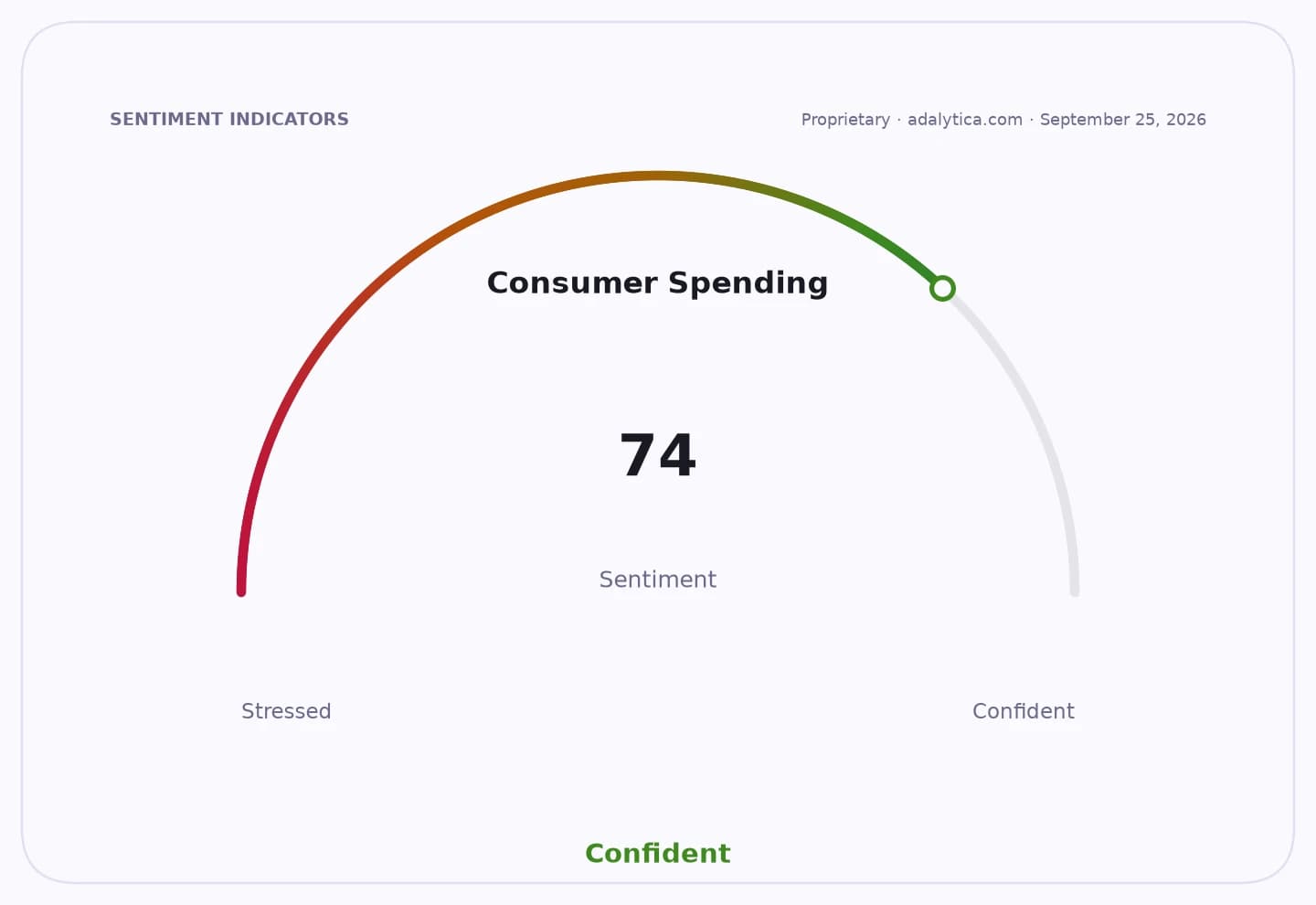
Still, the consumer backdrop is not uniformly supportive. The University of Michigan sentiment index was 49.5 in June and is forecast to slip to 43.99 in July, underscoring that households remain cautious even as they continue to buy. Adalytica’s Consumer Spending Sentiment gauge, by contrast, is flashing “Extreme Greed” at 96, while its Retail Sales Sentiment sits at 92, also in “Extreme Greed,” indicating that spending intent is holding up even as confidence-based measures weaken. That split is important for investors: consumers may not feel especially good about the economy, but they are still willing to spend for events that feel personally relevant.
The market is already pricing in a healthier retail backdrop. The XRT retail ETF has climbed to $92.35, above both its 50-day and 200-day moving averages, with its relative strength index at 60.5, a sign momentum has improved after a sharp selloff earlier in the year. Macy’s shares have also rebounded to $26.21, well above their 50-day and 200-day averages, while Costco has held near $947.85, reflecting investor preference for retailers with stronger traffic, pricing power and membership-driven repeat demand. That suggests the market is rewarding merchants best positioned to capture holiday spending without relying entirely on deep discounting.
For retailers, the key question is not whether Father’s Day lifts sales, but whether the lift comes with healthy margins. Chains that can move gifts, apparel and accessories at full price — or at least without heavy markdowns — stand to benefit most. Off-price players and mass merchants can also win if value remains the dominant shopping lens, but that usually comes at the cost of margin expansion. On the downside, softer confidence and weather disruptions could trim store traffic and push shoppers online or toward lower-ticket items.
The broader narrative is that discretionary spending is still alive, but it is increasingly event-driven and selective. If Father’s Day sales in South Carolina outperform, it would reinforce the view that consumers remain engaged enough to support retailers into the second half of the year. If they disappoint, the message would be less about one holiday and more about a household sector that is becoming more cautious just as retailers need incremental demand to defend results.
| Entity | Gains | Losses |
|---|---|---|
| Retailers | ▲Holiday sales lift | ▼Weak traffic, markdown pressure |
| Consumers buying gifts | ▲More promotions, more choice | ▼Higher prices, limited budgets |
| XRT and retail bulls | ▲Stronger spending narrative | ▼Slower discretionary demand |
| Value/off-price chains | ▲Traffic from bargain hunters | ▼Full-price specialty retailers |