ASEAN’s renewed push to finish a South China Sea code of conduct this year comes as a fresh maritime confrontation between China and the Philippines underscores the economic cost of leaving the dispute unmanaged.
South China Sea tensions raise Asia risk premium

That matters because the contested waterway is not just a sovereignty fight. It is a critical route for trade, energy shipments and regional supply chains, and every flare-up raises the odds of disruption, higher insurance costs and more volatility across Asian markets.
Sentiment IndicatorsⓘProprietary · adalytica.com · July 24, 2026
This is a snapshot — live sentiment, awareness and momentum for 130+ markets update continuously in the dashboard.Open AlphaPulse

The latest clash, in which China expelled Philippine vessels and a Filipino sailor was injured, has sharpened pressure on regional diplomats to turn years of talks into a binding framework. The U.S. called Beijing’s actions disturbing, while China argued that outside powers have no role in the dispute, a stance that leaves ASEAN members exposed to escalating tensions between the region’s biggest trading partner and the U.S.
For investors, the risk is less about a sudden full-scale blockade than about incremental friction: more patrol confrontations, more diplomatic retaliation and a higher geopolitical premium on shipping, energy and industrial supply routes. That dynamic can ripple through freight rates, commodity prices and sentiment toward Asia-focused assets, especially when markets are already sensitive to trade and tariff headlines.
Geopolitical Risk vs SEadalytica.com
Explore this data interactively — full history, time series and cross-market comparisons.Open AlphaPulse
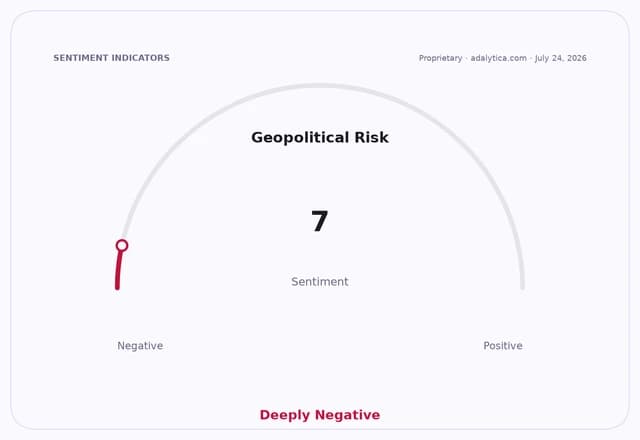
The backdrop is increasingly tense. Adalytica’s Global Stability Sentiment gauge shows “Extreme Fear” at 7, while its U.S.–China Relations Sentiment reads 4, also “Extreme Fear,” suggesting markets are pricing in a sharper geopolitical risk backdrop even as awareness remains elevated.
In equity markets, the strains come as regional and China-linked benchmarks stay fragile. Shares of Sea Ltd. have fallen to $99.50 from $106.26 on July 21, with the stock still well below its 200-day moving average, while the FXI China ETF is hovering around $34.46, near its 50-day average after a long slide from spring levels. The broader EEM emerging-markets ETF has also softened to $64.60 from a recent high above $69, reinforcing the market’s caution toward Asia risk.
The immediate catalyst is whether ASEAN can narrow differences quickly enough to produce a code that actually constrains incidents at sea. If talks slip again, investors will likely keep assigning a larger geopolitical discount to regional trade, energy logistics and China-exposed assets.
| Entity | Gains | Losses |
|---|---|---|
| ASEAN diplomats | ▲leverage for de-escalation | ▼credibility if talks slip |
| Shipping and insurers | ▲clearer rules, lower risk | ▼higher premiums from clashes |
| China and the Philippines | ▲diplomatic cover from a code | ▼domestic pressure from flare-ups |
| Investors in Asia assets | ▲reduced tail risk | ▼wider geopolitical discount |