Australia’s warning over the South China Sea is adding another layer of geopolitical risk to an already fragile Asia-Pacific trade outlook, even as Beijing insists “outsiders” should not be involved.
South China Sea Tensions Lift Asia Trade Risk
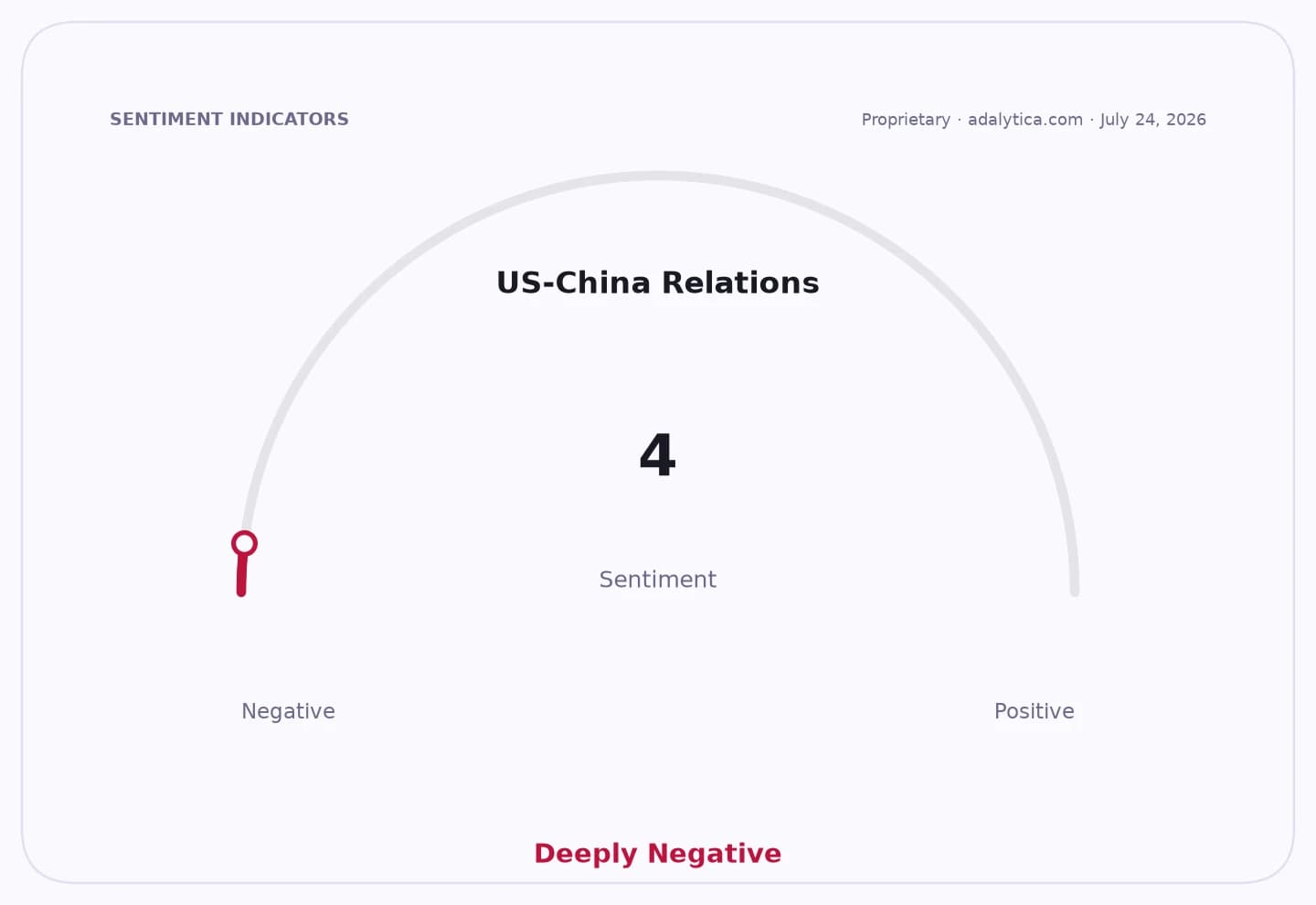
The significance is not the diplomatic rhetoric itself, but the economic exposure underneath it. The South China Sea is a critical shipping lane linking China, Southeast Asia, Japan and Australia to the rest of the world, and any escalation there can quickly spill into freight routes, insurance costs, supply-chain planning and investor sentiment across the region. For markets, the question is whether the dispute stays a contained sovereignty fight or starts to bleed into broader China-ASEAN and China-West relations.
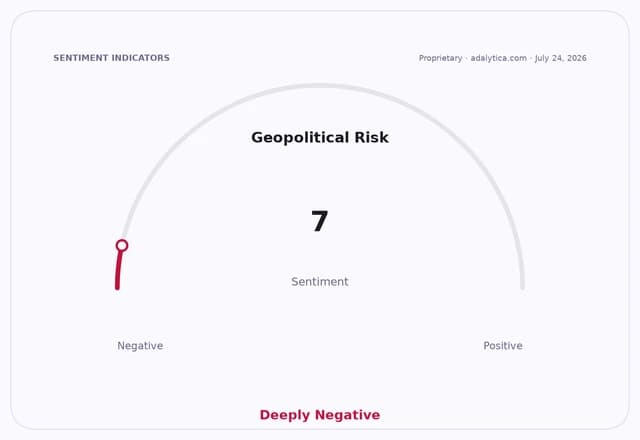
China’s pushback against Australia reflects a familiar strategy: keep the dispute framed as a regional matter and resist any wider international coalition around it. That matters because Beijing wants to preserve commercial ties with ASEAN while limiting the scope for outside pressure. Wang Yi’s call for the issue not to disrupt China-ASEAN relations underscores that priority. But the more China stresses sovereignty, the more it risks aggravating perceptions of instability among trade partners that depend on open sea lanes and predictable rules.
The latest flashpoint comes against a backdrop of repeated confrontations, including Chinese Coast Guard pressure on Philippine vessels and renewed concern over the Scarborough Shoal. ASEAN foreign ministers are still hoping for a code of conduct, but the fact that negotiations remain unresolved shows how little buffer exists against another maritime incident. That leaves the region reliant on diplomacy that has repeatedly lagged behind events on the water.
Geopolitical Risk — 30-day sentimentadalytica.com
Explore this data interactively — full history, time series and cross-market comparisons.Open AlphaPulse
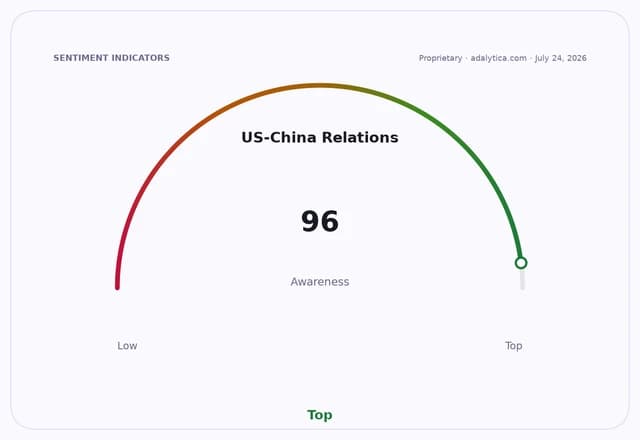
For investors, the immediate read-through is to geopolitical risk rather than direct market impact. Australia’s concern and China’s insistence that outsiders stay away can keep risk premia elevated for companies exposed to Asia-Pacific trade, logistics, shipping and defense. It also reinforces the case that regional tensions remain a background constraint on Chinese assets, even when the broader market is focused on growth, policy support or U.S.-China dialogue.
That tension is visible in China-focused equity proxies. The FXI ETF has slipped from recent highs and is trading below both its 50-day and 200-day moving averages, while its recent price action has been choppy rather than decisively bullish. EWM, a proxy for Malaysia, has been steadier and remains above its long-term average, reflecting how some Southeast Asian markets can benefit from trade diversification even as the region absorbs maritime uncertainty. BOAT, which tracks global ship operators, has outperformed and sits well above its moving averages, suggesting investors are still willing to pay for maritime exposure when freight and routing risks rise.
The broader market message is that the South China Sea is no longer a distant strategic backdrop. It is a live variable in Asia’s trade architecture, with the potential to hit China sentiment, complicate ASEAN diplomacy and force investors to price a higher probability of disruption. The key catalyst now is whether diplomacy over a code of conduct can reduce the frequency of incidents — or whether the next confrontation makes the economic costs impossible to ignore.
| Entity | Gains | Losses |
|---|---|---|
| China | ▲sovereignty leverage | ▼regional trust |
| Australia/ASEAN | ▲diplomatic backing | ▼trade certainty |
| Shipping and logistics firms | ▲risk premiums | ▼route stability |
| China-linked equities | ▲none | ▼higher geopolitical discount |




