South Korea’s main stock gauges fell at the open even after Wall Street rose overnight, underscoring how local markets remain hostage to domestic positioning and sector-specific selling rather than the global risk-on tone.
South Korea stocks fall despite Wall Street gains
S&P 500
By 9:27 a.m. in Seoul, the KOSPI was down 0.88% at 5,685.28, after opening weaker and extending losses, while the KOSDAQ slipped 1.68% to 779.46. The gap with New York was striking: the Dow, S&P 500 and Nasdaq all finished higher on Tuesday in the U.S., helped by improving AI-related sentiment and easing geopolitical tension.
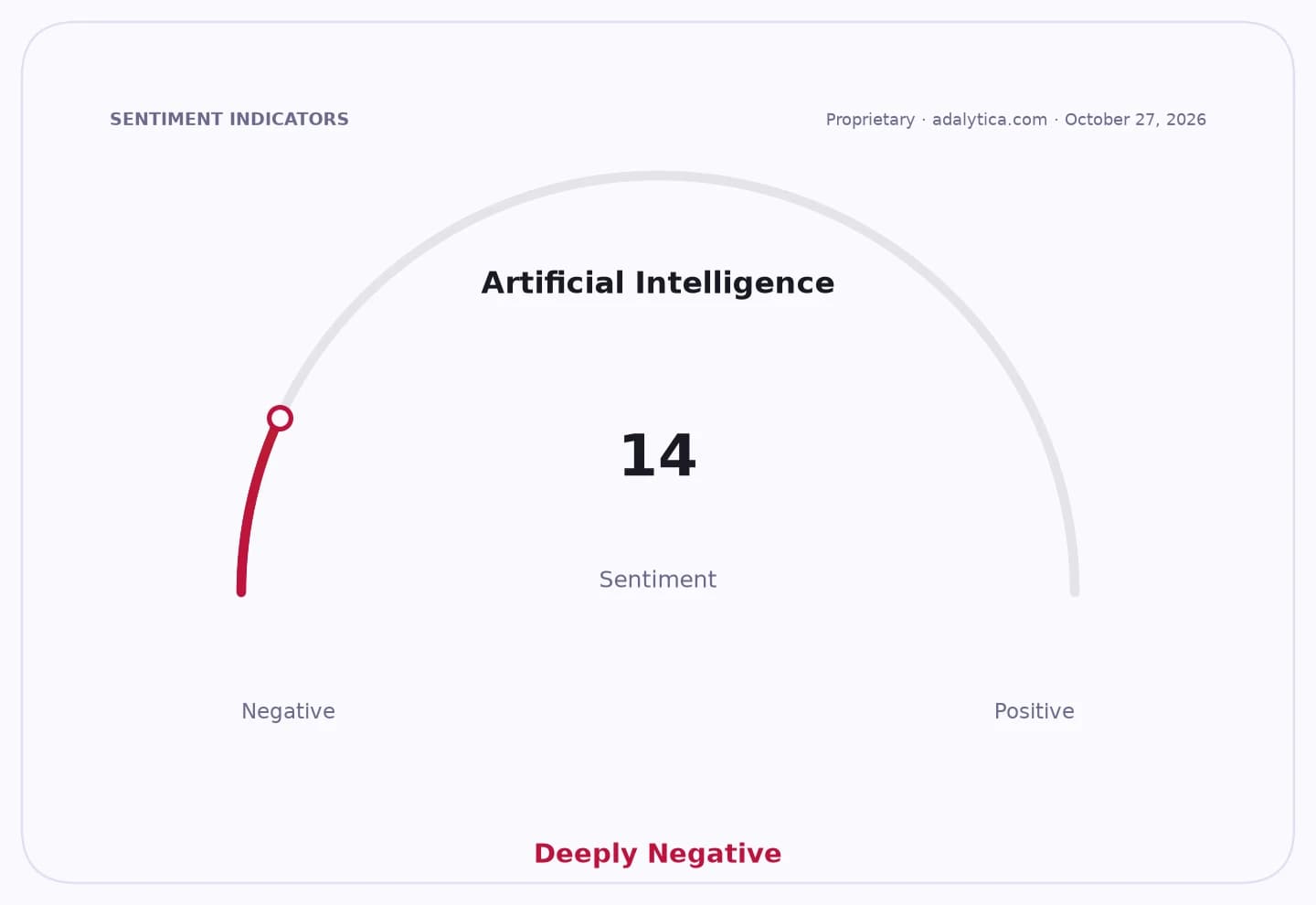
Sentiment Indicators
The weakness matters because Korea is still one of Asia’s most semiconductors-heavy and export-sensitive markets, and its index direction often turns on whether foreign buyers are willing to keep adding exposure after recent gains. Foreign investors were net buyers of 159.7 billion won in the KOSPI, but that was not enough to offset selling by retail and institutions, which suggests the market is struggling to find broad-based support even when global peers are firmer.
The selling was concentrated in the names that have driven much of the market’s recent momentum. Samsung Electronics was up 0.67% at 222,000 won after recent volatility, but SK Hynix still fell 0.77% to 1,284,000 won. LG Energy Solution dropped 3.16%, Samsung Biologics lost 1.83% and Hyundai Motor declined 1.62%. In the KOSDAQ, battery and biotech bellwethers were under heavier pressure, with Ecopro down 3.83%, Ecopro BM off 6.44%, Alteogen 2.71% lower and HLB down 2.01%.
S&P 500 vs ^KS11adalytica.com
Explore this data interactively — full history, time series and cross-market comparisons.
That pattern points to a market correcting from crowded leadership rather than a wholesale macro shock. Samsung’s shares have rebounded from their late-October lows, but the broader KOSPI remains fragile on a technical basis: the index is still below its 50-day average and the relative strength index sits in deeply oversold territory, suggesting trading conditions remain stretched even after the recent pullback. The KOSDAQ looks weaker still, with its level well below the 200-day moving average, highlighting persistent risk aversion toward growth and small-cap names.
The overnight U.S. rally offered only limited help because it was driven by themes that do not fully translate into Seoul’s open. New York’s gains came after stronger AI-linked earnings and hopes for easier geopolitical conditions, while a late-session rebound in oil trimmed some of the advance. That mix may be constructive for global sentiment, but it does little to remove the immediate concerns that weigh on Korean equities: valuation fatigue in large-cap tech, volatile flows into battery shares and a market that has already priced in a lot of the AI boom.
For investors, the message is that Korea is no longer moving in lockstep with Wall Street. Foreign inflows into semiconductors could still support the KOSPI if U.S. AI spending remains strong, but the day’s session shows that local sellers are still willing to lean against rebounds. Until breadth improves beyond a handful of large-cap names, the market looks set to remain choppy, with exporters and chipmakers more resilient than battery, biotech and smaller speculative growth stocks.
| Entity | Gains | Losses |
|---|---|---|
| Foreign KOSPI buyers | ▲Cheaper entry on pullback | ▼Wider market weakness |
| Samsung Electronics | ▲Stabilization after recent slide | ▼Broader sector caution |
| SK Hynix, battery and biotech shares | ▲— | ▼Profit-taking and risk-off flow |
| KOSDAQ small caps | ▲— | ▼Heavier pressure from domestic selling |