Minimum wage negotiations in South Korea are no longer just a labor issue — they are a direct test of who can absorb rising payroll costs and who cannot, with the gap between labor’s 11,150 won demand and management’s 10,550 won offer still unresolved as the committee edges toward a final vote.
South Korea Wage Talks Pressure Labor-Heavy Businesses

That 600-won divide matters because wages are not landing in a vacuum. Consumer prices remain elevated after a long inflationary cycle, with South Korea’s CPI still running far above pre-pandemic norms in the data context, while unemployment is low enough at 4.2% to keep workers pressing for a bigger share of economic gains. The result is a policy fight that could ripple through retail, restaurants, logistics and service businesses already operating on thin margins.
Sentiment IndicatorsⓘProprietary · adalytica.com · July 15, 2026
This is a snapshot — live sentiment, awareness and momentum for 130+ markets update continuously in the dashboard.Open AlphaPulse
Investors should see the minimum wage talks as a classic cost-pressure catalyst. The market often underestimates how quickly a few hundred won in labor costs can flow through to same-store margins, especially in labor-intensive businesses that cannot fully reprice without hurting traffic. That is why wage debates tend to hit consumer names first: the pain shows up in payroll expense before it shows up in the headline numbers.
The pressure is already visible in the wider consumer complex. McDonald’s, Walmart and Target all face the same broad reality in their own markets: labor inflation can overpower revenue growth when margins are already tight. In the latest price action, McDonald’s has fallen sharply from earlier highs, while Walmart has also retraced after a strong run, underscoring how quickly investors punish companies when operating costs become the main story. Target remains more exposed than Walmart because it has less pricing power and a more cyclical customer base.
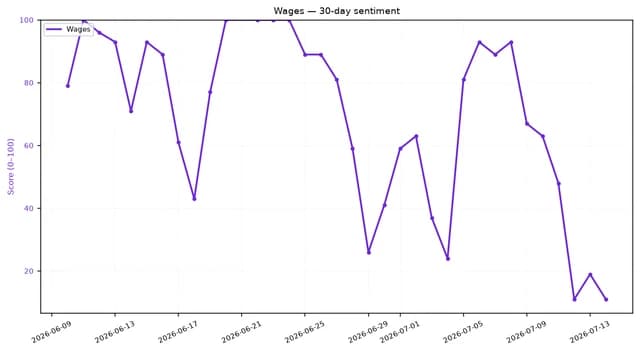
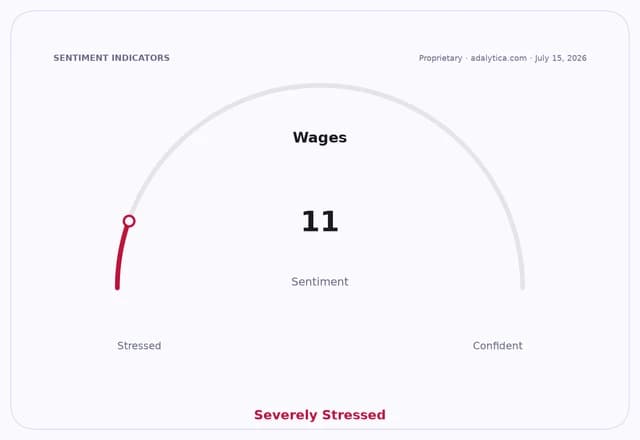
Adalytica’s wage inflation sentiment gauge has plunged to extreme fear, a sign that the market is increasingly worried about the next leg of labor-cost pressure. That is exactly the kind of setup that creates mispricing: the consensus usually reacts after wages are approved, not while the negotiation is still unresolved. For public markets, that means the real trade is not on the final vote itself, but on which companies have enough scale, automation and pricing power to protect earnings once the new floor is set.
The broader economic narrative is straightforward. South Korea is trying to balance fairness for workers with the health of small businesses and consumer demand. But from an investor’s point of view, the more important question is which sectors can turn higher wages into a competitive moat. Large chains, discount retailers, automation vendors and payroll-efficient operators should outperform local labor-intensive peers if the wage floor moves higher again.
If the committee closes the gap and pushes through a higher minimum wage, expect fresh pressure on low-margin employers and renewed interest in labor-saving plays. For investors, the actionable takeaway is to favor scale, automation and pricing power — and avoid businesses that depend on cheap labor to protect earnings.
| Entity | Gains | Losses |
|---|---|---|
| Workers | ▲Higher take-home pay | ▼None |
| Large retailers | ▲Pricing power, scale | ▼Payroll costs |
| Labor-intensive small businesses | ▲None | ▼Margin compression |
| Labor-saving tech/automation firms | ▲More demand | ▼None |