Spain’s latest housing decrees are already freezing the rental market, and the real economic risk is not the paperwork — it is the shrinking supply that could push rents higher and make access harder for households and younger buyers.
Spain rental market freezes after housing decrees
A survey by the National Federation of Real Estate Associations, based on more than 600 agencies in Spain’s main cities and provincial capitals, found that 72% had seen rental contracts stall since the measures were announced, while 78% reported owners pulling homes out of the standard rental market. In just 10 days, agencies logged 1,523 blocked signings and 5,758 affected transactions, including 2,067 homes removed from residential letting, 1,224 diverted to sale and 944 shifted into seasonal or room rentals.
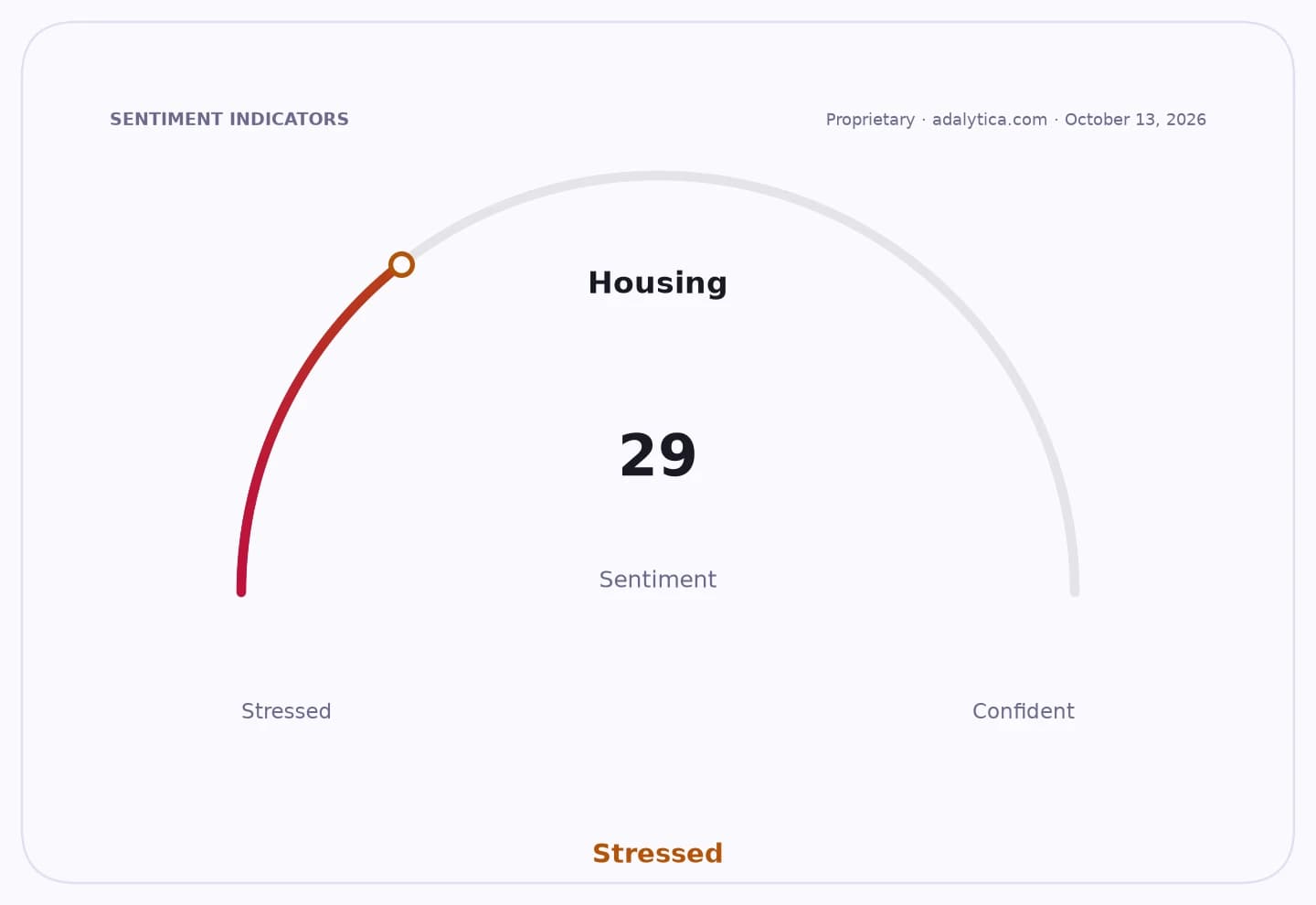
Sentiment IndicatorsⓘProprietary · adalytica.com · October 13, 2026
This is a snapshot — live sentiment, awareness and momentum for 130+ markets update continuously in the dashboard.Open AlphaPulse

That matters because housing policy is working less like a market stabilizer and more like a supply shock. If owners delay decisions, rework contracts or simply decide not to relist when leases expire, the stock of available rental homes falls just as demand remains structurally tight. The federation says 89% of agencies have already seen some disruption, and it warns rental transactions could drop 25% to 30% in the coming weeks.
The chain reaction is easy to see. Some landlords are waiting for legal clarity before re-entering the market. Others are already choosing to sell or convert homes to shorter-duration lets, where they see more flexibility and less regulatory risk. For tenants, that means fewer listings, tougher competition and more bargaining power shifting to owners willing to stay in the market. For policymakers, it means an intervention designed to ease access could end up tightening it.
The pressure is not just immediate. FAI chief José María Alfaro says some owners with leases expiring in months are already telling agents they will not renew into the rental market at all. ASVAL, which represents both small and large landlords, expects a staggered decline in supply as contracts roll off. That is the kind of behavior change that is hard to reverse, because once an owner sells a unit or repositions it into another use, that rental inventory may be gone for years.
For investors, the message is clear: the market underestimates how quickly regulation can redirect capital and inventory. In Spain, that favors the parts of the housing chain that benefit from scarcity and flexibility, from rental-management platforms to firms that help owners protect income and navigate compliance, while pressuring pure intermediaries exposed to lower transaction volumes. It also reinforces the broader European trade in “toll road” assets — businesses that profit from recurring housing demand even when ownership risk rises.
The likely next catalyst is simple: more contract expirations. As those dates arrive, the real test will be whether the new rules stabilize the market or accelerate the retreat of private landlords. Right now, the evidence points to the latter, and that makes housing-linked assets a place to watch closely for the next move.
| Entity | Gains | Losses |
|---|---|---|
| Landlords who exit | ▲Higher flexibility, lower regulatory risk | ▼Rental income, tenant turnover |
| Rental service firms | ▲More demand for income protection and compliance | ▼Less if broader market freezes |
| Tenants, families, young renters | ▲None | ▼Fewer listings, tougher access |
| Spain rental market | ▲Policy scrutiny, eventual clarity | ▼Near-term supply, transaction volume |