The U.S. equity market is becoming more concentrated, and that matters because a handful of mega-cap stocks now dominate liquidity, price discovery and index performance.
SPY at 773.26 as mega-cap concentration rises

The Big Ten account for 77% of the stock market’s liquidity and roughly £91 billion in trading value, a level of dominance that underscores how much the S&P 500 is being driven by a narrow group of giants rather than broad participation. For investors, that concentration is a double-edged sword: it can keep benchmarks levitating when money chases the leaders, but it also leaves portfolios far more vulnerable if flows reverse.
That is exactly the kind of market structure investors should pay attention to now. SPY is trading at 773.26, well above its 50-day and 200-day moving averages of 746.61 and 700.13, respectively, and its RSI reading of 69.6 shows momentum remains strong. But the move is happening in a market where breadth is thin and liquidity is clustered at the top, a setup that can mask fragility until it suddenly doesn’t.
The macro backdrop helps explain why. The 10-year Treasury yield is around 4.63%, while the 2-year sits near 4.23%, leaving the curve slightly positive at 0.46 percentage point. That mix says growth has not broken, but it also says rate risk is still alive and discount rates are not collapsing. In that environment, investors keep crowding into the stocks with the deepest balance sheets, the strongest earnings growth and the most reliable AI-linked capital spending, because those are the names that can absorb higher-for-longer financing costs and still attract flows.
The problem is that concentration cuts both ways. When a few stocks dominate trading, they become the market’s liquidity engine and its weak point at the same time. If positioning gets too one-sided, any disappointment in earnings, regulation, capex returns or guidance can hit index funds and passive products much harder than a normal sector rotation would suggest. That is why the market can look healthy on the surface even as underlying risk is building.
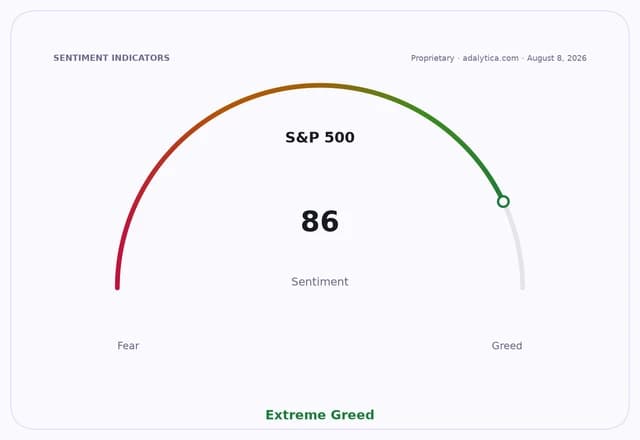
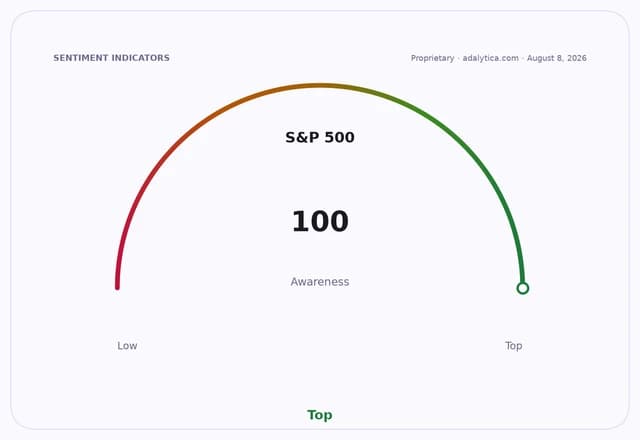
Adalytica’s S&P 500 trade signals also show extreme greed, with sentiment at 86 and awareness at 100, reinforcing the view that investors are still leaning aggressively into the same crowded leaders. The U.S. dollar is showing its own extreme-greed reading as well, which typically tightens global financial conditions at the margin and increases pressure on companies that depend on overseas demand or imported inputs.
The investable implication is clear: this is not just a story about stock-market concentration, it is a story about where capital is being forced to go. The winners remain the mega-cap platforms, AI infrastructure leaders, cloud vendors, chip suppliers, and the ETF wrappers that sit closest to those flows. The losers are the lagging equal-weight indexes, smaller caps that need easier funding conditions, and any high-multiple growth name without pricing power or durable free cash flow.
I believe the market is underestimating how much this concentration can persist. As long as the Big Ten continue to capture liquidity, they will keep pulling index performance, passive inflows and valuation support toward themselves. But that also means the next real opportunity may not be chasing the obvious leaders after they are already stretched — it may be owning the picks-and-shovels around them, or hedging the crowded trade before liquidity becomes a liability.
| Entity | Gains | Losses |
|---|---|---|
| Big Ten mega-caps | ▲Capture liquidity and index flows | ▼Become crowded and vulnerable to reversals |
| SPY holders | ▲Benefit from leader-driven gains | ▼Face concentration risk |
| Small caps | ▲Potential valuation reset if flows broaden | ▼Lose relative capital allocation |
| AI infrastructure suppliers | ▲Ride capex and demand from leaders | ▼Risk demand pause if leaders stumble |