Starbucks is still trading like a turnaround story with growth optionality, but the market may be missing that the real valuation debate is now about margin normalization, not just sales. At about 36 times forward earnings, the stock looks expensive against low-single-digit growth, yet that multiple is being applied to trough earnings depressed by restructuring as the business shifts toward a higher-margin royalty-heavy model.
Starbucks at $105.16 on Aug. 6 as margins reset
That matters because the earnings base is moving. When a company is still absorbing restructuring costs and reorganizing its operating model, the headline P/E can overstate the true earnings power. If Starbucks keeps pushing revenue mix toward royalties and licensed stores, the profit profile can improve without a dramatic acceleration in unit growth. In that case, the multiple does not need to expand for shareholders to win — it can compress on its own as earnings catch up.
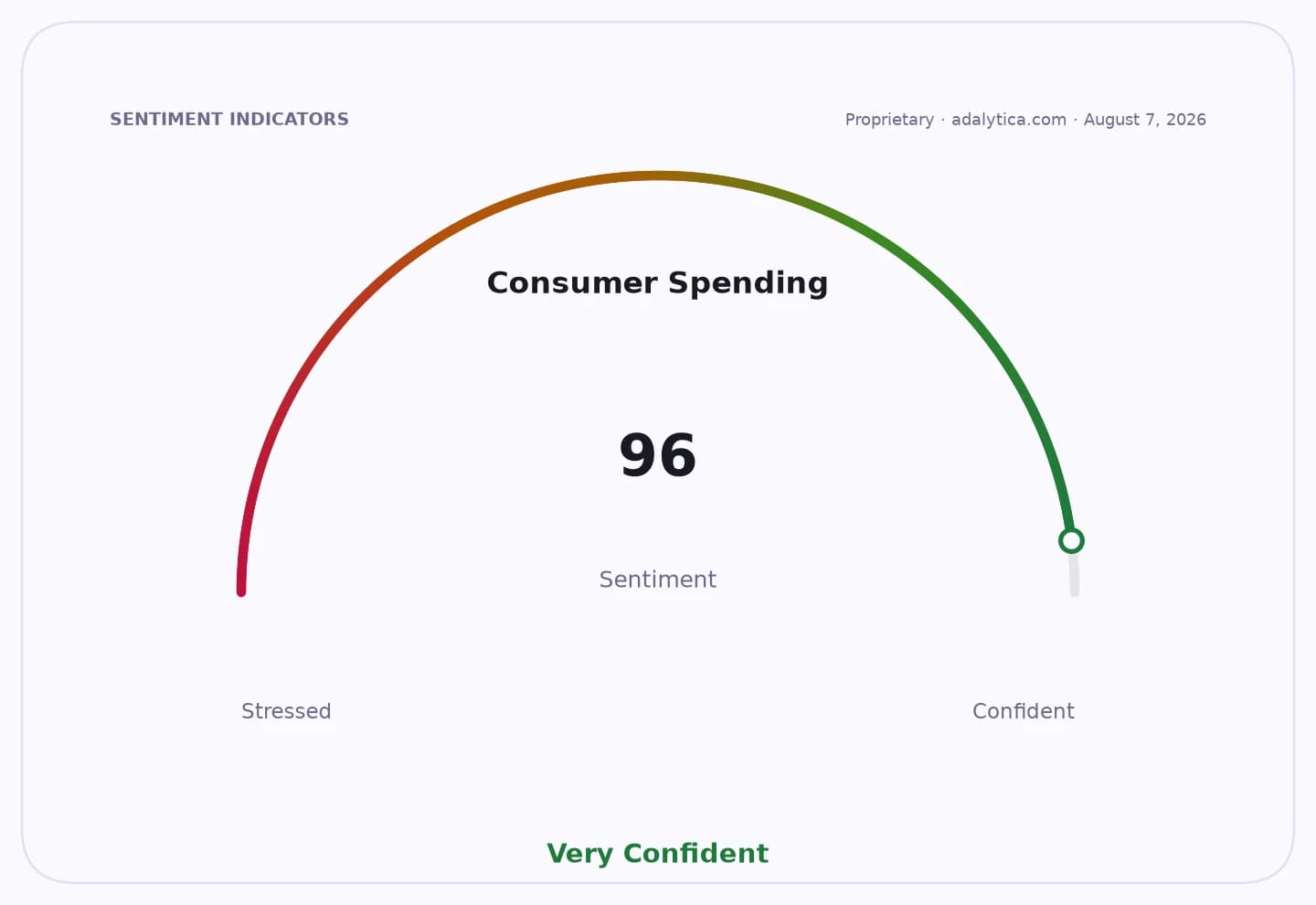
Sentiment IndicatorsⓘProprietary · adalytica.com · August 7, 2026
This is a snapshot — live sentiment, awareness and momentum for 130+ markets update continuously in the dashboard.Open AlphaPulse

The contrast with McDonald’s is telling. MCD trades around 25 times earnings for a mature, high-margin royalty-driven franchise model, and Starbucks is increasingly trying to borrow that playbook. The market is still pricing Starbucks as if it were a retail operator with cyclical margin pressure, rather than a branded platform that can monetize its global footprint with less capital intensity. That re-rating path is what creates the asymmetry.
Recent trading also suggests investors are warming to the thesis. Starbucks shares have climbed back above their 200-day moving average and have held near the low $100s, with the stock closing at $105.16 on Aug. 6. The 50-day moving average has also turned up, while RSI readings and MACD indicate the shares are no longer in a deep technical downtrend. That does not make the valuation cheap, but it does show the market is starting to price in a cleaner earnings profile.
The macro backdrop helps, too. U.S. Treasury yields are still around 4.6%, inflation remains sticky, and consumers are being more selective, which is exactly why investors have become more willing to pay for businesses that can defend margins through pricing and mix rather than volume alone. Adalytica’s consumer spending sentiment is also flashing extreme greed, underscoring how quickly risk appetite can rotate back into branded growth names when investors expect earnings stability.
For Starbucks, the key catalyst is execution. If management keeps progressing on restructuring and accelerates the shift toward royalty and licensing income, the market may eventually value the company less like a chain of coffee shops and more like an asset-light consumer franchise. That would make today’s 36x forward earnings look less like a peak multiple and more like a temporary penalty on trough profits.
My view: Starbucks is still not the cheapest stock on the board, but it is one of the more interesting valuation inversions in consumer staples-plus. If the margin reset continues, long-term investors can own the royalty transition before consensus fully accepts that the earnings base is being rebuilt, not merely defended.
| Entity | Gains | Losses |
|---|---|---|
| Starbucks bulls | ▲Margin reset upside | ▼Near-term valuation skepticism |
| Starbucks bears | ▲Trough earnings optics | ▼Multiple compression if mix improves |
| McDonald’s | ▲Benchmark for royalty model | ▼Relative valuation comparison |
| Short-duration consumer names | ▲Risk-on rotation | ▼Capital left for quality franchises |