The next leg of the wage cycle is shaping up to outpace productivity, a shift that could keep labour costs sticky, squeeze corporate margins and complicate the case for easier monetary policy.
Sticky Wages Threaten Margins and Bonds
That matters because when wages rise faster than output per worker, firms either absorb the hit in profits, raise prices, or cut hiring and investment. In all three cases, the macro effect is the same: inflation becomes harder to extinguish and real growth gets less efficient. The risk is most acute in sectors where labour is a large share of costs, from retail and logistics to consumer services, while capital-heavy firms may be better insulated if they can keep lifting productivity through automation and scale.
Sentiment IndicatorsⓘProprietary · adalytica.com · July 26, 2026
This is a snapshot — live sentiment, awareness and momentum for 130+ markets update continuously in the dashboard.Open AlphaPulse
The tension shows up in the market backdrop. U.S. equity benchmarks remain near record territory even as the 50-day moving average on the S&P 500 has flattened and the index has slipped below recent highs, a sign investors are not yet pricing a major earnings shock. But Treasury exposure tells a different story: the iShares 20+ Year Treasury Bond ETF has been trading with weakening momentum, with its RSI sinking into deeply oversold territory and price action hovering near the lower Bollinger Band. That combination suggests bond investors are still uneasy about the inflation path, even as stocks have been more forgiving.
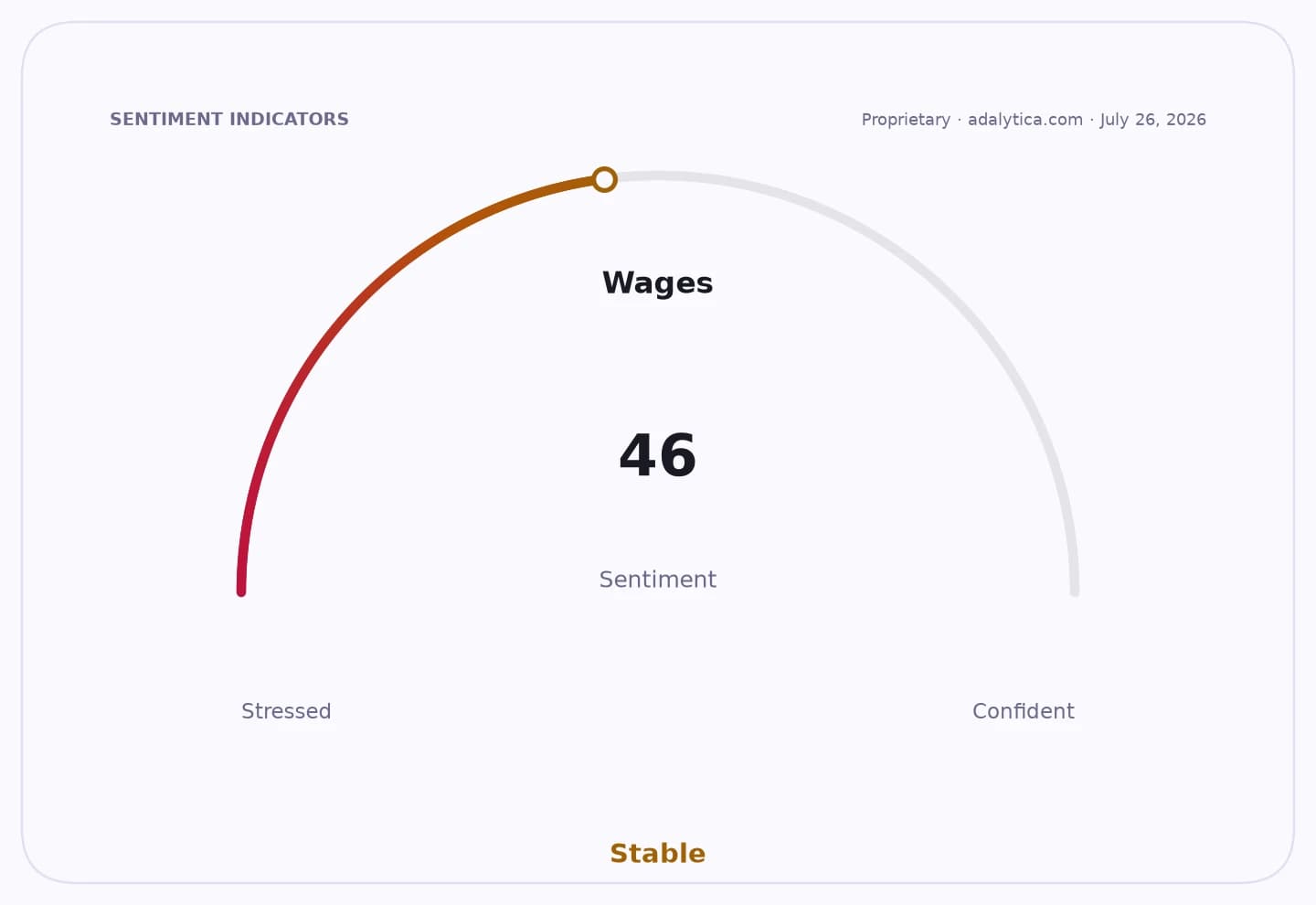
Adalytica’s wage inflation sentiment is neutral at 46, but the awareness reading of 29 and the sharp drop over the past week point to a market that is not fully focused on the issue yet. By contrast, nonfarm payroll sentiment remains elevated at 75, implying labour-market resilience is still the dominant macro narrative. CPI sentiment is only 5, an extreme fear reading, underscoring how sensitive investors remain to any hint that wage growth could feed back into prices. In other words, the market is not just watching inflation; it is watching the wage channel that can keep inflation persistent.
Wages — 30-day sentimentadalytica.com
Explore this data interactively — full history, time series and cross-market comparisons.Open AlphaPulse
For companies, the implications are immediate. Recent filings from Walmart and Apple show operating expenses rising, with both higher headcount-related costs and capital investment-linked depreciation weighing on expense ratios. That is the classic divergence trade-off: firms can spend more on labour and technology to defend productivity, but not all will convert those costs into higher output fast enough. Retailers such as Target and Ross Stores are also navigating a mix of wage pressure and margin management, which means the ability to pass through costs will separate winners from losers.
The broader policy issue is whether central banks can look through wage gains that reflect labour-market normalization rather than overheating. Bulls will argue that stronger wages support consumption and that productivity can catch up if firms continue investing in software, AI and automation. Bears will say wage growth is proving sticky while productivity remains uneven, leaving a higher-for-longer inflation floor and restricting how far rates can fall.
For investors, that means the wage-productivity spread is no longer a side issue. It is a direct test of margin durability, rate-cut timing and the relative performance of labour-intensive sectors versus businesses with pricing power or automation leverage. The next inflation and payroll prints will matter less for the headline numbers than for whether wage growth is finally slowing enough to let productivity narrow the gap.
| Entity | Gains | Losses |
|---|---|---|
| Workers | ▲Higher paychecks | ▼If firms cut hours/hiring |
| Labour-light tech firms | ▲Margin leverage | ▼Less |
| Retailers and consumer services | ▲If prices rise | ▼Wage-cost pressure |
| Treasury bulls | ▲If inflation cools | ▼If wage stickiness persists |