The U.S. Supreme Court has temporarily allowed states to use the federal SAVE database to check voter eligibility, giving President Donald Trump a short-term win in a broader fight over election administration before November’s elections.
Supreme Court Lets States Use SAVE Voter Database
The order matters less for any immediate purge of voter rolls than for the precedent it reinforces: a federal tool built for immigration verification can now keep serving as a channel for state election officials seeking citizenship checks, even as lower courts weigh privacy, accuracy and due-process objections. That puts the dispute at the center of a familiar trade-off in U.S. politics — tighter verification versus the risk of wrongly flagging eligible voters.
Sentiment IndicatorsⓘProprietary · adalytica.com · October 1, 2026
This is a snapshot — live sentiment, awareness and momentum for 130+ markets update continuously in the dashboard.Open AlphaPulse
The practical near-term effect may be limited. Federal law generally bars systematic voter roll purges inside 90 days of an election, and the SAVE program is voluntary for states. But the ruling preserves the administration’s ability to keep expanding the tool’s role while the case continues through the courts, and it gives Republican-led states a green light to lean on federal data in a politically charged area of election administration.
The court’s unsigned order left in place a lower-court ruling that had blocked the revamped version of SAVE on privacy grounds. Three liberal justices dissented publicly, with Justice Ketanji Brown Jackson warning that even a small number of erroneous removals could deny lawful voters access to the ballot.
Trump has made aggressive election-overhaul efforts a hallmark of his second term, including attempts to reshape mail voting and build a national voter list, and most have run into constitutional and legal limits. That broader campaign has strategic value for Republicans because it keeps voter integrity at the forefront of the political conversation, but it also carries legal and operational risks if states rely on flawed matches or overbroad data.
Supporters argue the database helps states identify ineligible noncitizens and clean up rolls, a long-standing administrative goal. Critics counter that the evidence of noncitizen voting is vanishingly small and that expanded screening can produce false positives. In Travis County, Texas, officials reviewed 97 voters flagged by SAVE and found at least 10% — and possibly as many as 21% — were U.S. citizens, a concrete example of the error risk opponents cite.
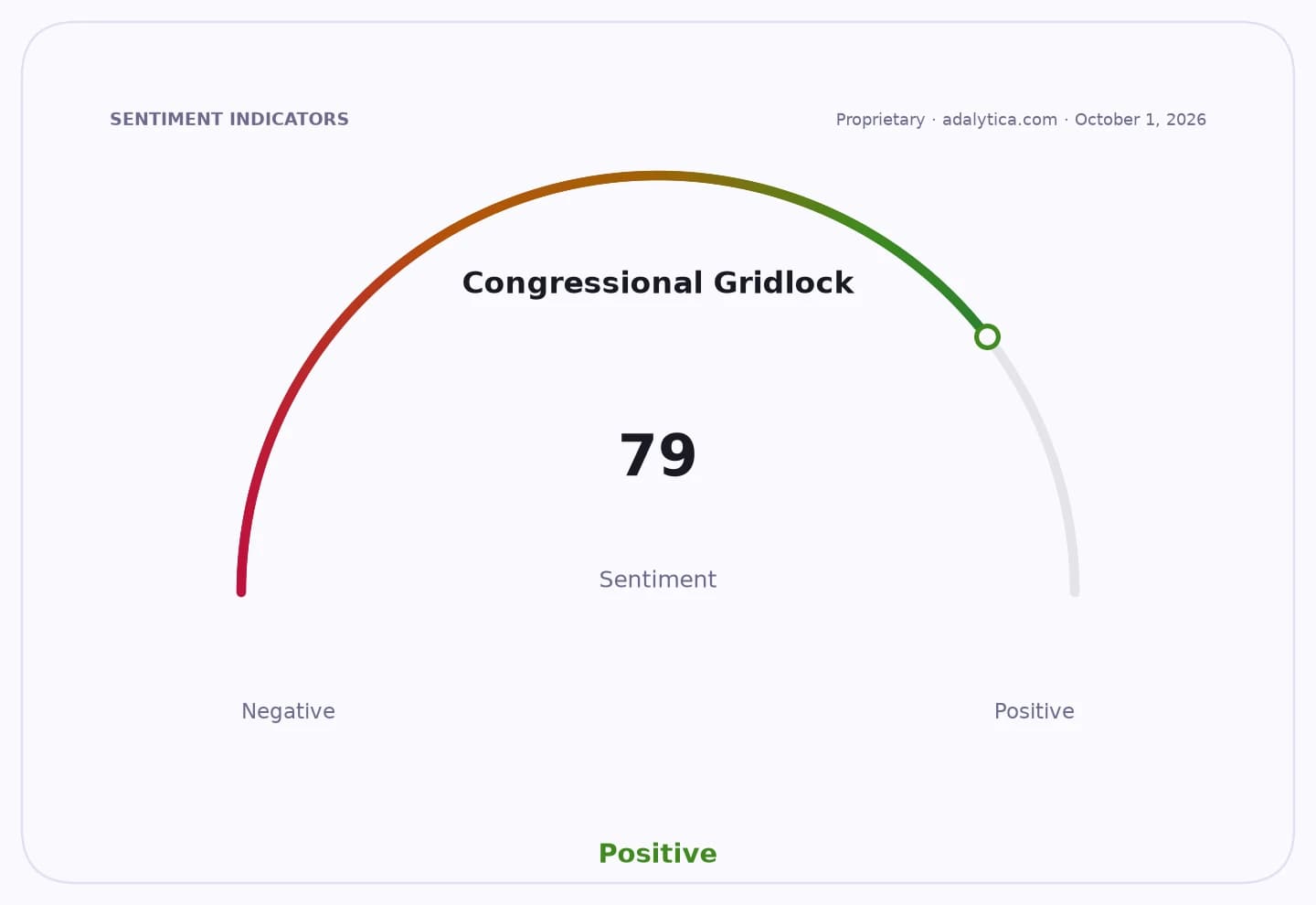
For investors, the case is not a direct market mover, but it is relevant to the policy backdrop for the 2026 midterms and to the broader U.S. governance risk premium. The Adalytica U.S. Congressional Gridlock Sentiment gauge shows extreme greed in gridlock, reflecting the market’s expectation that election rules will remain politically contested and legally unstable. That kind of uncertainty tends to favor industries and assets that benefit from institutional inertia, while raising the odds of headline-driven volatility around state-level compliance, legal spending and election-adjacent services.
The ruling also underscores a larger theme in Washington: the courts remain the main brake on executive attempts to centralize election rules, even as the White House keeps testing the boundaries. The next catalyst is whether lower courts ultimately uphold the SAVE expansion or rein it back in, and whether states move ahead with broader eligibility checks before the 90-day pre-election window closes.
| Entity | Gains | Losses |
|---|---|---|
| Trump administration | ▲Temporary legal backing | ▼Limits on rollout if courts reverse |
| Republican-led states | ▲Easier citizenship checks | ▼Risk of false positives |
| Eligible voters | ▲Protections from immediate purge | ▼Potential scrutiny and confusion |
| Civil-liberties challengers | ▲Ongoing litigation leverage | ▼Short-term setback at Supreme Court |