A Swedish foundation is spending 80 million kronor per hire to lure world-class researchers home, betting that stable funding and long planning horizons can give Sweden a lasting edge in artificial intelligence and other frontier fields.
Sweden funds AI hires with 80 million kronor each

That is the real significance of Julian Togelius’ move from New York University to Chalmers University of Technology in Gothenburg. The professor, who studies AI and games, says he will take a pay cut of up to 25% to leave the US, but gains something far more valuable: a research position funded for as long as 10 years, with enough money to build a team of roughly eight or nine PhD students and two or three postdocs.
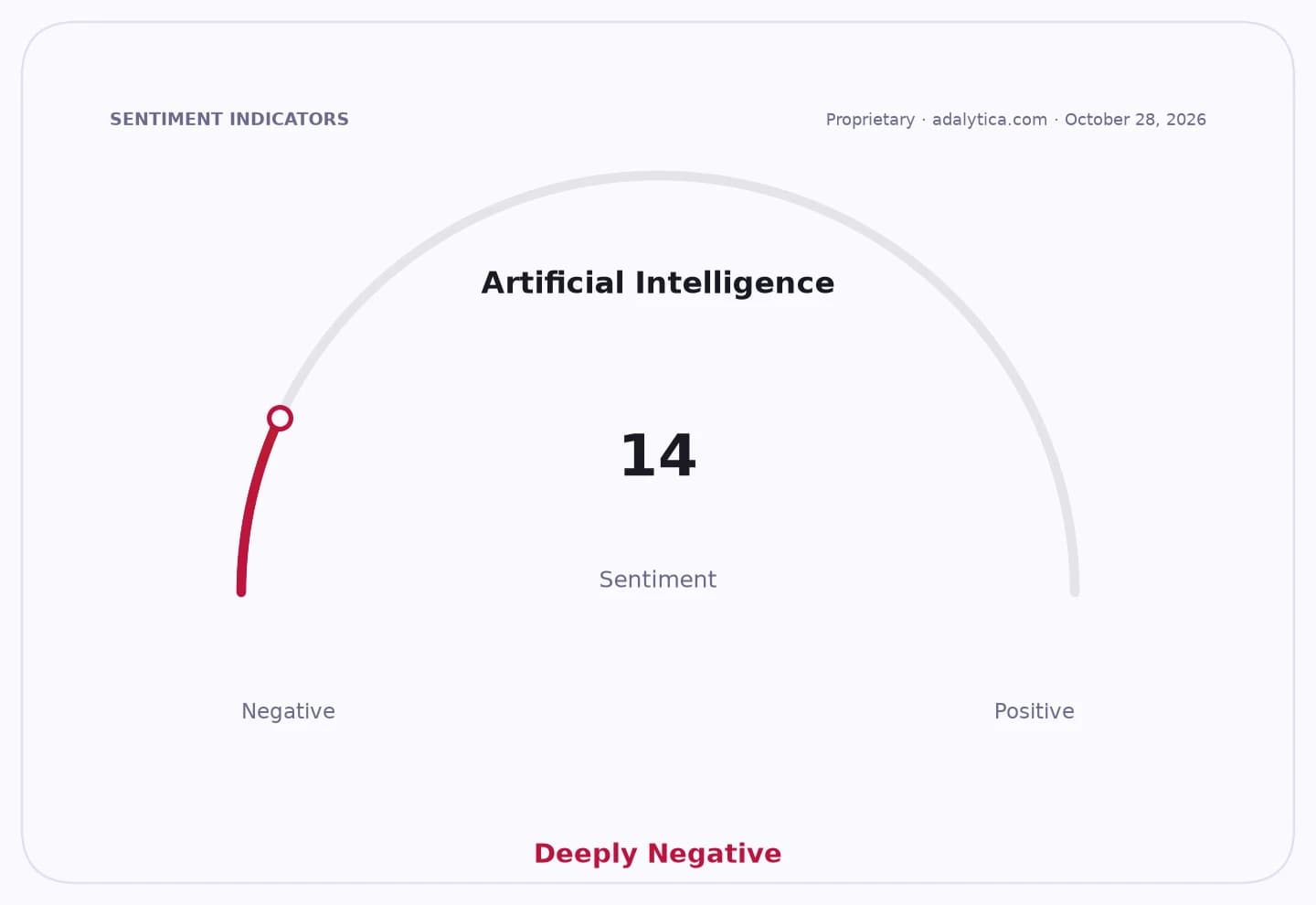
Sentiment Indicators
For investors, the story is bigger than one academic relocation. It shows how capital is being deployed not just into companies, but into the talent base that supports future innovation. In a global race for AI leadership, the bottleneck is increasingly human capital, not just chips or cloud servers. Sweden is trying to turn predictable funding and institutional stability into a competitive advantage at a time when researchers in the US are facing more uncertainty.
The package is sizeable but not extravagant by international standards. Under the Wallenberg model, each appointment comes with 80 million kronor, split between 50 million from the Knut and Alice Wallenberg Foundation and 30 million from the university. The money must be used to build a permanent research group, and the hire must spend at least 80% of working time at the Swedish university. Four researchers have accepted so far, including Togelius and three other professors recruited from US and European universities.
That makes the program a long-term strategic wager on Sweden’s ability to attract and retain talent. It also reflects a broader debate in higher education: should universities concentrate resources on a few marquee names, or spread money across more junior researchers and faculty? Chalmers says it already spends close to 100 million kronor a year on younger hires, but the Wallenberg-backed packages are meant to pull in established scientists whose work can anchor entire research clusters.
The timing matters. Three of the four hires are coming from the US, where research funding has become less predictable after the Trump administration froze or ended more than 8,000 research grants, according to the Grant Witness database cited in the report. Togelius said the biggest draw was not salary, but certainty — the ability to tell students and postdocs they would be funded for years, not months. That kind of stability is a powerful recruiting tool in any knowledge economy.
There are also questions investors should not ignore. The hiring process was not open to public application, which has drawn criticism from Sweden’s university staff union. And while the program may strengthen select departments, it also concentrates influence in the hands of a few outside funders, raising the usual question of opportunity cost: could the same money have produced more broad-based scientific output if it were spread differently?
Still, the broader message is encouraging. Countries and institutions that can offer reliability, autonomy and long funding runways may attract more of the world’s best minds as the AI boom matures. That is good for Sweden’s research ecosystem, and potentially for the companies that depend on it over the next decade. For investors who think in years rather than quarters, the lesson is clear: talent is becoming one of the most important compounding assets in the AI economy, and Sweden is trying to buy it at scale.
| Entity | Gains | Losses |
|---|---|---|
| Wallenberg Foundation / Swedish universities | ▲Top AI talent, global prestige | ▼Flexible use of capital |
| Julian Togelius and other recruited researchers | ▲Stable funding, research freedom | ▼Higher US pay |
| Sweden’s research ecosystem | ▲Stronger AI pipeline | ▼Some junior-hire funding tradeoff |
| US universities / grant-dependent labs | ▲— | ▼Talent outflow, funding uncertainty |