Swedish households should brace for higher borrowing costs again after a long pause, with the Riksbank widely expected to lift its policy rate in November and possibly again early next year.
Sweden Riksbank Seen Raising Rates Again

That matters because the break in Sweden’s rate cycle is ending just as inflation risks, higher fuel and power bills and still-elevated housing costs threaten to squeeze disposable income again. For mortgage holders, especially those on floating rates, the change would feed through quickly and raise monthly payments in a market where banks have already priced in some of the move.
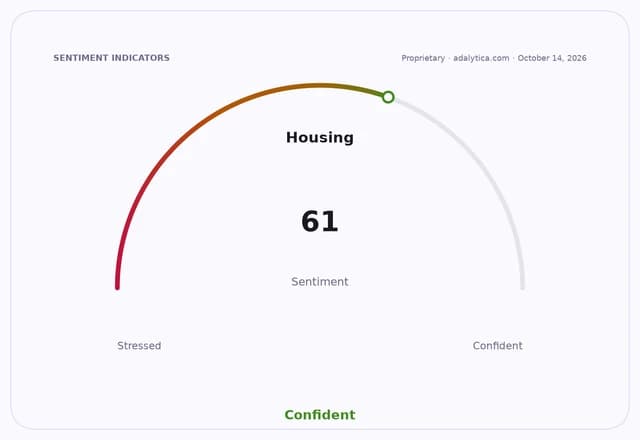
Sentiment IndicatorsⓘProprietary · adalytica.com · October 14, 2026
This is a snapshot — live sentiment, awareness and momentum for 130+ markets update continuously in the dashboard.Open AlphaPulse

The Riksbank last raised its key rate in September 2023, taking it to 4.0% before cutting it step by step to 1.75%, where it has stood for just over a year. Bank economist Arturo Arques of Swedbank said his base case is a 25-basis-point hike in November, followed by another 25 points in February, though some analysts expect more tightening if growth and inflation data hold up. The central bank itself has signaled that a year-end increase is likely if the economic outlook remains intact.
For households, the arithmetic is immediate. A borrower with 1 million Swedish kronor in debt would see annual costs rise by about 300 kronor after tax from a 50-basis-point increase, while a household with 3 million kronor in loans would face a jump of more than 10,000 kronor a year. The impact would come fastest through Sweden’s popular three-month floating mortgages, where banks typically pass on policy changes relatively quickly.
Current average floating mortgage rates already sit around 2.58%-2.71% at major lenders including Handelsbanken, SEB, Swedbank, Skandia and Länsförsäkringar, according to Compricer. Longer fixed-rate loans are more expensive still, in many cases above 3.2%, meaning the cost of locking in now is already high and may remain so if policy keeps tightening.
The macro backdrop makes the shift more than a technical adjustment. Arques warned of a “perfect storm” for households this winter as higher interest payments coincide with more expensive fuel, electricity and imported goods. That combination would slow consumption, hit retail and services spending and leave little room for households to absorb further shocks unless they have savings buffers and modest leverage.
Investors should care because Sweden’s housing market is unusually sensitive to rate changes, and renewed tightening can reverberate through consumption, bank lending volumes and property-linked credit risk. Any rise in default stress would be limited by Sweden’s generally strong household balance sheets, but the direction is clear: less disposable income, softer demand for new mortgages and a colder backdrop for housing-related equities.
The housing signal is not isolated. In the U.S., the average 30-year mortgage rate has climbed to around 7.4%, near a three-year high, while homebuilding ETFs such as ITB and XHB have fallen sharply in recent weeks as markets reassess the path of rates. In Sweden, a similar pattern would favor lenders and deposit-rich banks over consumers and rate-sensitive housing names, at least initially.
The key question now is whether inflation continues to cool enough to let the Riksbank stop at one or two hikes, or whether stubborn price pressure forces a more extended tightening cycle. For households, the message is simple: the era of cheap money is not returning soon, and the next move in rates is more likely to be up than down.
| Entity | Gains | Losses |
|---|---|---|
| Swedish banks | ▲Wider lending margins | ▼Slower mortgage demand |
| Floating-rate borrowers | ▲None | ▼Higher monthly payments |
| Fixed-rate borrowers | ▲Payment certainty | ▼Costly refinancing |
| Housing-linked retailers | ▲None | ▼Softer consumer spending |