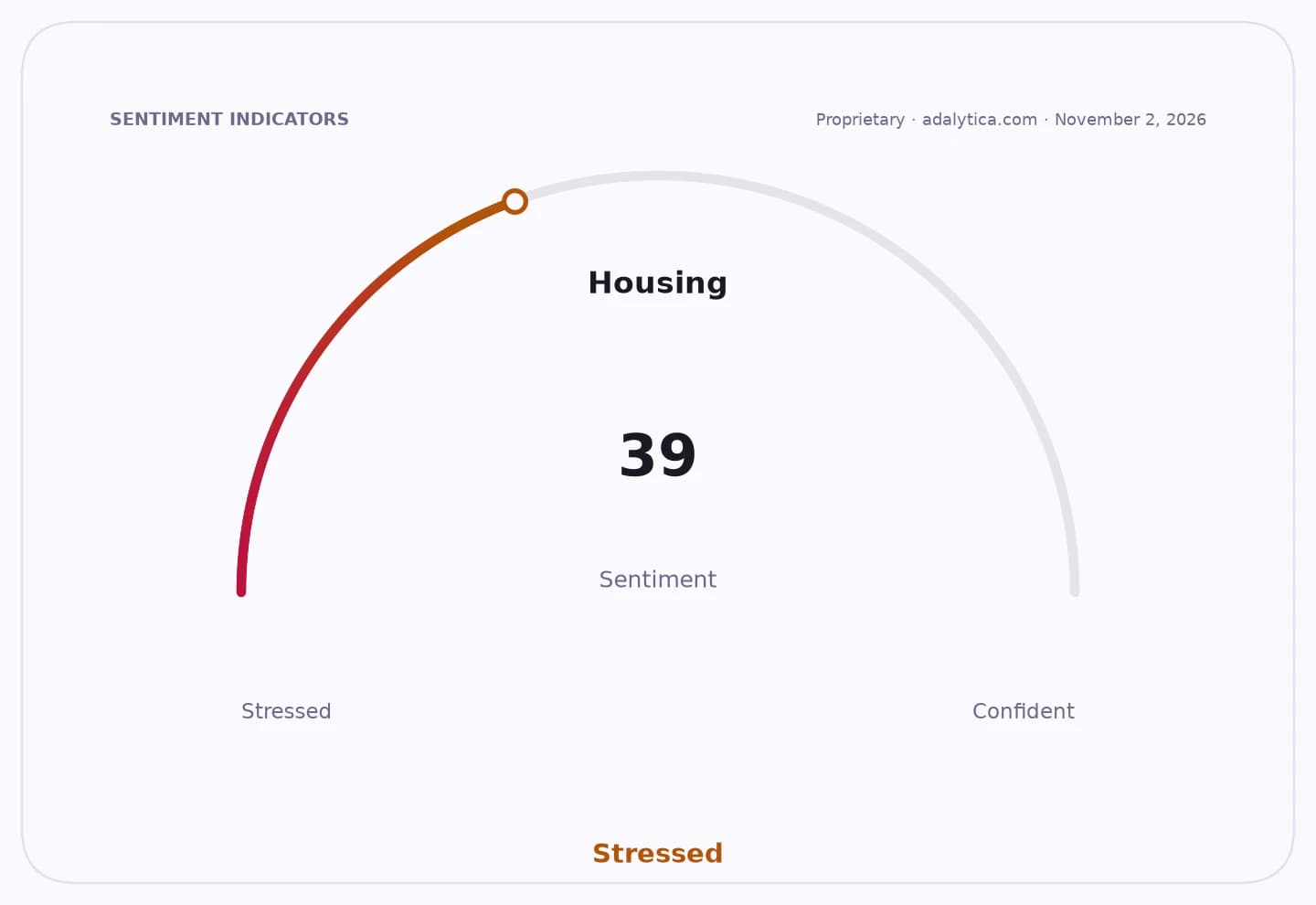
Sydney’s mortgage squeeze is no longer just a macro headline — it is showing up street by street, with Constitution Hill now carrying the highest share of borrowers behind on repayments in New South Wales.
Sydney mortgage arrears rise in outer suburbs
That matters because Australia’s higher-rate shock is not landing evenly. It is biting hardest in outer Sydney and other suburbs where borrowers stretched for bigger loans near peak prices, leaving them exposed when the Reserve Bank lifted rates to 4.85 per cent, the highest since 2008. For investors, that concentration is a warning sign: the stress in housing is increasingly a localized credit and consumption story, not a broad national collapse, but it still has real consequences for banks, retailers, builders and the broader economy.
Sentiment Indicators
In Constitution Hill, around 2.42 per cent of borrowers are in arrears, nearly triple the national average of 0.85 per cent and the second-highest level in Australia, according to S&P Global Ratings. Five of the 10 Australian suburbs with the highest arrears were in NSW at the end of June, with Baulkham Hills, Berkshire Park, Casula and Alison also featuring prominently. Across Sydney and Melbourne, postcode data suggest the pressure is clustering in places with high debt-to-income ratios and property prices that have already fallen.
The economic significance goes beyond one suburb. When mortgage payments rise by about $100 a month on a $600,000 loan after another RBA hike, households cut back elsewhere. That means fewer holidays, less discretionary spending, slower renovations and tighter cash flow for small businesses serving local communities. Ben Sandland’s decision to pause renovations, forgo overseas travel and divert spare cash into his offset account is exactly the kind of behavioral shift that ripples through the economy before defaults become a bigger problem.
That is why the market should pay attention to where the stress is concentrated. As S&P’s Erin Kitson noted, the heaviest strain is showing up in recent buyers on large mortgages, often those who borrowed close to peak prices when rates were lower. They are now facing the double blow of higher repayments and lower home values, which makes refinancing harder and reduces financial flexibility. Mortgage broker Finspo says some borrowers are moving to interest-only terms, stretching loans back to 30 years or seeking sharper rates, but many cannot clear the lending hurdles needed to refinance.
The investor angle is straightforward: this is less a systemic banking event than a slow bleed in household demand. Major lenders such as Westpac, JPMorgan and other mortgage-heavy banks are watching real estate values and repayment behavior closely, but arrears around 2 per cent in pockets of Sydney are still manageable from a capital perspective. The bigger opportunity is in spotting who benefits from refinancing demand, debt consolidation and financial distress, and who suffers from tighter household budgets.
That creates a mixed picture across sectors. Banks may face more work-out, servicing and repricing activity, but retailers, travel names and discretionary spenders tied to mortgage-heavy suburbs are more exposed to the pullback. Even local service businesses are adapting, as western Sydney fitness operator Manny Laris said clients are downgrading memberships and looking for cheaper options.
For investors, the message is not to panic about Australian housing. It is to recognize the inflection point. Rate pressure is reshaping consumer behavior in the suburbs first, and that usually shows up in earnings later. The best positioning now is around resilience: lenders with strong underwriting, firms that help borrowers refinance or manage cash flow, and companies selling affordability rather than aspiration. Mortgage stress in Sydney is not a one-off anecdote — it is the clearest sign yet that the cost-of-living squeeze is turning into an investable theme.
| Entity | Gains | Losses |
|---|---|---|
| Banks with strong underwriting | ▲Better pricing power | ▼Higher arrears in pockets |
| Mortgage brokers/refinancers | ▲More demand for repricing | ▼Harder qualification standards |
| Discount retailers and value services | ▲Trading-down behavior | ▼Weak discretionary spend |
| Sydney borrowers in outer suburbs | ▲Some access to offset/refi tactics | ▼Higher repayments and less flexibility |