Taiwan’s labor minister said Beijing did not downgrade Taipei’s status at this week’s APEC meeting, easing concerns that China would use the forum to tighten political pressure on one of the few multilateral venues where Taiwan participates on equal footing.
Taiwan Keeps APEC Rights in Nanjing Meeting
Hung Sun-han said Taiwan was granted the same rights as other members at the APEC Human Resources Development Ministerial Meeting in Nanjing, after Beijing had signaled it would handle the delegation under its “one China” principle. That matters because APEC is one of Taiwan’s rare formal international platforms, and any erosion of its participation rights would have reverberated beyond protocol into broader cross-strait tensions and investor risk sentiment across Asia.
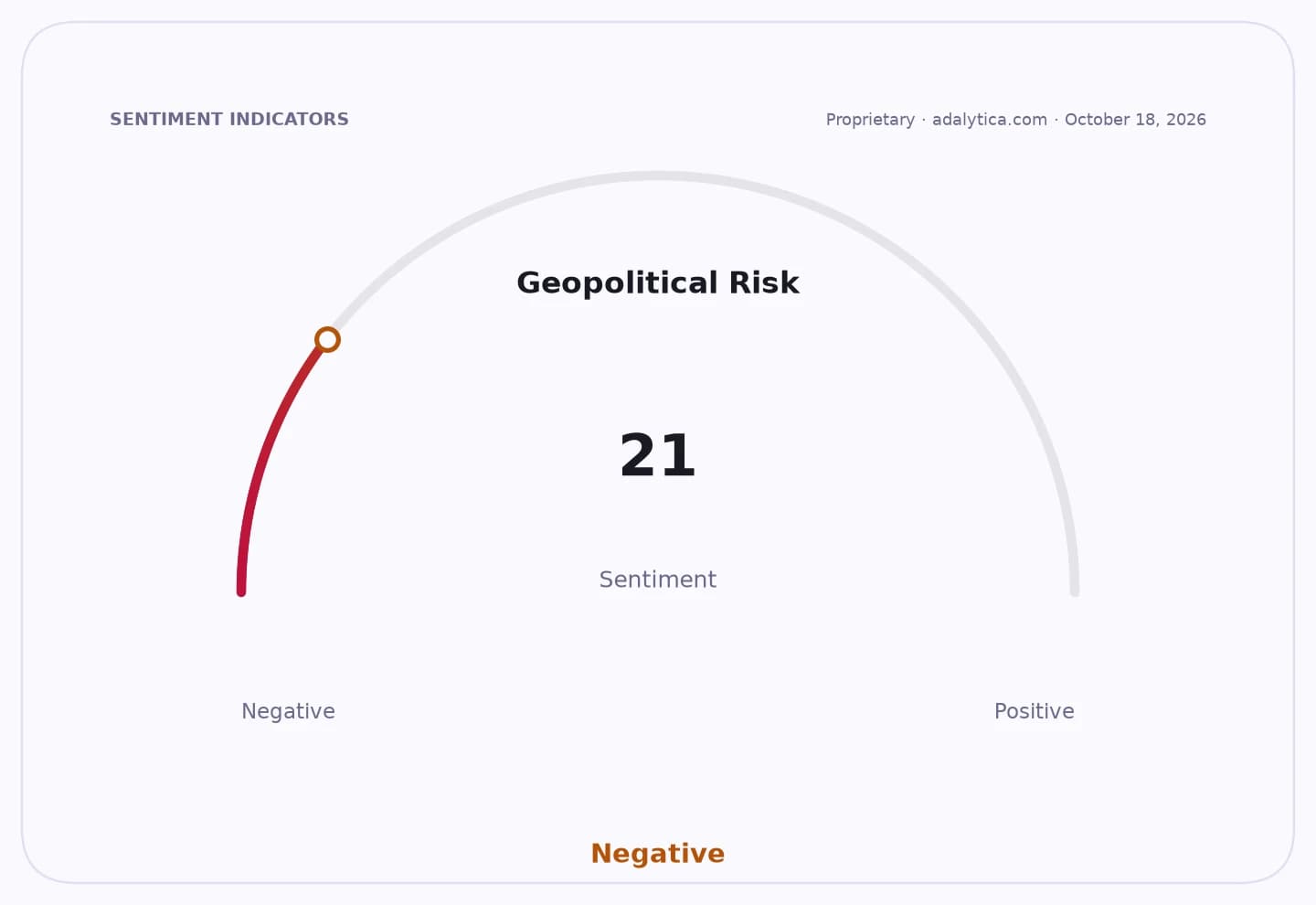
Sentiment IndicatorsⓘProprietary · adalytica.com · September 26, 2026
This is a snapshot — live sentiment, awareness and momentum for 130+ markets update continuously in the dashboard.Open AlphaPulse
Hung’s remarks suggest the host country opted for careful management over confrontation, at least for this meeting. He said Taiwanese officials entered China under the usual APEC invitation-letter arrangement rather than using a so-called Taiwan compatriot permit, underscoring that the trip followed established APEC practice rather than a bilateral immigration framework. He also stressed that the “Chinese Taipei” nameplate used at the meeting was Taiwan’s formal APEC designation, not evidence of a downgrade.
The trip was notable in its own right. Hung became the first Cabinet-level official from President Lai Ching-te’s administration to travel to China, a rare cross-strait visit at a time of strained political ties. That made the meeting a test case for whether Beijing would separate operational APEC rules from broader sovereignty claims. For markets, the fact that the session proceeded without a visible escalation is modestly stabilizing: it reduces the near-term risk of a diplomatic flare-up spilling into trade, travel or business ties.
The larger backdrop is still fragile. China’s Taiwan Affairs Office had previewed the meeting by reiterating Beijing’s “one China” position, while Taiwan’s Mainland Affairs Council insisted its APEC status could not be conditioned on that framework. The latest outcome does not resolve that dispute. But it does show both sides preserving a narrow channel for interaction in a forum that increasingly matters as an arena for trade, technology and supply-chain diplomacy.
For investors, the significance lies less in the protocol itself than in what it implies for regional risk. APEC friction is not a direct market driver on its own, but it is a useful signal of whether cross-strait tensions are moving toward sharper diplomatic confrontation or managed containment. With U.S.-China talks also advancing in New York on trade, AI and critical minerals, the Nanjing meeting adds to a short-term narrative of cautious de-escalation. That supports Asian risk assets at the margin, even if the underlying political fault line remains unresolved.
The key question now is whether this outcome proves repeatable as China hosts more regional or multilateral meetings. If Beijing continues to follow established APEC practice, Taiwan can preserve its participation without a fresh diplomatic crisis. If not, each meeting becomes another flashpoint for cross-strait friction and a reminder that political risk in Asia can still surface quickly in venues that markets usually treat as procedural.
| Entity | Gains | Losses |
|---|---|---|
| Taiwan government | ▲Preserved APEC standing | ▼No resolution of sovereignty dispute |
| China host authorities | ▲Avoided visible protocol clash | ▼Continued scrutiny over Taiwan treatment |
| Asian risk assets | ▲Lower immediate geopolitical risk | ▼Residual cross-strait uncertainty |
| Taiwan businesses | ▲Reduced near-term diplomatic tension | ▼Ongoing exposure to political shocks |