Taiwan faces a growing risk that China could choose an economic blockade rather than an outright invasion by 2028, a shift that would still hit global trade, chip supply chains and investor confidence even if no shots are fired.
Taiwan blockade fears pressure TSMC and Taiwan stocks
That warning from Senator Tammy Duckworth matters because a blockade would amount to a coercive act with immediate economic consequences for Taiwan and far-reaching spillovers for technology, shipping, insurance and Asian markets. It would test how far Beijing is willing to move below the threshold of war while still putting pressure on Taipei and its supporters, and it would force investors to price a disruption to the world’s most important semiconductor hub.
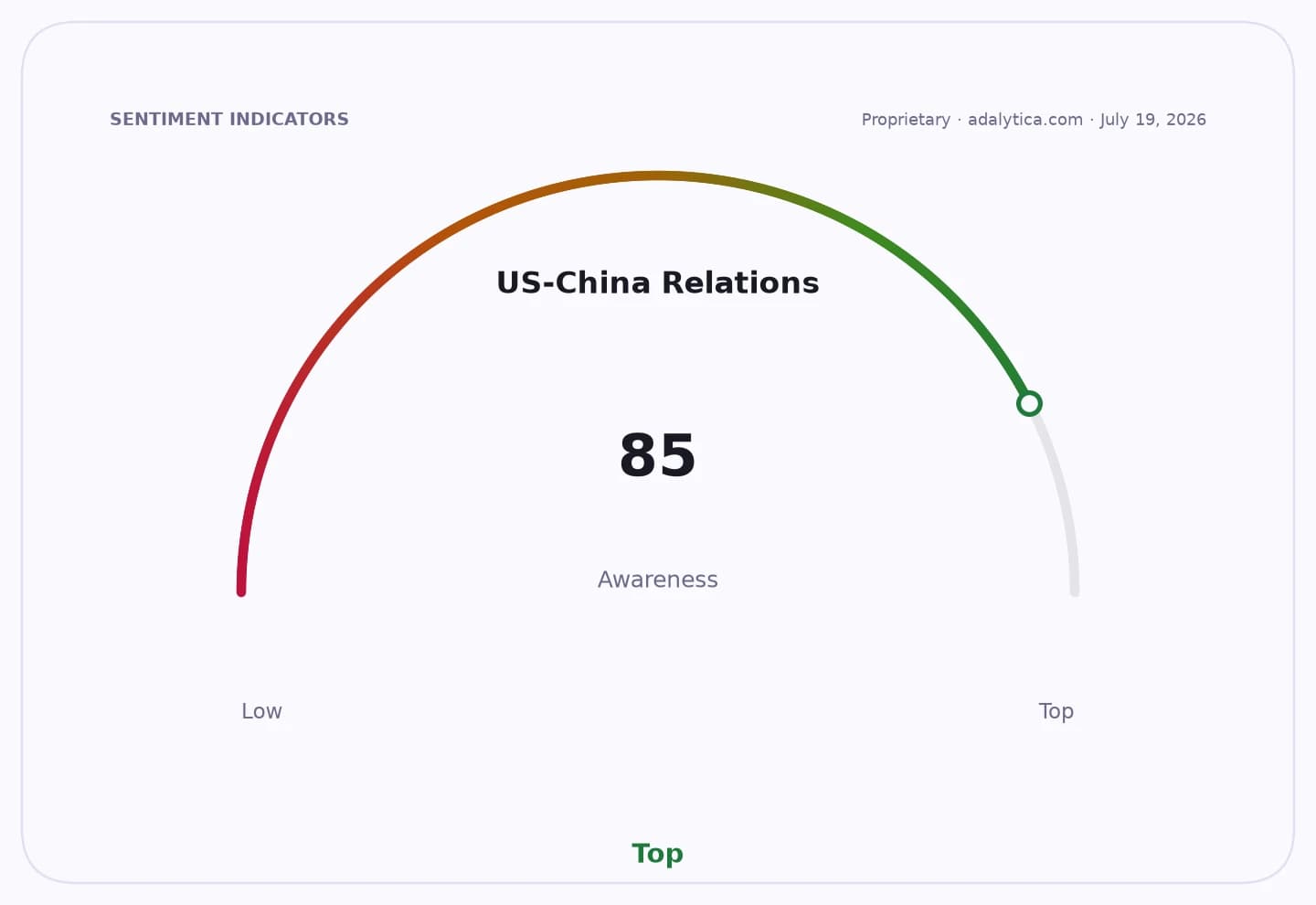
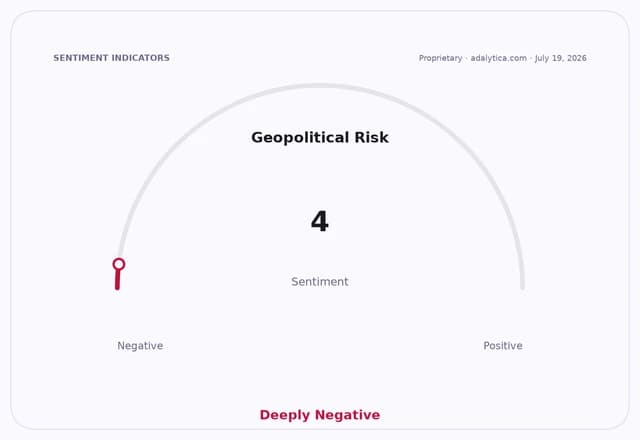
Sentiment IndicatorsⓘProprietary · adalytica.com · July 19, 2026
This is a snapshot — live sentiment, awareness and momentum for 130+ markets update continuously in the dashboard.Open AlphaPulse
The market response in Taiwan Semiconductor Manufacturing Co underscores how quickly geopolitical risk can be transmitted into valuations. TSMC shares fell to $398.37 on July 17 from $451.79 on July 6, a drop of nearly 12% in less than two weeks. The stock has slipped below its 50-day moving average of $425.19 and, at a relative strength index of 39.9, has moved into technically weaker territory after a long rally that had carried it well above its 200-day average. That does not by itself signal a fundamental break in the company’s earnings power, but it does show investors are trimming exposure as headline risk rises.
For Taiwan itself, the pressure is more direct. The iShares MSCI Taiwan ETF closed at 86.17, down from 97.35 on July 6, while volume picked up on the latest decline. The ETF is now well below both its 50-day and 200-day moving averages, a sign that broad market confidence in the island’s risk profile is deteriorating. The move fits with the broader Adalytica US-China relations gauge, which shows sentiment in “Fear” territory and a sharp one-day drop, while the global stability measure sits at “Extreme Fear.” In other words, the market is increasingly treating Taiwan not as a distant geopolitical issue but as a pricing input.
US-China Relations vs TSMadalytica.com
Explore this data interactively — full history, time series and cross-market comparisons.Open AlphaPulse
Economically, a blockade would be less catastrophic than a full military assault, but it could still be severe. Taiwan’s export model depends on open sea lanes, uninterrupted power, and logistics links with the mainland, the U.S. and the rest of Asia. A quarantine or blockade could choke shipments, disrupt chip output, and force multinational manufacturers to activate contingency plans. Even a temporary interruption at TSMC would ripple through smartphones, data centers, autos and defense systems worldwide, because the company sits at the center of advanced semiconductor supply.
That is why investors are watching not just military rhetoric but the diplomatic and economic pressure campaign around Taiwan. The news that Papua New Guinea has closed its office in Taiwan, while symbolic on its own, fits Beijing’s broader effort to narrow Taiwan’s international space and normalize the idea that Taiwan can be isolated without a formal annexation move. Each diplomatic loss may look marginal, but together they reinforce China’s leverage and complicate the calculus for allies and companies trying to map escalation risks.
The bull case for markets is that China remains deterred by the enormous economic cost of any blockade, which would invite sanctions, export controls, and severe blowback from the United States, Japan and Europe. Beijing also depends on stable trade and access to advanced technology, so a blockade would be a high-risk tool even by coercive diplomacy standards. The bear case is that Beijing may believe incremental pressure can be calibrated to stay below the level that triggers full military intervention, while still weakening Taiwan’s economy and testing allied resolve.
For investors, the important point is that the market is no longer pricing Taiwan risk as a tail event with only military dimensions. A blockade scenario would hit revenues, shipping routes, insurance premia, currency stability and capex plans long before any long-term territorial outcome is decided. That makes semiconductor stocks, Asian transport names, defense contractors and regional currencies increasingly sensitive to every sign of escalation in the Strait.
What to watch next is whether China intensifies non-military pressure around Taiwan, whether Washington responds with clearer deterrent messaging, and whether the recent slump in TSMC and Taiwan equities broadens into a sustained de-risking across Asia. The nearer the market gets to treating 2028 as a plausible stress date, the more this becomes a structural valuation issue rather than a temporary geopolitical scare.
| Entity | Gains | Losses |
|---|---|---|
| China | ▲More leverage over Taiwan | ▼Higher sanction risk |
| Taiwan | ▲Deterrence support from allies | ▼Trade and supply-chain pressure |
| TSMC | ▲Strategic importance rises | ▼Valuation de-rating risk |
| Global investors | ▲More clarity on tail risk | ▼Higher volatility and hedging costs |