Taiwan’s latest military assessment underscores the scale of the China risk that investors cannot ignore: Beijing’s armed forces now include about 1.04 million army troops and 474 operational naval vessels, a reminder that the cross-strait standoff remains one of Asia’s biggest geopolitical overhangs.
Taiwan warns on China military risk to markets
Chinese Yuan
That matters economically because Taiwan sits at the center of global electronics supply chains, and any escalation around the Taiwan Strait would quickly spill into trade, shipping, insurance and semiconductor production. For long-term investors, the point is not that war is imminent, but that the region’s risk premium stays elevated whenever China demonstrates it can sustain pressure on Taiwan by air, sea and missile forces at scale.
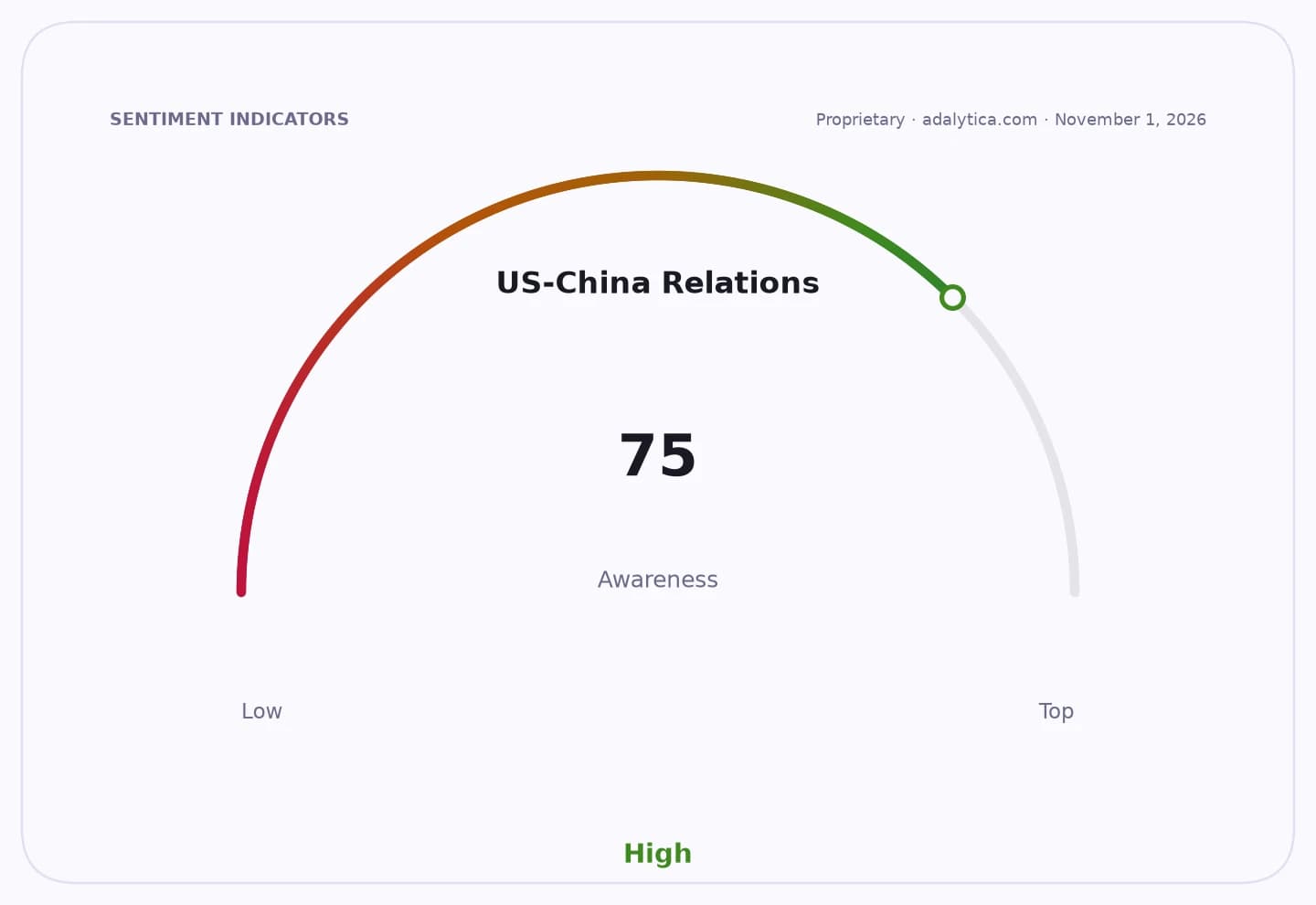
Sentiment Indicators
Taipei said the People’s Liberation Army also fields about 3,600 aircraft and roughly 3,450 missiles, including conventional ballistic weapons and strategic systems, while China’s defense budget rose 7% this year to 1.91 trillion yuan, or about 405 billion yuan. The numbers help explain why Taiwan is spending so much time and money on readiness, even if military size alone does not determine battlefield outcomes.
That last point is important for investors as well. One scholar cited by Taiwan’s defense ministry argued that equipment counts do not automatically translate into invasion success, especially if not all of that hardware can be deployed effectively across the strait. In other words, the headline figures are a measure of China’s capability and intent, not a forecast of immediate conflict.
Chinese Yuan — 30-day sentimentadalytica.com
Explore this data interactively — full history, time series and cross-market comparisons.
Still, the operational picture is hard to dismiss. Taiwan said it detected 22 Chinese military aircraft, seven warships and five government vessels around the island in a single 24-hour period, including 14 aircraft crossing the median line of the Taiwan Strait. That kind of persistent activity keeps defense spending, regional security alliances and supply-chain diversification firmly on the investor radar.
For markets, the broader takeaway is straightforward: the more China showcases its military depth, the more companies and investors should think about resilience over concentration. That favors defense-related spending, supply-chain redundancy and geographically diversified portfolios, while keeping a lid on complacency around Asia exposure. For patient investors, Taiwan’s warning is worth watching not as a trading signal, but as a reminder that geopolitical risk in the region is structural and likely to remain so.
| Entity | Gains | Losses |
|---|---|---|
| Taiwan | ▲stronger case for defense readiness | ▼higher security pressure |
| China | ▲deterrence leverage | ▼added scrutiny abroad |
| Defense contractors | ▲more demand for spending | ▼— |
| Global investors | ▲clearer risk pricing | ▼higher geopolitical uncertainty |