Taiwan’s cabinet has allowed China-bound tourism by sea through the outlying islands of Kinmen and Matsu, a small but politically charged easing that could reopen a limited channel for cross-strait travel even as broader relations remain frozen.
Taiwan allows China-bound sea tourism via Kinmen, Matsu

The move matters less for the immediate tourist numbers than for what it says about Taipei’s approach to the mainland: selective de-risking rather than full disengagement. By using Kinmen and Matsu as transit points, the government is preserving room for people-to-people contact and local economic activity without granting Beijing a sweeping policy victory or fully restoring direct mainland tourism.
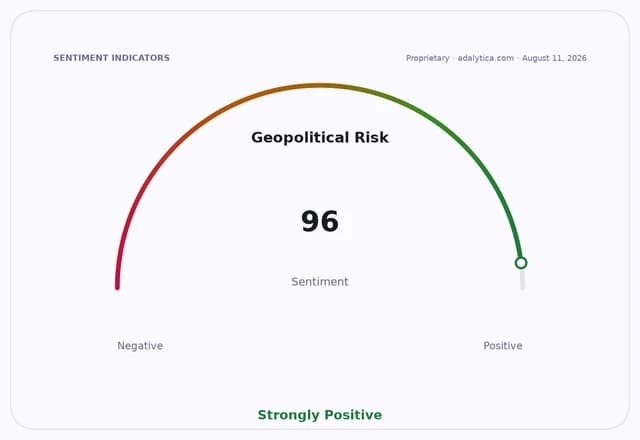
Sentiment IndicatorsⓘProprietary · adalytica.com · August 11, 2026
This is a snapshot — live sentiment, awareness and momentum for 130+ markets update continuously in the dashboard.Open AlphaPulse
That balance has economic implications for the island communities closest to China. Kinmen and Matsu are more exposed than Taiwan’s main island to shifts in cross-strait traffic, and even modest gains in visitor flows can help hotels, ferry operators, restaurants and small retailers that depend on seasonal demand. For Taipei, the policy also serves a domestic purpose by supporting local livelihoods while keeping political control over the pace and scope of reopening.
Markets are likely to view the decision through a cautious lens. Tourism-linked names can get a tactical lift from any sign of easier travel, but investors will not assume a broad demand surge until Beijing reciprocates. The bigger test is whether the change becomes part of a wider normalization of movement, or remains a narrow exception shaped by security concerns and political signaling.
The backdrop is still hostile. Adalytica’s US-China Relations Sentiment gauge is in “Extreme Fear,” underscoring how fragile the geopolitical setting remains even as global stability sentiment has improved. Against that backdrop, any tourism opening is best read as a contained policy adjustment rather than a meaningful thaw.
For investors, the key question is whether Taipei’s incrementalism can generate real earnings support for transport and hospitality companies without exposing them to renewed policy risk. If the opening stays limited to Kinmen and Matsu, the upside will likely be local and modest. If it is expanded, it could become an early marker of a broader cross-strait economic reset.
| Entity | Gains | Losses |
|---|---|---|
| Kinmen and Matsu tourism operators | ▲More visitor traffic | ▼Continued policy uncertainty |
| Taiwan local economies | ▲Higher spending | ▼Limited upside if flows stay narrow |
| Beijing-travel hopefuls | ▲Easier access | ▼No full reopening |
| Taiwan security hawks | ▲Controlled scope | ▼Pressure for broader easing |