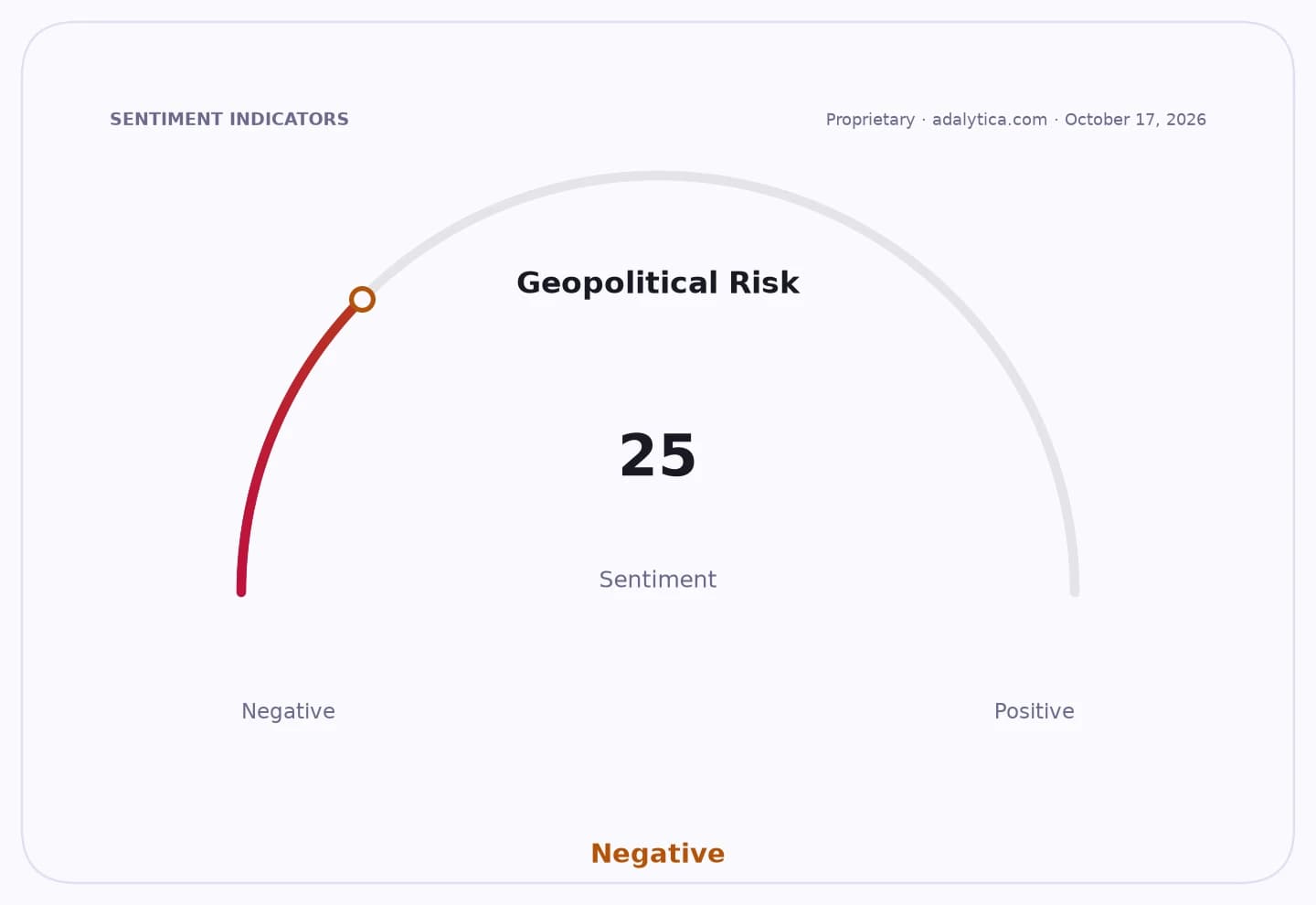
The U.S. midterm debate is being decided less by foreign policy doctrine than by the price Americans pay for food, fuel and rent — and that matters for Taiwan because its security now depends on how Washington links Asia strategy to domestic economic pain.
Taiwan Risk and U.S. Inflation Politics

For Taiwan, the key economic lesson is that support in the United States is not sustained by geopolitical consensus alone. It has to survive inflation, tariff pressure and a voting public that experiences overseas conflict through higher costs at home. That makes the island’s case to Washington more fragile, but also more urgent: if voters see foreign commitments as a driver of price increases, the political coalition behind Taiwan can erode quickly.
Sentiment Indicators
That is why the argument over Taiwan cannot be separated from broader U.S. price dynamics. The context for the election is a still-sensitive consumer environment, with the consumer price index running 40.7% above the 2026 low in the data provided, crude oil having swung back above $105 a barrel in late October after earlier weakness, and unemployment near 4.2%. Even with labor market conditions still relatively firm, households remain acutely exposed to gasoline and grocery costs, making any foreign policy tied to tariffs, sanctions or military escalation an easy target for voter backlash.
The article’s central point is that international strategy now flows through the domestic inflation channel. Tariffs can show up in supermarket prices, sanctions can raise energy costs, and military conflict can move oil markets. For Taiwan, that means the economic case for deterring conflict across the Strait may be as important as the military case. If a Taiwan crisis would disrupt trade, lift shipping costs or unsettle semiconductor supply chains, then the island’s strongest argument in Washington is not only about democracy or deterrence — it is about avoiding another inflation shock that American voters would feel immediately.
US-China Relations — 30-day sentimentadalytica.com
Explore this data interactively — full history, time series and cross-market comparisons.
Markets are already trading those linkages. The U.S. dollar has slipped sharply from earlier highs, while the semiconductor ETF SMH has been volatile, falling to about 508 after a powerful mid-year rally and leaving it well below its 50-day moving average. That kind of price action reflects how sensitive chip stocks remain to any escalation in U.S.-China tensions, especially given the industry's dependence on Taiwan. Adalytica’s U.S.-China Relations Sentiment gauge has also turned sharply higher on the latest snapshot, suggesting investors are again pricing a more constructive but still fragile geopolitical backdrop.
The investor takeaway is straightforward: Taiwan risk is not just a defense issue, it is a macro and supply-chain issue. A deterioration in cross-Strait stability would likely pressure semiconductors, widen volatility across tech, and potentially support oil and defense names while hurting companies exposed to Asian manufacturing and global trade. Conversely, a policy framework that keeps Taiwan secure without stoking inflation would be the most market-friendly outcome, preserving access to advanced chips while avoiding another spike in energy and transport costs.
That is why this election matters beyond Washington. The next U.S. administration will have to defend Taiwan in a way that is legible to households already squeezed by prices. If it cannot make the economic logic clear, support for Taiwan could become collateral damage in domestic politics.
| Entity | Gains | Losses |
|---|---|---|
| Taiwan | ▲Stronger case for U.S. support | ▼Risk if support becomes politically costly |
| U.S. voters | ▲Lower inflation if tensions stay contained | ▼Higher costs if conflict or tariffs escalate |
| Semiconductor stocks | ▲Stability from de-escalation | ▼Volatility from Taiwan shock risk |
| Energy consumers | ▲Relief if war premium stays low | ▼Pain if oil jumps on geopolitical risk |