Tesla beat Wall Street’s third-quarter delivery estimates as a sharp recovery in Europe helped offset fading U.S. tax credits and tougher competition in China, giving investors fresh evidence that the company’s core auto business is stabilizing just as its AI story dominates the valuation.
Tesla Q3 Deliveries Beat Estimates on Europe Rebound

That matters because Tesla is still a car company first, even if the market increasingly prices it like a software-and-robotics platform. Tesla said it delivered 486,532 vehicles in the July-September period, well above the 456,896 analysts expected, and now needs at least 311,448 deliveries in the fourth quarter to avoid a third straight annual decline. The market was quick to notice: the shares rose more than 3% in early trading after having fallen more than 21% this year through the previous close.
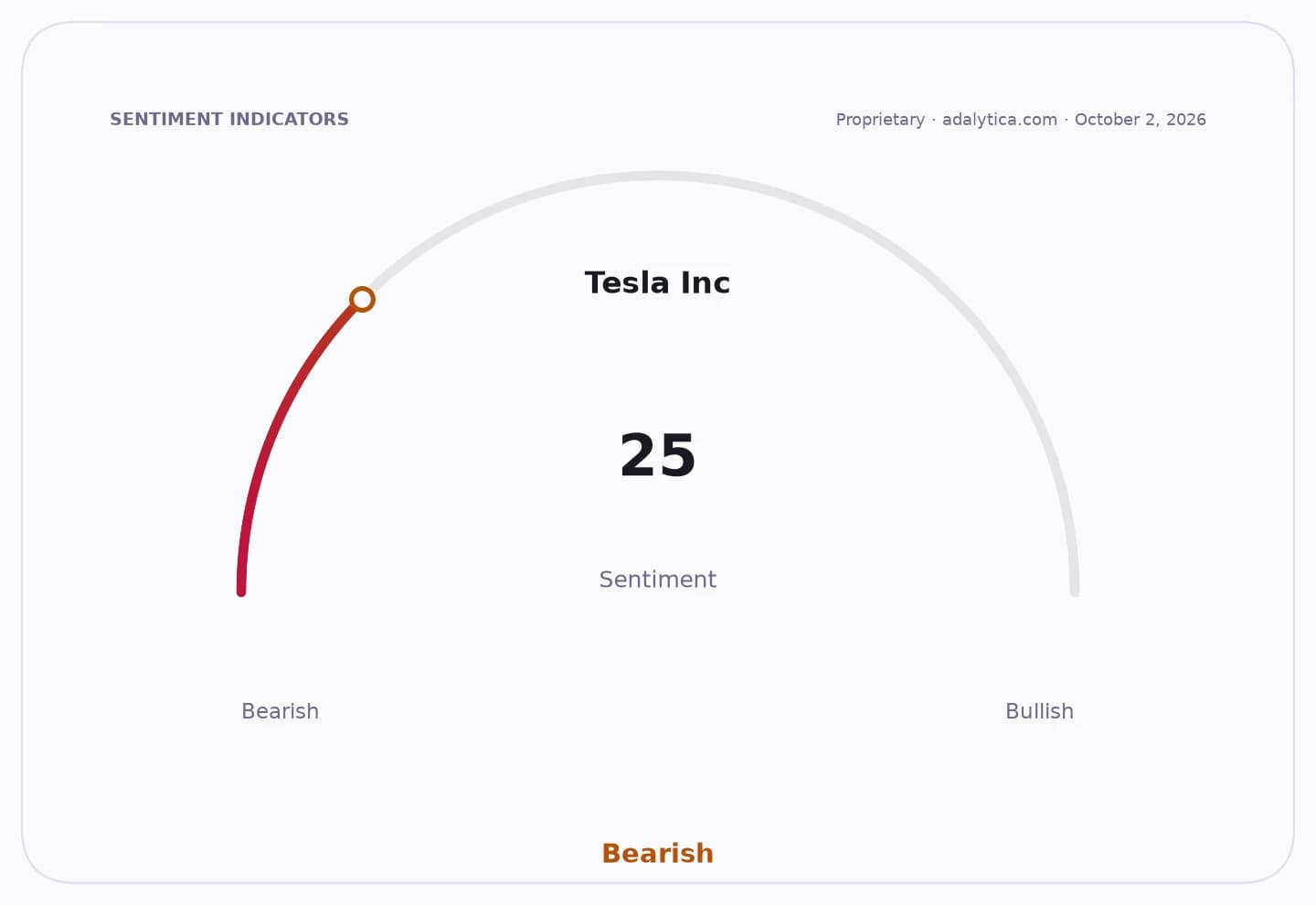
Sentiment IndicatorsⓘProprietary · adalytica.com · October 2, 2026
This is a snapshot — live sentiment, awareness and momentum for 130+ markets update continuously in the dashboard.Open AlphaPulse

The bigger message is that demand is no longer falling off a cliff in Tesla’s most important international market outside China. European registrations rose by about two-thirds through August after last year’s slump, when Musk’s politics alienated some buyers, and the Model Y became France’s best-selling vehicle of any type for the first time a Tesla has topped that ranking. That rebound, along with nearly doubled exports from Shanghai in July and August, suggests Tesla may be entering a more durable demand phase even without the support of U.S. incentives.
For investors, this is the kind of print that can reset expectations fast. Tesla’s nearly $1.4 trillion valuation depends heavily on robotaxis, humanoid robots and full self-driving, but the market still needs proof that the money engine under those ambitions is not deteriorating. A vehicle business that can at least hold steady removes one of the biggest overhangs on the stock and buys time for the AI narrative to mature. It also raises the probability that full-year deliveries can grow again after two straight annual declines, a shift analysts already seem to be pricing in by lifting 2026 forecasts to 1.82 million from 1.65 million in June.
Europe is the key battleground. Tesla’s Full Self-Driving software is now approved in eight countries, and analysts expect that slow rollout to help sales further. That gives Tesla a differentiated product pitch at a time when the broader EV market remains uneven and price competition is still intense. Rivals such as Rivian and Nio continue to trade on fragile demand and heavy discounting, while Tesla is using software, brand and scale to defend share.
There is still plenty to prove. Third-quarter production of 464,391 vehicles came in below estimates, which means inventory and manufacturing execution remain important. And the company’s robotaxi effort is still tiny compared with Alphabet’s Waymo. But the near-term investment case is becoming clearer: if Tesla can keep deliveries growing while expanding its AI optionality, the stock can re-rate from a purely speculative autonomy bet into a cash-generating platform story with multiple catalysts.
The takeaway for investors is straightforward: Tesla’s delivery beat does not just confirm a rebound in Europe, it reinforces the thesis that the market may be underestimating how quickly the core auto business can recover. If that momentum carries into the fourth quarter, the shares could have room for another leg higher as the Street starts treating 2026 growth as the base case again.
| Entity | Gains | Losses |
|---|---|---|
| Tesla | ▲Europe demand rebound; growth outlook improves | ▼Short sellers; bearish delivery calls |
| Tesla shareholders | ▲Better odds of 2026 reacceleration | ▼Investors waiting for cheaper entry |
| European EV buyers | ▲More product choice; FSD rollout | ▼Legacy automakers’ market share |
| Rivian, Nio and peers | ▲— | ▼Relative demand and pricing pressure |