U.S. Treasury bonds are selling off hard enough to force the Federal Reserve back into a credibility test, and that matters because the bond market is now telling policymakers their inflation-fighting reputation still isn’t fully secure.
Treasury yields hit 4.68% as TLT falls to $82.25

The 10-year Treasury yield, the benchmark that shapes borrowing costs across the economy, was at 4.66% in the latest forecast, after touching 4.68% on July 30. That is miles above the 0.73% trough seen in March 2020 and well above the Fed’s easier-money era, when investors were willing to price in ultra-low rates for years. The 2-year/10-year yield spread was still positive at 0.47 percentage point, suggesting the market has backed away from recession panic and is instead demanding a higher term premium to lend to Washington for a decade.
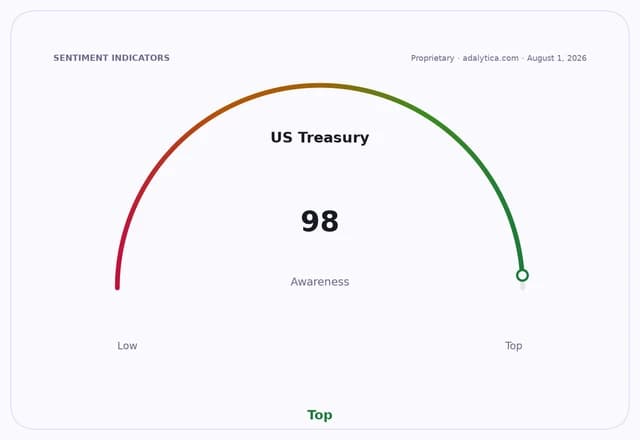
Sentiment IndicatorsⓘProprietary · adalytica.com · August 1, 2026
This is a snapshot — live sentiment, awareness and momentum for 130+ markets update continuously in the dashboard.Open AlphaPulse

That shift is important for the real economy. Higher long-term yields feed directly into mortgages, corporate debt, auto loans and valuation models, making it more expensive to finance everything from factory expansion to stock buybacks. It also changes the conversation inside the Fed: if bond investors are pushing yields higher even as inflation remains sticky, policymakers have less room to sound casual about easing and more reason to emphasize that rates may need to stay restrictive longer.
The bond market has already started voting with its feet. TLT, the iShares 20+ Year Treasury Bond ETF, fell to $82.25 on July 31 from $84.24 three days earlier, while the 10-year Treasury futures contract slid to 108.31 from 110.78 over the same stretch. Technical indicators also point to pressure: TLT is trading below its 50-day moving average of 84.78 and its 200-day average of 85.87, while its relative strength index is in the low 30s, a sign the selloff has been intense. In other words, this is not just a one-day wobble; it is a repricing of duration risk.
DGS10 vs T10Y2Y — macro contextadalytica.com
Explore this data interactively — full history, time series and cross-market comparisons.Open AlphaPulse
The inflation backdrop explains why. The consumer price index has climbed to 332.568 in June from 332.407 in April, underscoring that price pressures have not disappeared. Even with the Fed no longer hiking aggressively, investors are still wary that tariffs, services inflation or a stronger economy could keep yields elevated. That is why the bond market is forcing the central bank to defend its inflation credibility rather than simply announce victory.
For investors, the message is straightforward. A sustained move toward 4.5% to 4.7% on the 10-year is a headwind for rate-sensitive sectors, especially utilities, real estate and long-duration growth stocks that depend on cheaper capital. It can also hurt bond funds such as TLT and IEF in the near term. On the other hand, higher yields improve the income available from cash-like and short-duration assets, and they can eventually create better entry points for long-term buyers if the Fed convinces markets inflation is under control.
The bigger story is that Treasury markets are still the world’s referendum on Federal Reserve policy. If yields keep climbing, the Fed may have to talk tougher, stay higher for longer, or both. For long-term investors, that makes discipline more valuable than prediction: own quality, diversify broadly, and be ready to add to bonds only when the market has done the work of resetting expectations.
| Entity | Gains | Losses |
|---|---|---|
| Banks and cash savers | ▲Higher lending income, better deposit yields | ▼Bond prices remain weak |
| Treasury bondholders | ▲Short-dated buyers may earn more yield | ▼Long-duration holders see losses |
| Fed credibility | ▲Stronger inflation-fighting stance if it stays firm | ▼Risks looking behind the curve if yields rise more |




