President Donald Trump’s latest comments underscored the biggest investment question in artificial intelligence right now: whether Washington will lean into guardrails that slow deployment or keep the rules loose enough to let spending, earnings and chip demand keep compounding.
Trump AI comments lift Nvidia, Microsoft, Alphabet focus
Artificial Intelligence
Speaking in a way that suggested he sees AI as “almost completely good, but has some bad elements,” Trump signaled support for caution without embracing the kind of heavy-handed regulation that could choke off one of the most important growth engines in the market. For investors, that matters because AI is no longer a niche technology story — it has become a capital-allocation race shaping everything from data-center construction to semiconductor orders and cloud margins.
Sentiment Indicators
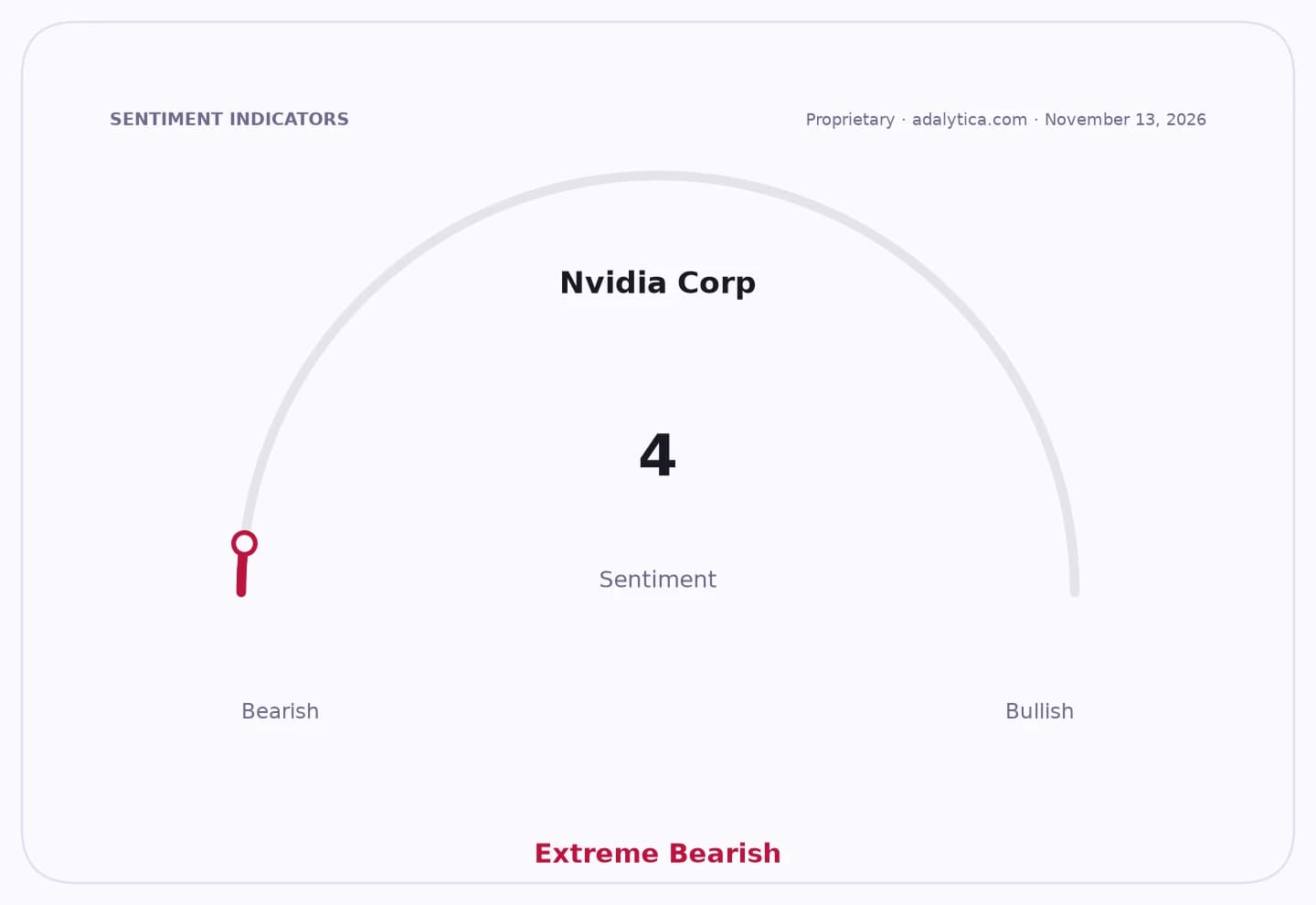
That’s why the stakes are so high for Nvidia, Microsoft and Alphabet’s Google. These are the companies most directly exposed to both the upside of AI adoption and the risk that policymakers decide to slow it down. Nvidia, the market’s bellwether for AI infrastructure, has seen its shares swing violently in recent weeks and was last trading at $147.05, well below its 50-day moving average of $208.88 and its 200-day average of $203.32. That kind of technical damage reflects more than chart noise; it shows how quickly investor enthusiasm can evaporate when growth expectations run into policy or margin anxiety. Even so, Adalytica’s Nvidia earnings sentiment snapshot still shows “Fear” while awareness remains in “Extreme Greed,” a sign that investors are still intensely focused on the stock even as conviction wobbles.
Microsoft, meanwhile, remains a prime beneficiary of a relatively open AI policy backdrop because it can keep monetizing AI through Azure, Copilot and enterprise software without the threat of abrupt legal constraints. But the stock has also cooled after touching a recent high above $550. It closed at $499.70, just below its 50-day average of $520.09, as the market digested how much AI spending is being pushed ahead of revenue. Alphabet is in a similar position. Google has made AI central to its search and cloud strategy, but it has also warned in filings that evolving data-protection interpretations around the world could raise costs and expose it to more scrutiny. Its shares closed at $273.70, down from the September peak above $350, and remain below the 50-day average of $323.79.
The economic significance is straightforward. AI is a productivity story, a capex story and a supply-chain story all at once. The less aggressive the regulation, the easier it is for hyperscalers, chipmakers and software platforms to keep spending. That supports demand for advanced semiconductors, networking gear, data centers and cloud services. It also helps preserve the pace of investment that has turned AI into one of the market’s most powerful secular themes.
But investors should not confuse lighter regulation with no risk. Trump’s comments come as global debates intensify over autonomous weapons, personal AI agents and data privacy. Governments are still deciding where to draw the line, and that uncertainty is part of the reason AI stocks remain volatile. In a world where policy can change fast, the winners are likely to be companies with the deepest moats, the strongest balance sheets and the ability to absorb compliance costs without losing growth momentum.
For long-term investors, the message is not to trade every headline. It is to recognize that AI remains a multi-year compounding opportunity, even if the path is noisy. If Washington resists broad restrictions, the biggest beneficiaries should remain the firms building the picks and shovels of the AI boom. That makes the policy debate worth watching closely — not because it ends the story, but because it helps determine how fast the story can unfold.
| Entity | Gains | Losses |
|---|---|---|
| Nvidia | ▲Faster AI chip demand | ▼Regulatory slowdowns |
| Microsoft | ▲Cloud and Copilot monetization | ▼Policy uncertainty |
| Alphabet | ▲AI search and cloud growth | ▼Compliance costs |
| AI skeptics/regulators | ▲More leverage for safeguards | ▼Less room to restrict innovation |