President Donald Trump’s attack on communities blocking AI data centers underscores a widening political risk for the infrastructure race that powers artificial intelligence, and it comes as China sees its main rival running into local resistance just as U.S. tech spending stays near record levels.
Trump Criticizes AI Data Center Opposition
The fight matters because data centers are now the physical backbone of AI, cloud computing and digital commerce. If permitting battles, zoning fights and public pushback slow projects, the impact ripples through power demand, construction, chip orders and the long-term return on the hundreds of billions of dollars being deployed by Big Tech.
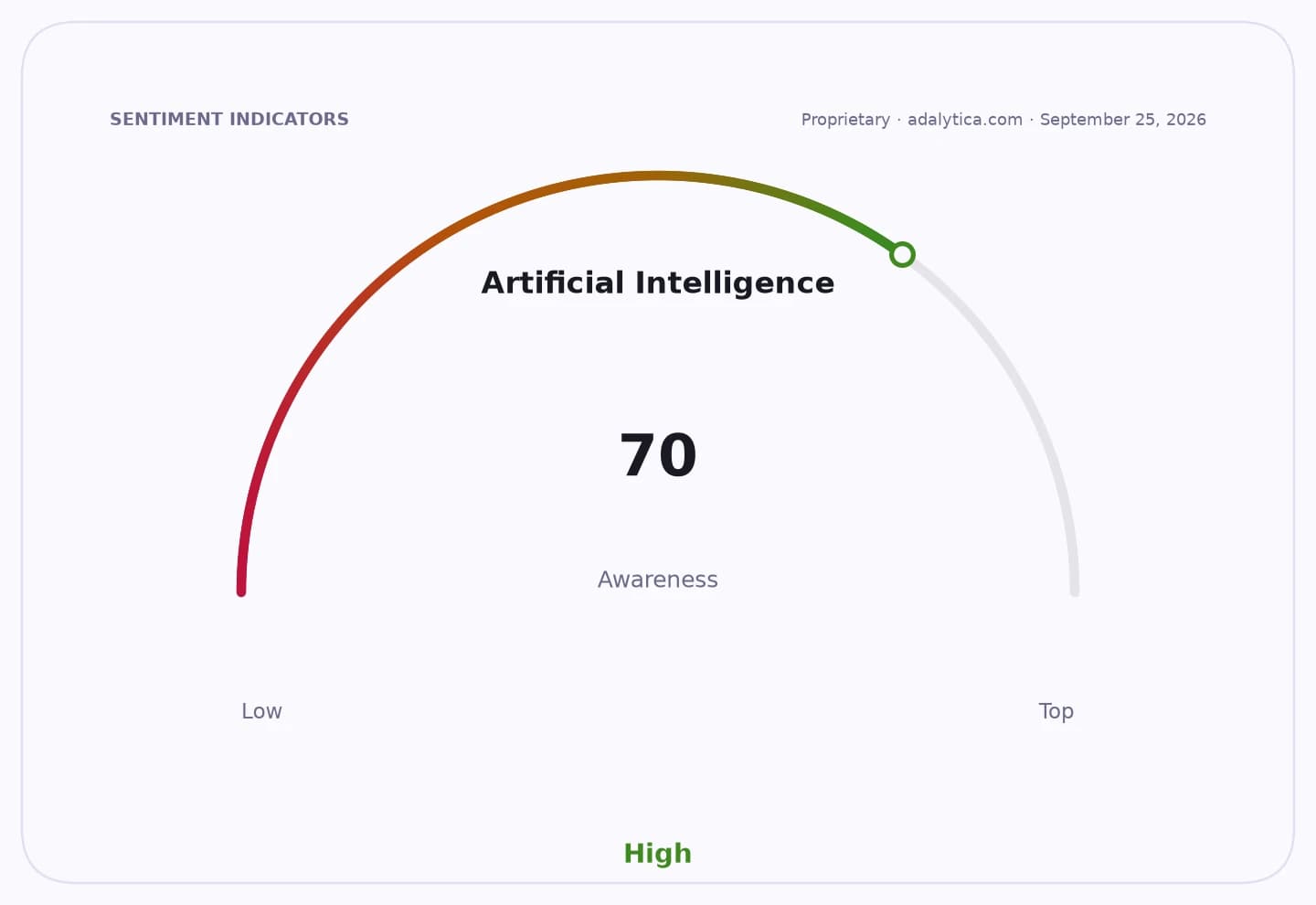
Sentiment IndicatorsⓘProprietary · adalytica.com · August 31, 2026
This is a snapshot — live sentiment, awareness and momentum for 130+ markets update continuously in the dashboard.Open AlphaPulse
That is why the backlash is drawing close attention from investors in Apple, Microsoft and Amazon, along with suppliers tied to the buildout. Microsoft shares ended Aug. 31 at $507.29, far above the 50-day moving average of $432.55, while Apple closed at $316.85 and Amazon at $259.77, both sitting near or below recent momentum levels, showing how quickly sentiment can diverge even as the AI infrastructure theme remains intact.
Adalytica’s U.S.-China Relations Sentiment gauge was at 22, labeled Fear, while China CCP Policy Direction Sentiment sat at 15, or Extreme Fear, suggesting a market backdrop that is already heavily focused on geopolitical friction. For Beijing, any delay in U.S. AI infrastructure is useful: it narrows the speed gap in computing capacity, eases pressure on power and land at home, and increases the odds that U.S. projects face higher costs and slower returns.
The controversy is spreading beyond the U.S. Firmus Bell Bay’s AI data center in Tasmania was approved despite local resistance, and towns in New Jersey have moved to block similar projects. That points to a broader bipartisan unease with Big Tech’s expansion, even as the sector keeps pouring money into infrastructure to support AI models, cloud services and future consumer devices.
For investors, the immediate risk is not that the data center theme disappears, but that it gets more expensive and politically brittle. The winners are likely to be firms with secured power, land and permits; the losers are developers, hyperscalers and equipment suppliers if community opposition starts to lengthen timelines or force design changes.
The next catalysts are local planning decisions, state-level regulation and the pace of capital spending from the largest cloud and AI platforms. If the backlash keeps spreading, China will not need to outbuild the U.S. to gain an edge — it only needs Washington’s infrastructure bottlenecks to widen.
| Entity | Gains | Losses |
|---|---|---|
| China | ▲slower U.S. AI buildout | ▼none materially |
| U.S. hyperscalers | ▲approved projects with strong permits | ▼delayed data center pipelines |
| Local communities / regulators | ▲leverage over development terms | ▼lost investment if bans spread |
| Chip and power suppliers | ▲projects that still get built | ▼orders tied to stalled sites |