Trump’s clash with Republicans over crypto legislation is rattling digital assets again, with Bitcoin and Ethereum sliding as traders price in a slower path to regulatory clarity and more headline risk for the sector.
Trump Crypto Clash Pressures Bitcoin and Ethereum
The move matters because crypto has been trading less like a standalone asset class and more like a high-beta proxy for policy, liquidity and risk appetite. When Washington turns hostile or uncertain, leverage unwinds fast, and the market’s most crowded positions tend to get hit first.
Sentiment IndicatorsⓘProprietary · adalytica.com · July 19, 2026
This is a snapshot — live sentiment, awareness and momentum for 130+ markets update continuously in the dashboard.Open AlphaPulse
Bitcoin was changing hands at $64,462.57 on July 19, after briefly touching $63,899.46 intraday, while Ethereum traded at $1,867.79. Both remain above their 50-day moving averages, but Bitcoin is still well below its 200-day average of $73,043.49, a sign the longer-term trend has not fully recovered from the earlier drawdown.
That weakness lands against a backdrop of sharp swings rather than a clean trend. Bitcoin plunged to $62,702.10 in early February from more than $86,000 in late January, and Ethereum fell to $1,821.68 around the same period from roughly $2,816, showing how quickly policy and macro shocks can wash through the market.
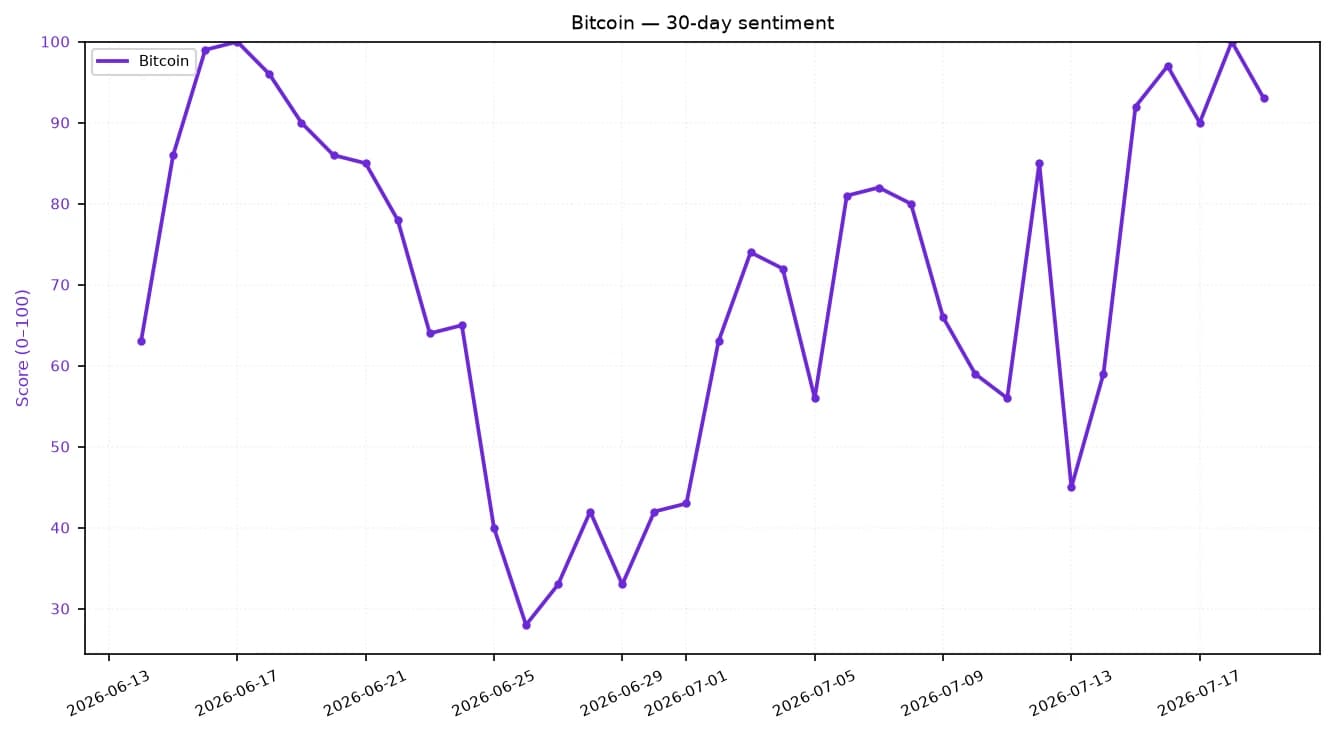
Technical gauges suggest the market is still fragile even after the rebound. Bitcoin’s relative strength index has eased to 54.1 from overheated levels, while Adalytica’s Bitcoin Fear & Greed Index remains at 93, in “Extreme Greed,” alongside “Extreme Fear” awareness, a combination that often leaves crowded longs vulnerable to a fast correction.
The policy overhang is what investors are watching most closely. Trump’s objections to crypto-related provisions have complicated the Clarity Act debate, and that uncertainty is feeding into broader concerns that Washington could slow or reshape the rules that would govern trading platforms, token issuance and market structure.
That matters beyond Bitcoin and Ether. A softer crypto tape can pressure exchange operators such as Coinbase, miners including Riot Platforms and Marathon Digital, and companies with large bitcoin treasuries such as Strategy, while also cooling retail risk appetite across memecoins and other speculative tokens.
Macro conditions are not offering much cushion. The 10-year Treasury yield sits around 4.56%, with the federal funds rate expected near 3.63%, a backdrop that keeps the cost of capital elevated and makes non-yielding assets easier to sell when sentiment turns.
For investors, the immediate question is whether the latest decline is just another policy-driven shakeout or the start of a broader de-risking phase. Until lawmakers settle the crypto rules and traders see follow-through buying above Bitcoin’s recent resistance near the mid-$60,000s, volatility is likely to stay elevated.
| Entity | Gains | Losses |
|---|---|---|
| Crypto bears | ▲Faster unwind | ▼Less upside |
| Bitcoin longs | ▲Higher volatility trading | ▼Near-term drawdown risk |
| Coinbase/crypto exchanges | ▲Trading volume spikes | ▼Lower sentiment, fee pressure |
| Regulators/hawks | ▲More leverage to push oversight | ▼Less market enthusiasm |