President Donald Trump’s accusation that Democrats are threatening the attorney general and other officials with dismissal underscores a widening institutional fight in Washington that could shape policy execution, cabinet stability and market confidence in the Trump administration.
Trump Democrats Clash Over Justice Department
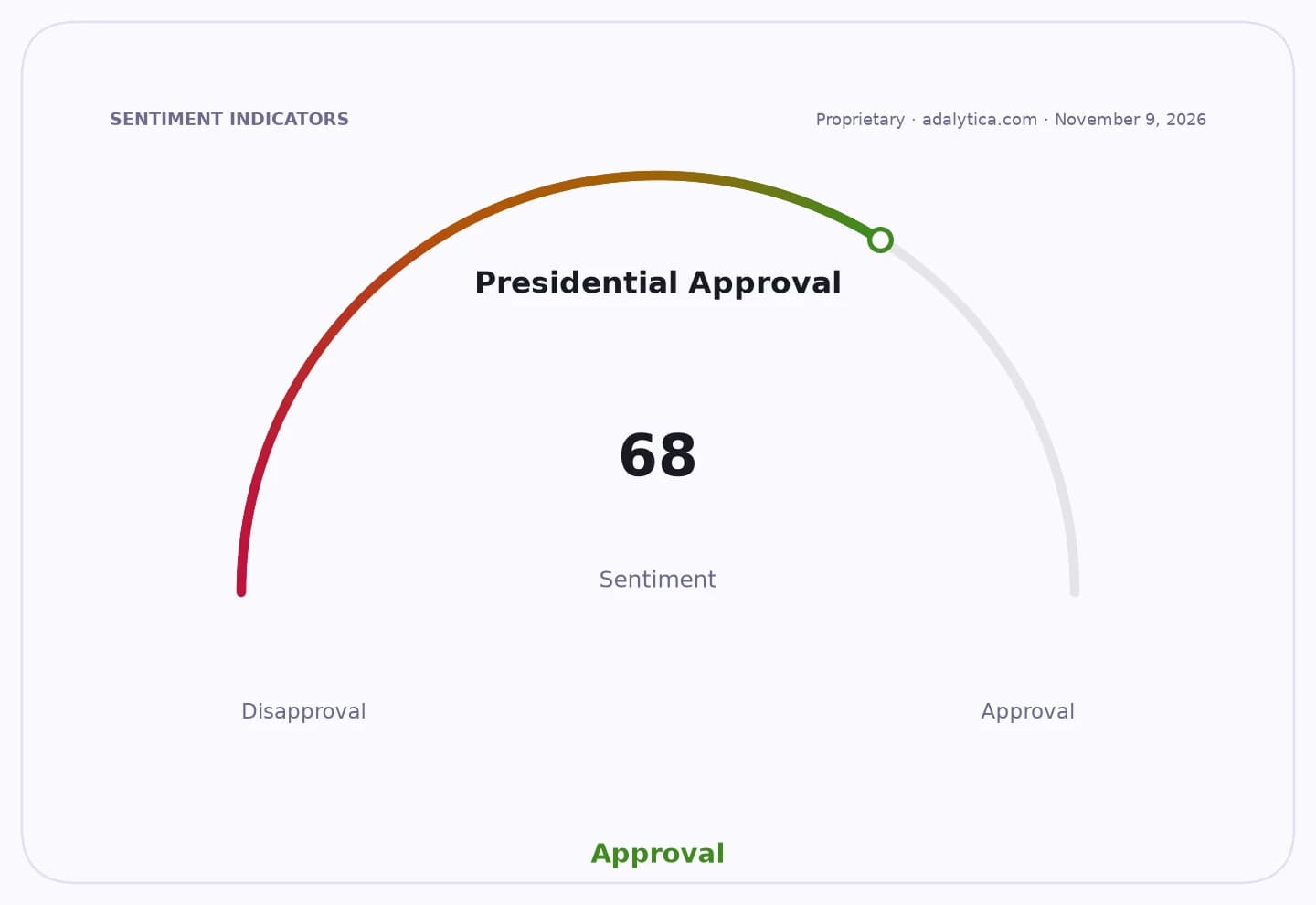
The remarks, framing the dispute as “blackmail at the highest levels,” add to a political environment already marked by elevated fear in U.S. presidential approval sentiment, which Adalytica’s US-PAPR gauge puts at 18, down 61 points over the past week and 36 points over the past month. For investors, that matters because political volatility is no longer just a polling story: it can affect the durability of policy priorities, the pace of regulatory decisions and the premium markets assign to U.S. governance risk.
Sentiment Indicators
At the same time, Adalytica’s White House policy-direction sentiment remains relatively firm at 75, even after slipping 7 points on the day. That gap between policy optimism and approval fear suggests the market is still willing to price in an aggressive policy agenda, but sees rising execution risk. In practical terms, that can leave sectors exposed to sudden shifts in enforcement, tariffs, taxes or spending decisions more vulnerable to headline-driven repricing.
The broader backdrop is one of weakening confidence in political stability. Global stability sentiment has fallen sharply to 43 from 73 a day earlier, with awareness of risk in “extreme fear” territory. Against that setting, the Trump-Democrat confrontation around the Justice Department is more than partisan rhetoric. It reinforces concerns that legal and administrative battles could consume political capital just as the administration needs continuity to deliver on its agenda.
For markets, the immediate question is whether this is a rhetorical escalation or a sign of more serious institutional turnover. A cabinet or Justice Department shake-up would matter for regulatory enforcement, merger reviews, corporate investigations and the tone of federal oversight. The bull case for investors is that Trump uses the fight to consolidate control and push through a clearer policy line. The bear case is that the conflict deepens paralysis, increases legal uncertainty and raises the odds of abrupt personnel changes that complicate planning for companies and investors.
What to watch next is whether the dispute spills into formal dismissals, public resignations or direct legal action. If it does, the story shifts from political theater to governance risk with real implications for Treasury yields, equities sensitive to regulation and the dollar’s policy premium.
| Entity | Gains | Losses |
|---|---|---|
| Trump White House | ▲Consolidates political control | ▼Faces higher governance risk |
| Democrats | ▲Gain leverage in opposition | ▼Risk being cast as obstructionist |
| Investors | ▲Potential clarity if policy hardens | ▼Higher volatility and legal uncertainty |
| Justice Department | ▲Could see leadership reset | ▼Institutional independence comes under pressure |