President Donald Trump’s 17-minute tirade disputing the election results has turned a disputed vote into a broader political risk event for markets, sharpening doubts about the continuity of U.S. policy and raising the odds of a prolonged institutional fight just as Democrats have won control of both chambers of Congress.
Trump election dispute raises U.S. market uncertainty
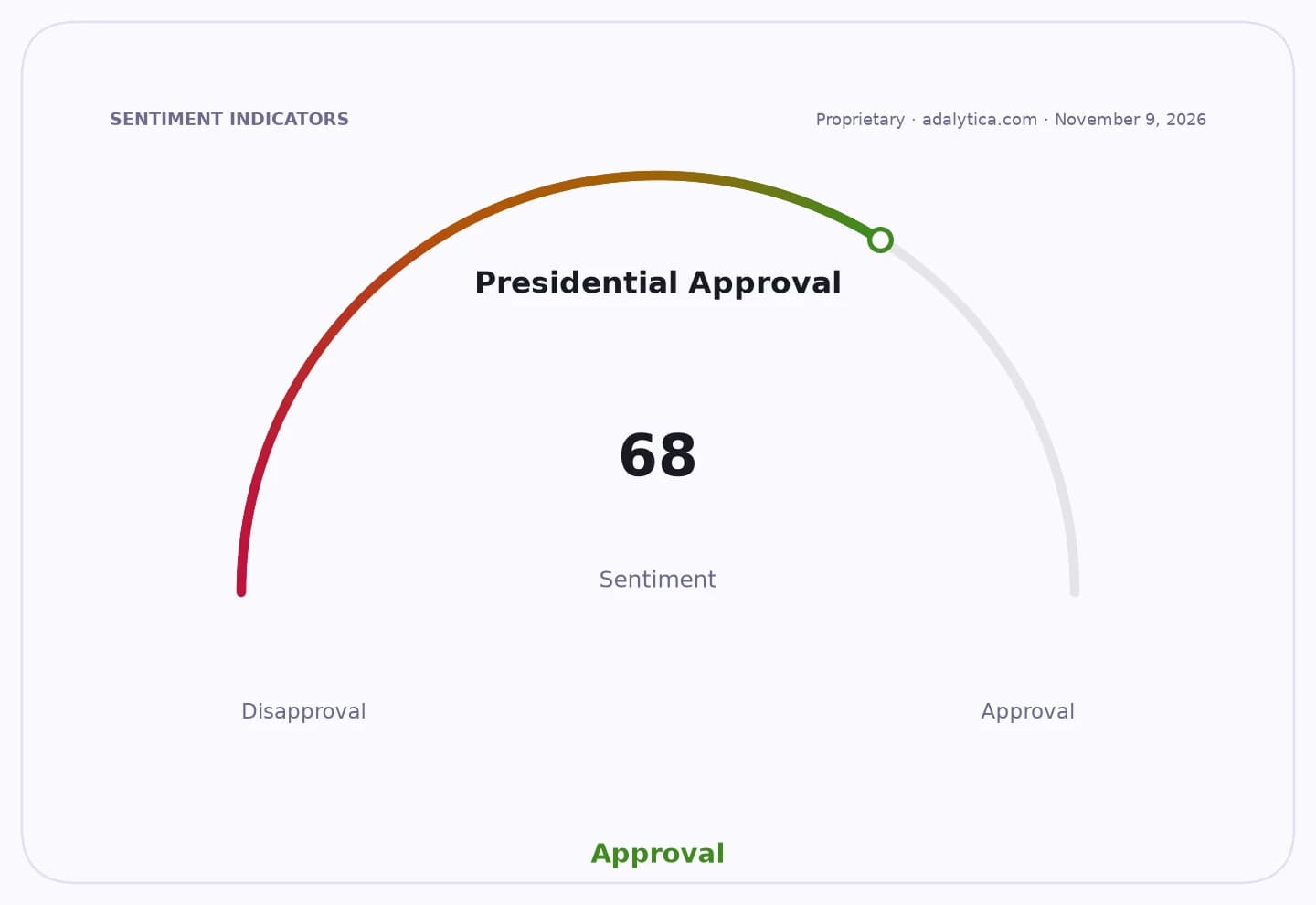
Presidential Approval
The most immediate economic significance is not the speech itself but what it implies: a president openly challenging the legitimacy of the result at a moment when investors were hoping for a clean transition and a clearer policy path. With Congress now shifting to Democratic control, the balance of power in Washington is changing quickly, and the combination of electoral uncertainty and legislative gridlock could delay fiscal decisions, complicate pandemic response measures and cloud the outlook for regulation, taxes and spending.
Sentiment Indicators
That matters for markets because U.S. assets have long traded on the presumption of institutional stability, predictable transfers of power and credible policymaking. When that assumption is questioned, risk premia can rise even without an immediate change in earnings or growth forecasts. Treasury yields, the dollar and equities may not react uniformly, but a rise in political uncertainty tends to support defensive positioning, pressure cyclical and domestically sensitive sectors and keep volatility bids firm until the dispute is resolved.
The data context points to that tension. Adalytica’s U.S. Presidential Approval Sentiment gauge shows fear at 21, down sharply on the day, while its awareness reading sits at 96, indicating the market and public are highly focused on the episode. The White House policy direction gauge remains elevated at 75, suggesting investors still see the administration as active, but that reading has softened from recent highs, consistent with a deterioration in confidence around execution. Global stability sentiment has also fallen to 57 from 86 days earlier, a sign that the political shock is bleeding into broader risk perception.
For investors, the key question is whether this becomes a short-lived post-election dispute or the start of a longer period of constitutional and policy friction. In the bull case, the rhetoric remains largely symbolic and markets quickly refocus on the incoming policy mix, especially if Democrats can use unified control to advance fiscal support and spending. In the bear case, the dispute drags on, undermines confidence in the transition and makes it harder to price the next phase of fiscal and regulatory policy with any conviction.
The S&P 500’s trade signals remain neutral, but awareness is still in extreme-greed territory, a combination that suggests investors have not yet fully de-risked into the political noise. That leaves room for sharper moves if the standoff escalates, particularly in sectors sensitive to government spending, healthcare, defense, financial regulation and the dollar. For now, Trump’s outburst is less about one speech than about the market cost of contested legitimacy in Washington.
| Entity | Gains | Losses |
|---|---|---|
| Democrats | ▲Control of Congress | ▼Less room for compromise |
| Trump and allies | ▲Mobilize base support | ▼Credibility and transition control |
| Equities with policy clarity | ▲Faster resolution of uncertainty | ▼Higher volatility and risk premium |
| Defensive assets | ▲Safe-haven demand | ▼Cyclical and domestically sensitive sectors |