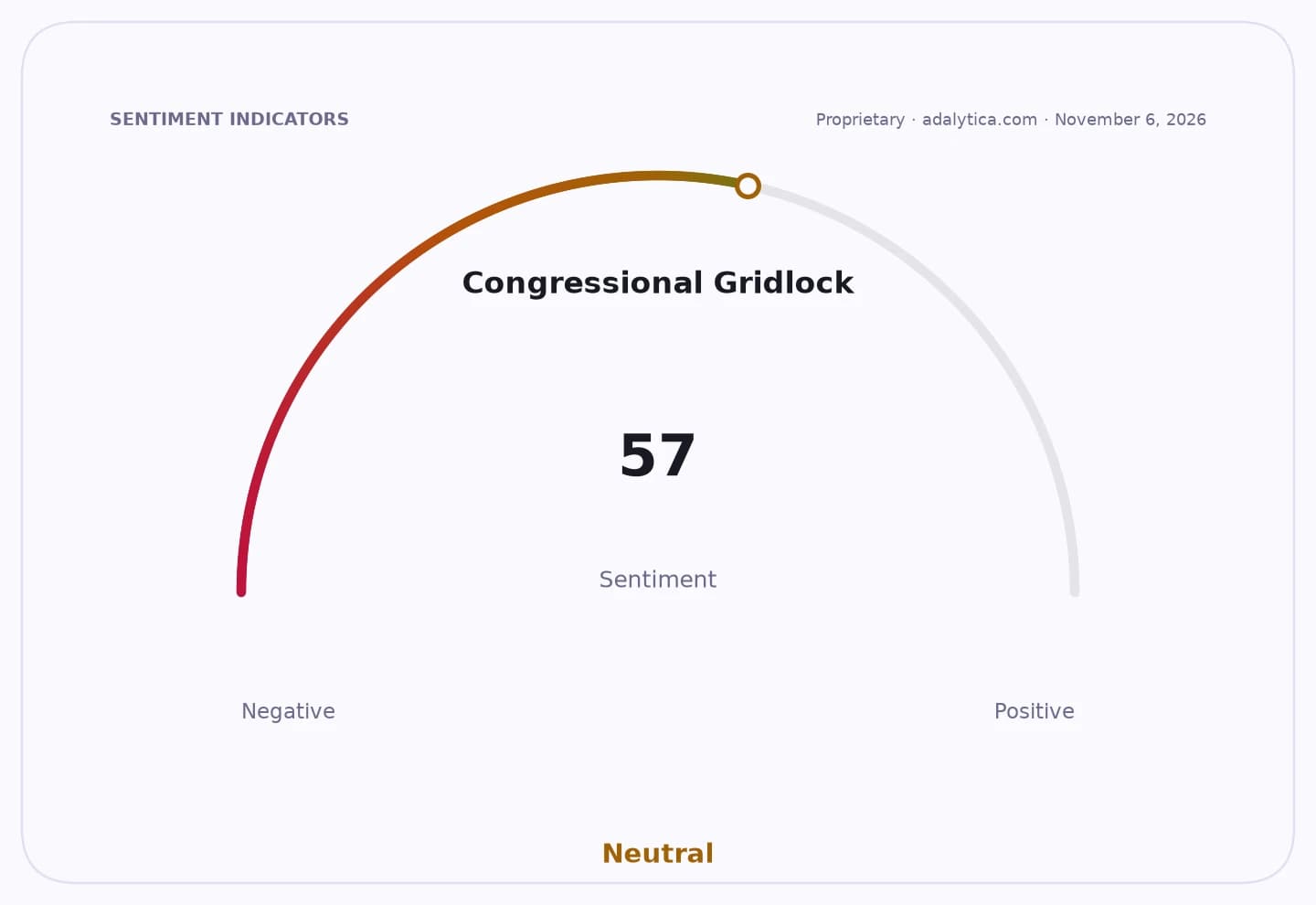
Donald Trump’s acknowledgment that Republicans face a hard fight in Tuesday’s midterm elections underscores a pivotal risk for U.S. policy: whether the White House keeps control of Congress or is forced into divided government that could stall spending bills, tax priorities and the rest of the president’s domestic agenda.
Trump midterm comments highlight Congress risk

The president cast the vote as “the most important midterm election” of his life, a phrase that reflects more than campaign rhetoric. Midterms often punish the party in power, and the historical pattern is especially relevant here: since 1934, the president’s party has usually lost House seats, while Senate control often comes down to a handful of races. For investors, that means the election is less about ideology than about the probability of legislative gridlock, the pace of fiscal decision-making and the durability of policy support for sectors exposed to Washington.
Sentiment Indicators
Trump’s comments that he could become a “veto guy” if Democrats win both chambers highlight the binary market setup. A Republican sweep would keep the administration’s ability to pass spending and policy measures largely intact, supporting the status quo for defense, energy, tariffs and tax policy. A Democratic House, and especially a Democratic Congress, would raise the odds of confrontation over funding, investigations and the next round of domestic priorities, even if compromise remains possible later. That makes the election a direct input into fiscal execution and the timing of government shutdown risks.
The arithmetic favors a close result. Democrats are seen as having a realistic path to retaking the House, where Republicans hold only a narrow 218-214 advantage, with additional seats vacant or held by an independent. Cook Political Report’s classifications suggest the chamber is on a knife edge. In the Senate, Republicans’ 53-45 edge gives them more room, but Democrats would need only a net gain of four seats to take control, and several battlegrounds in states such as Alaska, Iowa, Kansas, Ohio and Texas are rated competitive.
Market sentiment data from Adalytica points to elevated attention around the vote, with U.S. presidential approval awareness near an extreme level and broad U.S. equity trade signals still in neutral territory. That combination suggests investors are watching for policy direction but have not yet positioned for a decisive macro regime shift. The broader global stability gauge is also elevated, reinforcing the sense that election outcomes are being weighed alongside other political and geopolitical risks rather than in isolation.
For equities, the main issue is not who wins every race, but whether the result unlocks or constrains the next phase of Washington’s agenda. Republican control would likely preserve policy continuity, while a split Congress could increase volatility in budgeting, regulation and sector-specific legislation. The closer the race, the more markets may price in delay rather than direction — especially for industries sensitive to federal spending, defense procurement, healthcare reimbursement and energy permitting.
What happens after Election Day will matter as much as the result itself. If neither party secures clear control, Washington could drift into a period of negotiation punctuated by veto threats and short-term funding fights. If one party wins decisively, investors will have a clearer read on the legislative path into 2027. Either way, Trump’s framing of the vote as existential is a reminder that midterms are not just a political test; they are a test of how much policy can move through Congress in a market that still depends heavily on Washington.
| Entity | Gains | Losses |
|---|---|---|
| Republicans | ▲Retain legislative control | ▼Face loss of House or Senate |
| Democrats | ▲Chance to block agenda | ▼Need gains to control Congress |
| Investors | ▲Clarity on policy path | ▼Higher uncertainty if split Congress |
| Federal policy agenda | ▲Stability under GOP sweep | ▼Gridlock under divided government |