President Donald Trump’s softer line on Russia is rippling through markets because it raises the odds of looser sanctions, cheaper Russian fuel flows and a more volatile geopolitics premium across energy, currencies and bonds.
Trump Russia stance lifts energy and defense trades
That’s the real investment story behind the latest comments and reports that the White House ordered Ukraine to curb Starlink access: the market is not just watching diplomacy, it is pricing the possibility that Washington could ease pressure on Moscow while pressing Kyiv to absorb more battlefield and economic strain. Alvydas Medalinskas’ point that a weak president does not necessarily mean a weak America matters because investors care less about rhetoric than about the machinery of U.S. power — sanctions, military support, energy policy and dollar liquidity — all of which can move asset prices fast when policy turns.
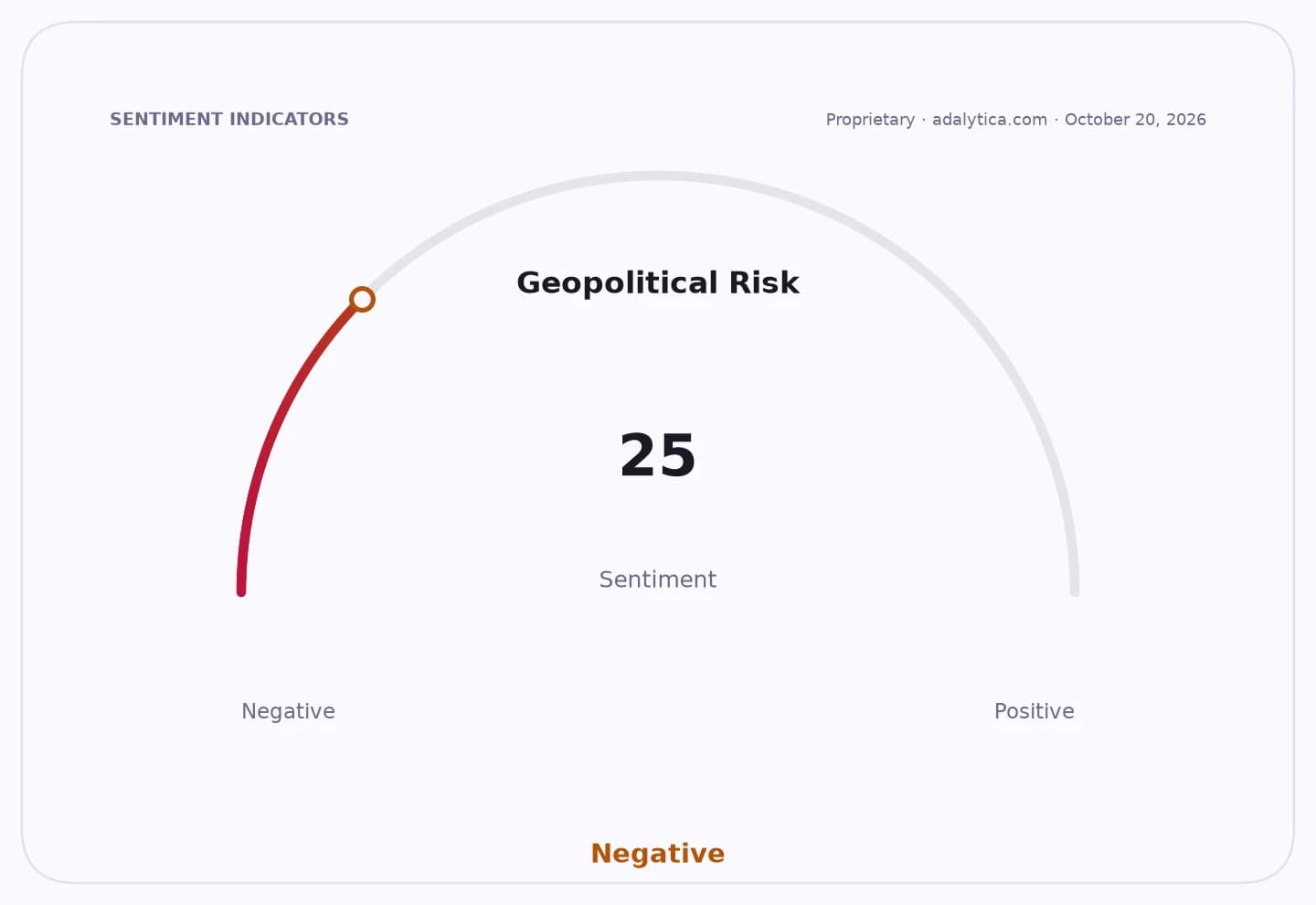
Sentiment IndicatorsⓘProprietary · adalytica.com · October 20, 2026
This is a snapshot — live sentiment, awareness and momentum for 130+ markets update continuously in the dashboard.Open AlphaPulse
Oil has been one of the clearest tells. Brent and WTI have jumped on supply-risk headlines, with WTI recently above $102 a barrel after a sharp run-up, while the next-day move in crude has been driven as much by the Strait of Hormuz risk premium as by U.S. policy signals. If Washington tolerates more Russian exports, or simply signals a willingness to accommodate Moscow on refined products such as diesel, that could eventually cap some of the upside in crude and diesel spreads. But in the near term, the uncertainty itself is bullish for energy volatility and for the producers, shippers and service names that benefit from higher prices and tighter supply chains.
The bigger macro consequence is that a geopolitical shift of this kind can echo through Treasuries and the dollar. The 10-year Treasury yield has held around 5.1%, still near levels that keep pressure on equity valuations and financing costs, while the dollar has stayed firm enough to matter for global risk appetite. If investors conclude the White House is willing to prioritize a narrower bilateral deal over a hard line on Russia, that could raise global risk premia even as it weakens confidence in the consistency of U.S. policy. In that environment, money tends to rotate toward hard assets, defense, energy infrastructure and short-duration cash flows, while long-duration growth and rate-sensitive sectors remain vulnerable.
Equities are already telling that story. The SPY is trading near 768, above its 200-day moving average, but the 50-day average is flattening and momentum has cooled from earlier extremes, suggesting the broader market is still constructive but more sensitive to shocks. That argues for selective positioning rather than broad beta. Defense contractors, LNG infrastructure, pipeline operators, oilfield services and uranium-linked names are better placed than airlines, refiners without feedstock flexibility, and import-heavy consumer companies exposed to higher energy costs.
The market underestimates how quickly foreign policy can become a capital-markets catalyst. A president may look weak in rhetoric, but if he is willing to use U.S. leverage differently — on sanctions, technology access, NATO support or energy flows — the consequences show up immediately in commodities, FX and equity leadership. Investors should treat this as an inflection point in the geopolitics trade: own the beneficiaries of higher volatility, tighter supply and strategic rearmament, and stay cautious on sectors that depend on stable energy prices and a predictable White House.
| Entity | Gains | Losses |
|---|---|---|
| Energy producers | ▲Higher crude and diesel pricing | ▼Fuel-intensive industries |
| Defense contractors | ▲More security spending demand | ▼Peace-sensitive exporters |
| Dollar bears | ▲Geopolitical risk can weaken confidence | ▼U.S. policy stability trade |
| Long-duration equities | ▲— | ▼Rate-sensitive growth stocks |