The next front in the US-China rivalry is supply chain control, and Beijing still holds the stronger hand because it dominates the rare earth materials needed for magnets, missiles and other advanced systems.
TSMC at $406.59 as US-China supply-chain rivalry deepens

That matters far beyond trade politics. Rare earths sit at the center of the push to rearm, electrify and rebuild industrial capacity, which means China’s leverage over those inputs can slow US defense procurement, raise costs for manufacturers and force companies and governments to redesign products around materials that are harder to source outside China. The issue is not just whether Washington can spend more on domestic mining and processing, but whether it can replace an ecosystem China spent decades building.
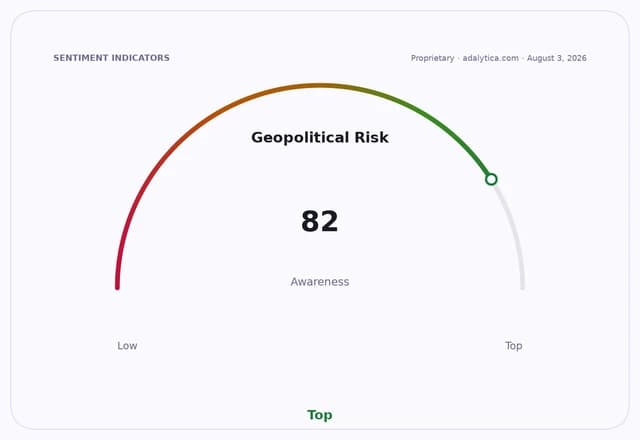
Sentiment IndicatorsⓘProprietary · adalytica.com · August 3, 2026
This is a snapshot — live sentiment, awareness and momentum for 130+ markets update continuously in the dashboard.Open AlphaPulse
Markets are already reflecting that strategic split. Investors have been piling into Taiwan Semiconductor Manufacturing Co. as the company remains the clearest beneficiary of the global AI buildout, but the stock has turned volatile after a sharp run. TSMC closed at $406.59 on Aug. 3, far above its 200-day moving average of $356.56, though still below its 50-day average of $425.16, with a relative strength index of 44.7 suggesting momentum has cooled after earlier overbought readings. The S&P 500, meanwhile, sits at 758.28, near its highs, underscoring how much the broader market still depends on the same technology cycle that Washington wants to secure against geopolitical disruption.
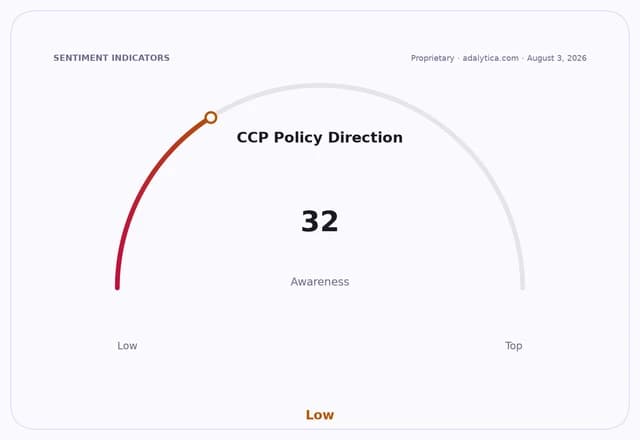
China’s equity gauge tells a different story. The FXI China ETF has climbed back to $36.44, just under its 50-day moving average of $34.22 and slightly below its 200-day average of $36.94, but the bounce has not erased the larger strategic discount investors assign to Chinese assets as relations remain strained. Adalytica’s US-China Relations Sentiment stands at 7, or “Extreme Fear,” while China CCP Policy Direction Sentiment reads 100, or “Extreme Greed,” highlighting a market that sees Beijing as more assertive even as it faces heavier political risk.
The bond market adds another layer. The 10-year US Treasury yield has risen to 4.68%, with a 4.66% forecast for July 31, a level that keeps financing costs elevated for any US industrial push to localize supply chains, build mines and subsidize processing plants. In other words, Washington’s answer to China’s materials dominance is likely to be expensive, slow and politically contentious.
For Beijing, the advantage is structural. China controls much of the refining capacity and downstream know-how that turns mined ore into usable industrial inputs, giving it more control over prices and timelines than the West can easily match. For the US, the bull case is that export controls, subsidies and defense demand eventually create a parallel supply chain. The bear case is that the effort remains fragmented, costly and years behind the military and commercial needs it is meant to solve.
Investors should watch for more US policy moves around critical minerals, defense procurement changes and any escalation in Chinese export controls. The broader thesis is simple: the rivalry is moving from tariffs and chips into materials, and that gives Beijing a leverage point that is harder to legislate away.
| Entity | Gains | Losses |
|---|---|---|
| China | ▲Supply-chain leverage | ▼Pressure for decoupling |
| US defense makers | ▲Incentives for domestic sourcing | ▼Higher input costs |
| Rare earth producers outside China | ▲New investment demand | ▼Slow build-out risk |
| TSMC / AI supply chain | ▲Strategic investor demand | ▼Geopolitical premium risk |