TSMC is still posting record AI-fueled revenue, but Washington’s drive to rebuild U.S. chipmaking is starting to bite into the world’s most important foundry’s margins — a reminder that the semiconductor boom is now colliding with geopolitics and higher costs.
TSMC Faces Margin Pressure Amid AI Boom
For investors, the issue is no longer whether TSMC can sell enough advanced chips. It can. The question is how much profit it can keep as it funds new U.S. capacity, navigates tighter trade policy and absorbs the operating drag that comes with expanding outside Taiwan. That matters because TSMC sits at the center of the AI supply chain for Nvidia, Apple and the rest of the market’s most valuable tech names.
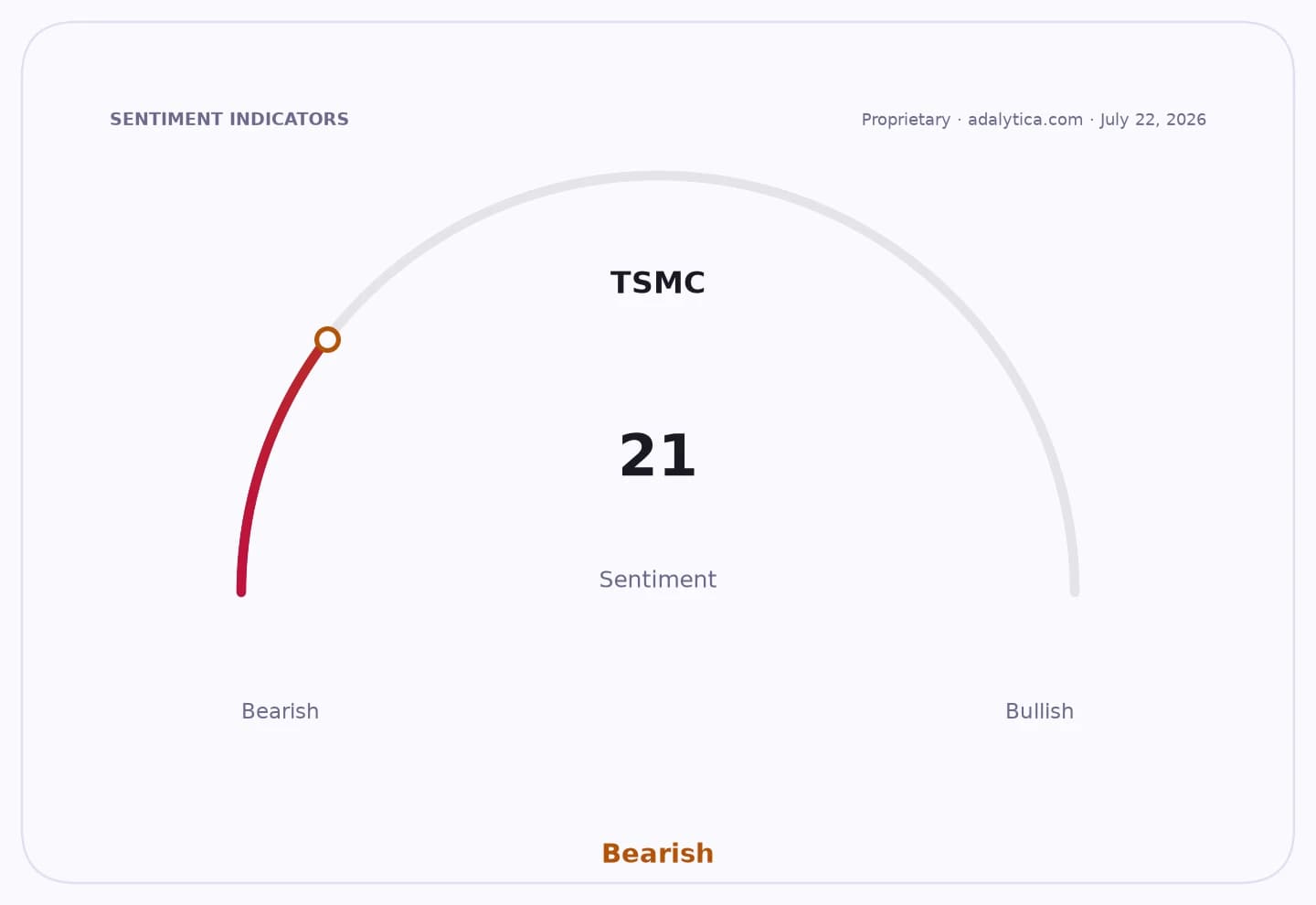
Sentiment IndicatorsⓘProprietary · adalytica.com · July 22, 2026
This is a snapshot — live sentiment, awareness and momentum for 130+ markets update continuously in the dashboard.Open AlphaPulse
TSMC’s June revenue rose 67.9% from a year earlier to NT$442.68 billion, underscoring how the AI buildout continues to fill order books. But the stock has become more volatile around the trade-off between surging demand and margin pressure, with shares closing at $424.61 on July 21 after briefly trading as high as $477.57 at the end of June, while the 50-day moving average has flattened near $425. Technical readings also show weakening momentum, with RSI at 32.3 and MACD below its signal line.
The market backdrop is still supportive for semiconductors. Nvidia, the clearest beneficiary of AI spending, closed at $207.29 on July 21, just under its 50-day moving average, after regaining traction from a June pullback. Adalytica’s NVIDIA Earnings Sentiment gauge sits at 95, or “Extreme Greed,” reflecting investors’ continuing appetite for AI exposure even after recent volatility.
But TSMC does not enjoy the same clean story. Adalytica’s TSMC Earnings Sentiment gauge has dropped to 21, labeled “Fear,” even as awareness remains elevated at 86, suggesting the market is closely focused on policy risk and margin compression rather than growth alone. That split captures the broader investor concern: AI demand is strong, but the economics of supplying it are getting tougher.
The pressure is also showing up in the sector itself. Intel shares jumped as high as $139.63 in late June before sliding to $105.45 on July 21, highlighting how quickly chip stocks are being repriced as investors weigh policy support, factory spending and execution risk. The U.S. Industrial Production index is forecast to edge up to 102.9436 in July, but that macro improvement does little to offset the capital intensity of the chip reshoring campaign.
TSMC remains the clearest winner from AI demand, but it is also becoming a test case for how much margin global chip leaders must surrender to stay aligned with U.S. industrial policy. The next catalyst is likely to be TSMC’s full earnings update, where investors will watch for commentary on U.S. capex, gross margin guidance and whether AI demand is still strong enough to absorb the higher cost of doing business.
| Entity | Gains | Losses |
|---|---|---|
| TSMC | ▲Record AI revenue growth | ▼Margin pressure from U.S. expansion |
| Nvidia | ▲Strong AI chip demand | ▼Near-term volatility in chip valuations |
| U.S. chip policy | ▲More domestic capacity | ▼Higher costs for global foundries |
| Intel | ▲Policy-linked trading interest | ▼Shares remain highly volatile |