China’s pressure campaign around Taiwan is once again putting Taiwan Semiconductor Manufacturing Co. at the center of a geopolitical risk that investors cannot price away, and the market’s recent slide in TSMC and Taiwan-focused assets suggests that concern is reasserting itself.
TSMC Falls as Taiwan Risk Rises

The immediate significance is not just diplomatic theater. Taiwan’s semiconductor industry is embedded in global supply chains for advanced chips, data centers and consumer electronics, so any escalation in the Taiwan Strait carries an economic cost well beyond the island. TSMC is the clearest transmission mechanism: it is the world’s most important contract chipmaker and a linchpin for Nvidia, Apple and other technology groups whose supply continuity depends on Taiwan remaining stable and accessible.
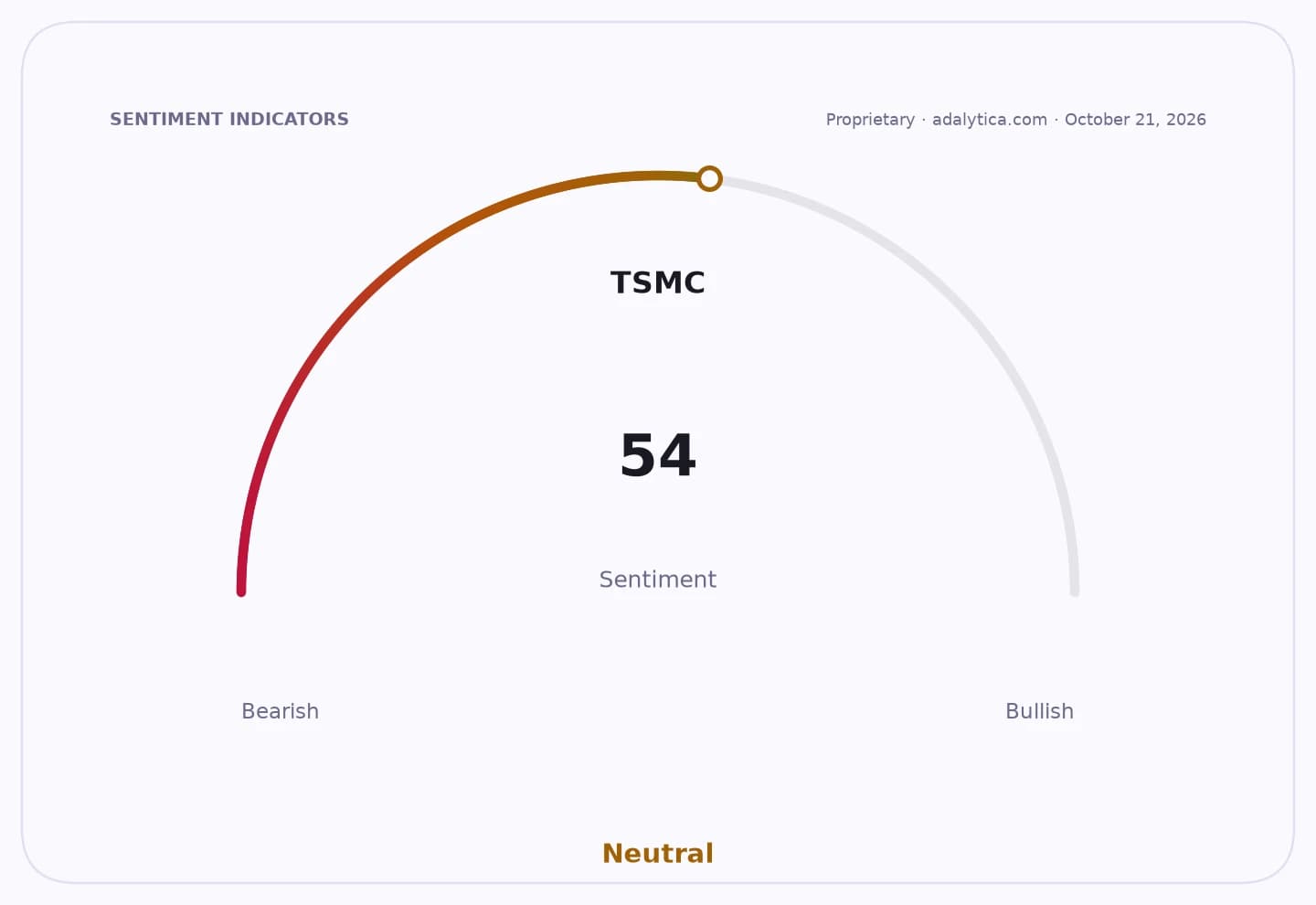
Sentiment Indicators

That risk has become more visible in the market. TSMC shares fell to $406.13 on Oct. 30 from $439.51 two sessions earlier, with trading volume jumping to 21.9 million shares, well above the prior day’s 8.5 million. The stock has also slipped below its 50-day moving average of $434.53, while the relative strength index has dropped to 35.6, a sign that momentum has weakened. Taiwan equity exposure has softened as well: the iShares MSCI Taiwan ETF slipped to $101.11 on Oct. 30 from $108.99 on Oct. 21 and remains below its 50-day average of $110.19.
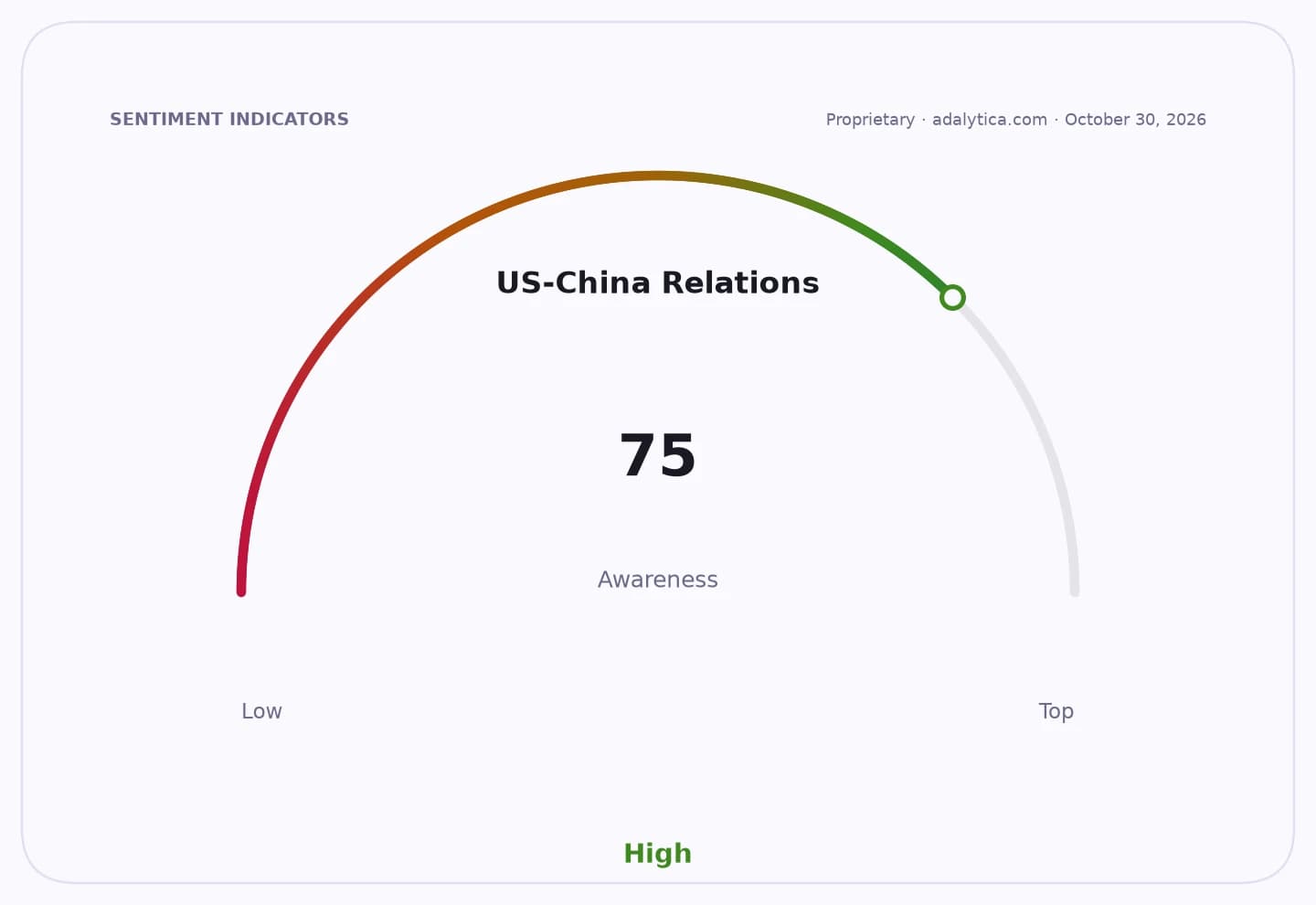
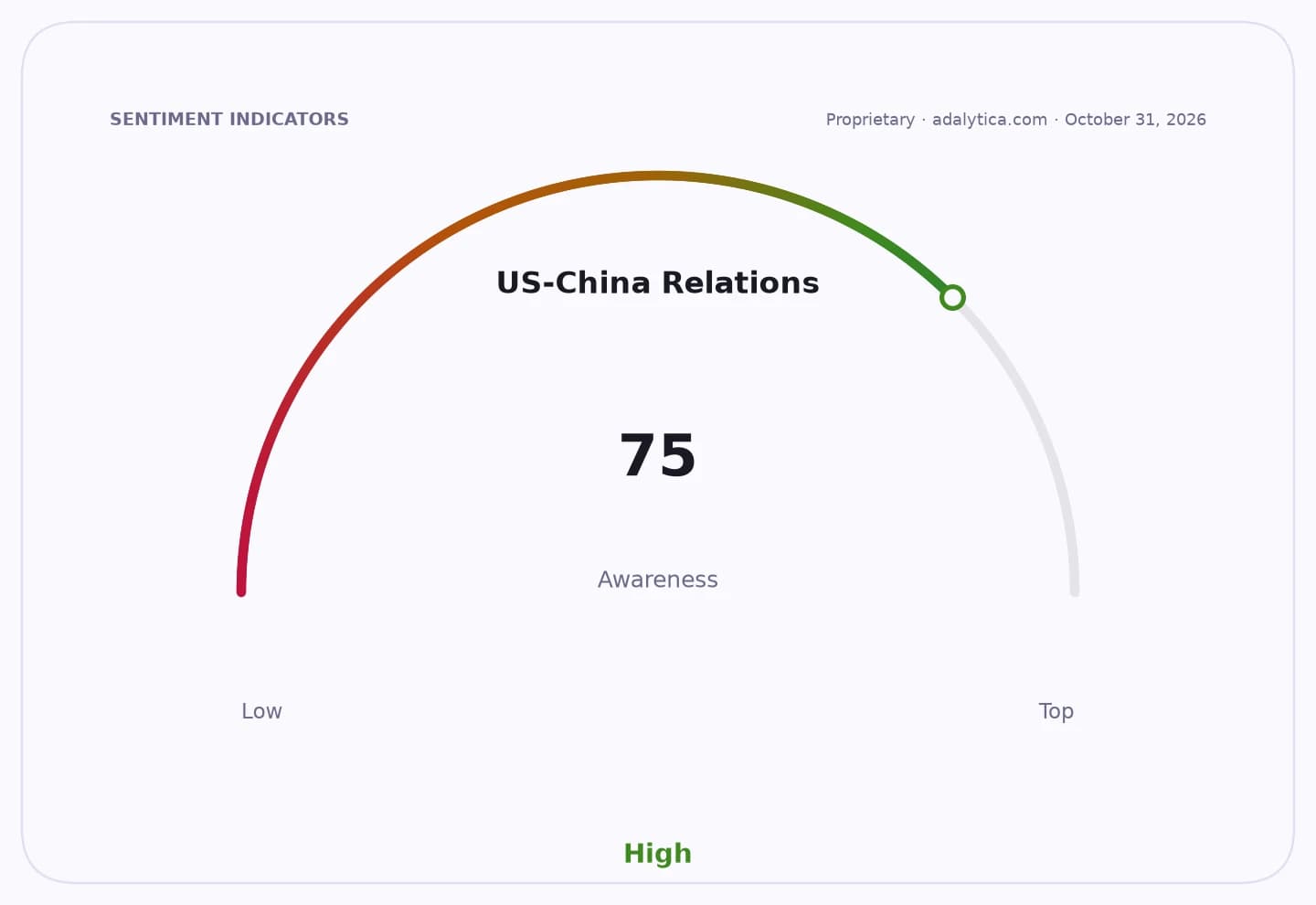
The broader market backdrop reinforces why investors are sensitive to the latest tensions. Sentiment around U.S.-China relations has improved sharply in the short term, but that has not removed the structural premium attached to Taiwan risk. Adalytica’s Global Stability Sentiment gauge is flashing extreme greed, even as awareness of fragility remains near extreme fear, a combination that can amplify abrupt repositioning when geopolitical headlines turn adverse.
US-China Relations vs TSMadalytica.com
Explore this data interactively — full history, time series and cross-market comparisons.
US-China Relations
Economically, the stakes are larger than one company’s share price. Taiwan is a critical node in the semiconductor cycle, and disruptions there would ripple through AI hardware, smartphones, automotive electronics and industrial systems. Even without a physical confrontation, escalatory signaling can affect shipping routes, airline operations, insurance costs, capital allocation and customer sourcing decisions. For the chip sector, that means higher risk premiums and more urgency around diversification, dual sourcing and onshore capacity expansion.
For TSMC, the bull case remains that it is still the indispensable supplier in advanced logic chips, with demand tied to AI and high-performance computing. Its shares are still comfortably above the 200-day moving average of $397.73, showing the longer-term uptrend remains intact. The bear case is that each new round of pressure from Beijing raises the probability of operational disruption, sanctions spillovers or forced strategic shifts that could crimp margins and slow the pace of customer investment.
For investors, the question is no longer whether Taiwan risk exists, but whether it is being adequately compensated in valuations. As long as China keeps raising pressure around the island, TSMC and Taiwan-linked equities are likely to trade not only on earnings and AI demand, but on every sign that the status quo in the strait is becoming more fragile.
| Entity | Gains | Losses |
|---|---|---|
| TSMC | ▲AI demand remains strong | ▼Geopolitical risk premium rises |
| Taiwan equities | ▲Potential policy support | ▼Foreign capital patience weakens |
| China | ▲Leverage over Taipei | ▼Greater scrutiny from investors |
| Global chip buyers | ▲Incentive to diversify supply | ▼Higher supply-chain and insurance risk |