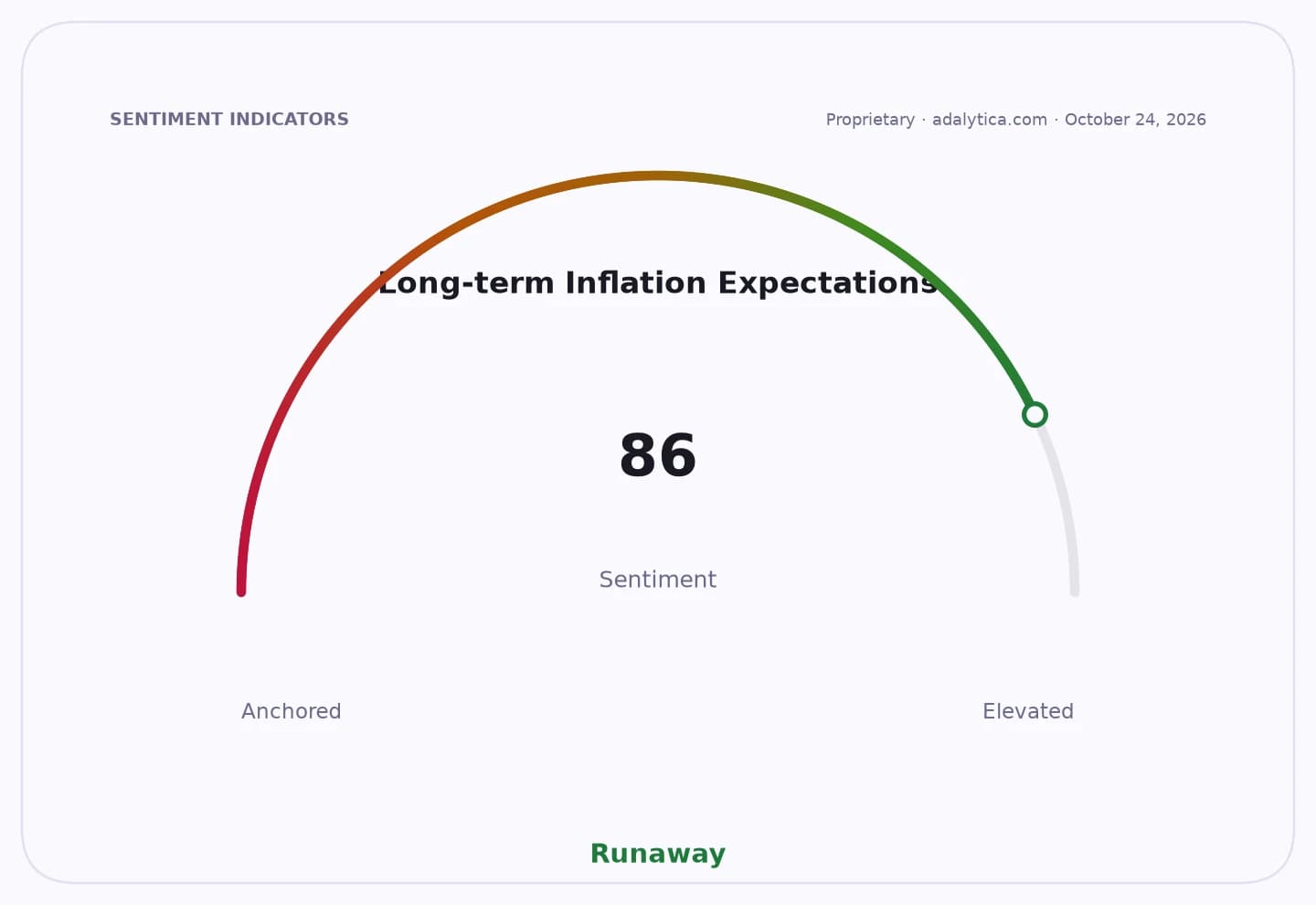
Turkey’s central bank has lifted its year-end 2026 inflation forecast to 29.5%, forcing Ankara to recalculate the wage and pension increases that millions of retirees and public workers will receive and underscoring how persistent inflation continues to outpace income gains.
Turkey raises 2026 inflation forecast to 29.5%
Long-term Inflation Expectations
The revised outlook means SSK and Bağ-Kur retirees are now set for a 9.96% increase, while retired civil servants and active civil servants will get 7.91% before an additional welfare adjustment. The move is significant because it shows the government is still indexing benefits to a price path that remains too hot for retirees to regain lost purchasing power, even after years of repeated adjustments.
Sentiment Indicators
That is the economic problem at the heart of the story: nominal raises are being delivered, but the real income picture remains weak. Inflation on a consumer-price basis is still forecast near 30% at year-end, and core inflation is expected to remain elevated as well. In that environment, pension rises that look sizeable in percentage terms may still leave households struggling with food, rent and utility costs, especially after a long stretch in which retirement income has lagged the cost of living.
For investors, the pension revision matters beyond the social-policy angle because it is another reminder that inflation is still shaping fiscal policy and market pricing in Turkey. Higher public-sector pay and pension obligations can add to budget pressure, even if the increases are partly a mechanical response to inflation rather than a discretionary stimulus. They also feed into expectations for rates, bonds and the lira, since investors will be watching whether the central bank can keep bringing inflation down without allowing real incomes to deteriorate further.
The backdrop in markets reinforces that tension. Long-end U.S. Treasury ETF TLT has been volatile, reflecting shifting rate expectations, while gold ETF GLD has also swung sharply as investors hedge inflation and policy risk. In Turkey’s case, the key question is whether the central bank’s revised forecast proves conservative or whether another round of price pressure forces still larger adjustments later.
The next catalyst is the mid-December inflation release, which will determine the final pension formula and show whether the year-end forecast has enough room to hold. If inflation comes in hotter than expected, retirees could see a bigger nominal raise — but that would likely deepen the argument that Turkey has not yet restored price stability, only recalibrated its compensation for losing it.
| Entity | Gains | Losses |
|---|---|---|
| Turkish retirees | ▲Higher nominal benefits | ▼Real purchasing power still eroded |
| Civil servants | ▲Larger wage increase | ▼Budget constraints and inflation pass-through |
| Turkish government | ▲Short-term social relief | ▼Higher fiscal pressure |
| Inflation fighters | ▲Stronger case for disinflation urgency | ▼More evidence inflation remains sticky |