Credit stress is starting to bleed into stocks, with U.S. high-yield spreads widening, bank shares trading like investors expect more loan losses, and the broader equity market losing some of its recent momentum.
U.S. High-Yield Spread Rises to 2.891%, Banks Lag
The move matters because tighter credit conditions usually hit the economy with a lag. When lenders demand more compensation for risk, borrowing costs rise for weaker companies, refinancing gets harder and profit expectations for banks and cyclical stocks come under pressure.
Sentiment IndicatorsⓘProprietary · adalytica.com · July 30, 2026
This is a snapshot — live sentiment, awareness and momentum for 130+ markets update continuously in the dashboard.Open AlphaPulse

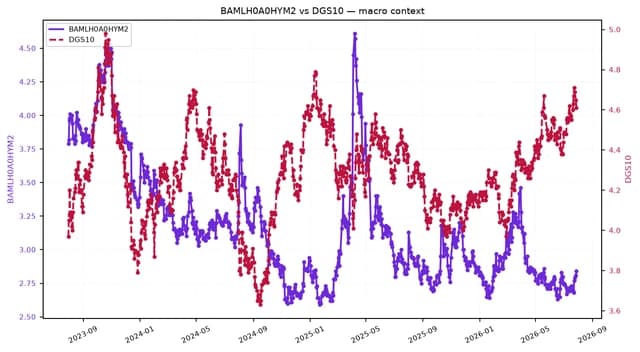
The ICE BofA U.S. High Yield Index Option-Adjusted Spread, a common gauge of junk-bond risk, was at 2.891 percentage points on Thursday, up from 2.81 on July 27 and above the 2.84 reading a day earlier. The spread remains far below the 4.16 peak seen in April 2025, but the recent uptick shows investors are still marking up credit risk even as the Federal Reserve watches a labor market that has cooled only modestly, with the unemployment rate forecast at 4.18% for July.
At the same time, Treasury yields are keeping pressure on financing conditions. The 10-year yield was 4.612% in the latest forecast after closing near 4.61% on July 28, leaving companies facing a higher hurdle rate than during the low-rate era that helped sustain debt-heavy balance sheets.
Bank stocks are reflecting the strain. The Financial Select Sector SPDR Fund, XLF, closed at 56.67 on July 30, up from 56.68 the prior session but still short of the recent 57.6 peak, while its 50-day moving average sits near 53.99 and the 200-day near 52.47. The fund’s RSI reading of 60.1 suggests the group is still firm, but recent price action shows investors are paying close attention to credit quality after a sharp run-up in banks.
The S&P 500 ETF, SPY, also looks more fragile. It closed at 739.1 on July 30 after slipping to 729.46 a day earlier, and its RSI fell to 37.6 from 30.7, signaling weaker momentum after the index had surged to 746.25 in May. Adalytica’s S&P 500 trade signals show sentiment at 43, neutral, while awareness remains at 93, an extreme-greed reading that suggests crowded positioning even as risk appetite cools.
The credit message is also showing up in bank disclosures. Citigroup said in its latest 10-Q that provisions were $94 million, driven by a net allowance build of $91 million tied to increased uncertainty in the macroeconomic outlook and changes in credit quality on certain exposures. Bank of America, meanwhile, reported second-quarter net income of $9.1 billion and raised its dividend, a reminder that large lenders still have earnings power even as they prepare for more stress.
Outside the U.S., the theme is the same: growth in lending is still happening, but banks are becoming more selective. In Indonesia, ACB said second-quarter pre-tax profit fell nearly 12% as credit-risk provisions more than doubled, while BCA said its first-half credit portfolio reached IDR 1,000 trillion and profit rose to IDR 29.5 trillion. That split underscores how stronger banks can keep expanding while weaker credit books force heavier provisioning.
For investors, the key risk is that credit spreads are not yet flashing crisis, but they are moving in a direction that can quickly pressure valuations. If spreads keep widening and Treasury yields stay elevated, the market may have to price in slower loan growth, thinner margins and more earnings downgrades across banks, industrials and highly leveraged issuers.
| Entity | Gains | Losses |
|---|---|---|
| Cash-rich banks | ▲Higher lending spreads | ▼Slower loan demand |
| Leveraged borrowers | ▲Cheaper debt markets | ▼Refinancing stress |
| Bank stocks | ▲Stronger net interest income | ▼Higher loan-loss provisions |
| Broad equity market | ▲Resilient earnings from lenders | ▼Lower risk appetite |




