U.S. inflation has cooled from its peak, but it is still running hot enough to keep eroding purchasing power and keep pressure on consumers who say their budgets are being squeezed faster than the official numbers suggest.
U.S. Inflation and Consumer Spending Pressure Continue
Consumer Spending
The latest Consumer Price Index reading points to a persistent cost-of-living problem rather than a clean disinflation story. CPI rose to 337.476 in October from 333.979 in May, while core CPI — which strips out food and energy — climbed to 339.9 from 336.121 over the same period. Forecasts for November call for further gains to 338.6475 on the headline measure and 340.8161 on core, implying inflation is still advancing at a pace that matters for wages, rates and retail spending even if the monthly changes look modest on paper.
Sentiment Indicators

That gap between official inflation and household experience is the real economic story. Union leaders and consumer advocates have been arguing that the published index misses the inflation many families actually feel in rent, groceries, transport, utilities and debt service. For workers whose pay increases lag the rise in essentials, the practical effect is the same: salaries leak away through dozens of small, recurring expenses rather than one visible shock. With unemployment at 4.1% in October and forecast to hold near 4.11% in November, the labor market is still tight enough to keep incomes supported, but not tight enough to fully offset higher living costs for lower- and middle-income households.
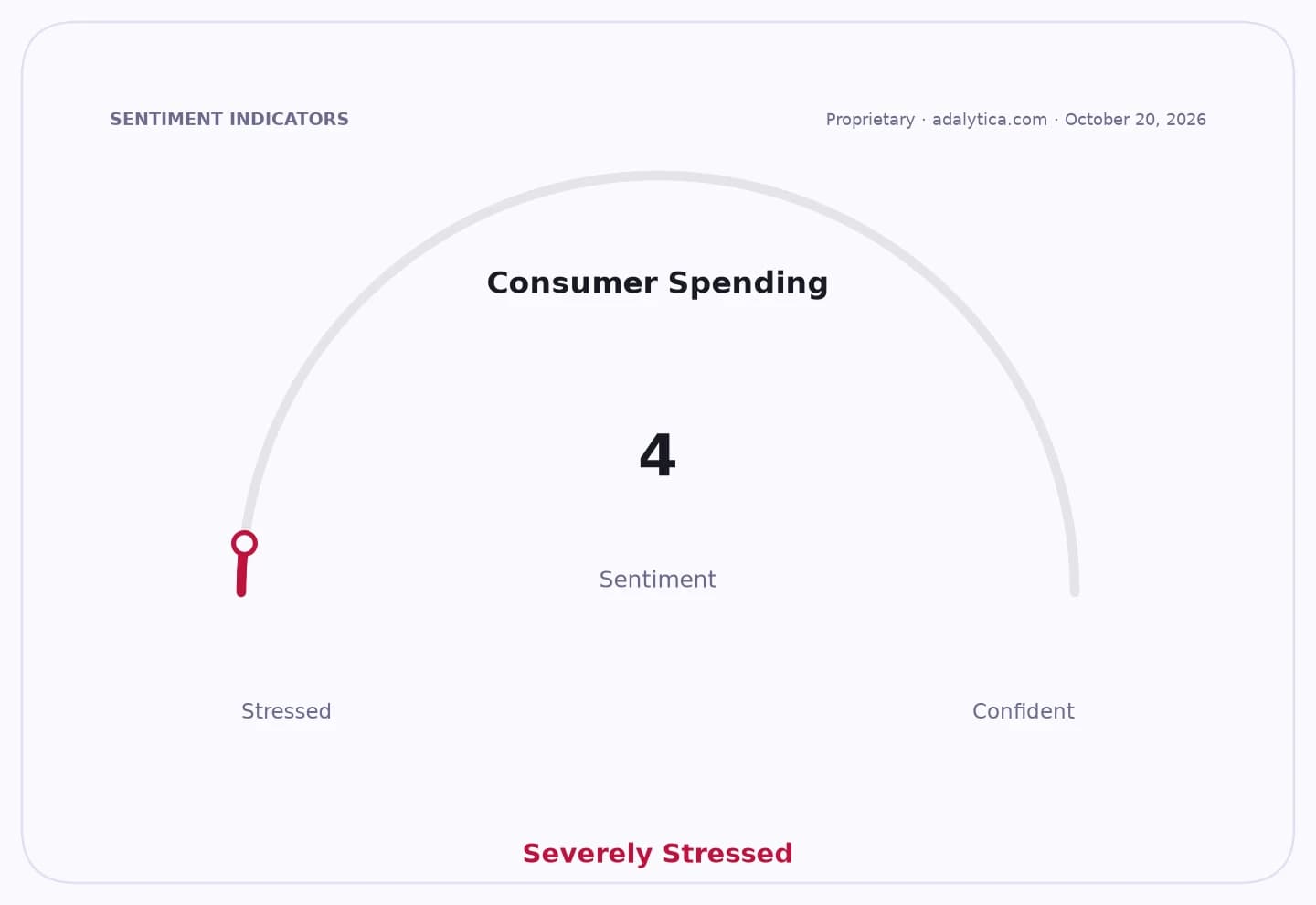
That matters because inflation is no longer just a macro headline; it is a demand story. When consumers feel poorer, they trade down, defer discretionary purchases and become more price-sensitive. Adalytica’s consumer spending sentiment gauge underscores that strain, showing “Extreme Fear” at 7, a level consistent with a sharp deterioration in willingness to spend. For retailers, that is a warning sign that unit growth will remain hard won and promotions may need to do more of the heavy lifting.
Consumer Spending — 30-day sentimentadalytica.com
Explore this data interactively — full history, time series and cross-market comparisons.
The market has already started to separate winners from losers. Walmart and Costco have been bid up as investors favor chains that can capture budget-conscious shoppers and defend traffic with scale, private label and membership economics. Target has also rallied, but its moves have been more volatile, reflecting the market’s view that it is more exposed to discretionary weakness and margin pressure if consumers keep trading down. Technical momentum in all three names has improved, with prices trading above their 50-day moving averages, but those gains are only partly about confidence in earnings and more about expectations that value retailers can absorb inflation better than broader merchants.
There is also a policy implication. If inflation remains sticky while unemployment stays near 4%, the Federal Reserve has less room to ease and more reason to keep policy restrictive for longer. That is good for dollar support and a drag on highly levered consumers, but it keeps borrowing costs elevated for households already using credit to bridge the monthly gap. For investors, that means the next leg of the consumer trade will depend less on whether inflation falls in headline terms and more on whether real wage growth can finally outrun the quiet leaks in household budgets.
The central question for 2026 is not whether inflation has moderated from its worst levels; it is whether it has come down enough to restore spending power. If not, the official data may keep improving while consumers, retailers and policymakers continue to behave as if the squeeze has never really ended.
| Entity | Gains | Losses |
|---|---|---|
| Walmart | ▲Trade-down traffic | ▼Broadline rivals |
| Costco | ▲Membership demand | ▼Premium discretionary sellers |
| Target | ▲Defensive spending mix | ▼Margin-sensitive households |
| U.S. consumers | ▲Wage gains in tight labor market | ▼Real purchasing power |