Ukraine’s 2027 external debt service bill is set to reach $6.674 billion, underscoring how the country’s financing crunch will remain one of the biggest economic risks as the war drags on and public debt keeps climbing.
Ukraine 2027 Debt Service Reaches $6.7 Billion
That payment schedule matters because it lands on top of a debt stock already above $215 billion and a budget that is still heavily reliant on outside support. Of the 2027 bill, $3.335 billion is principal and $3.339 billion is interest and other servicing costs, according to the finance ministry’s calendar. In other words, roughly half of what Kyiv must pay next year is simply the cost of carrying the debt, not reducing it.
Sentiment IndicatorsⓘProprietary · adalytica.com · October 18, 2026
This is a snapshot — live sentiment, awareness and momentum for 130+ markets update continuously in the dashboard.Open AlphaPulse

The larger issue is that this is not a one-off spike. Ukraine’s overall state debt was reported at 9.60289 trillion hryvnias, or about $215.55 billion, and the finance ministry has projected it could rise to $240 billion by end-2026. With a 2027 debt-service wall already visible, investors should assume the country will need continued concessional financing, rollovers and aid-linked budget support well beyond next year.
That makes the story economically important far beyond Ukraine’s borders. Sovereign risk in a war economy does not just affect Treasury calendars; it shapes funding costs for allies, multilateral lenders and any future restructuring negotiations. As debt service rises, every dollar spent on creditors is a dollar not available for defense, reconstruction or social spending. The arithmetic also keeps pressure on officials in Kyiv and partner capitals to preserve grant-based support rather than force the country deeper into borrowing.
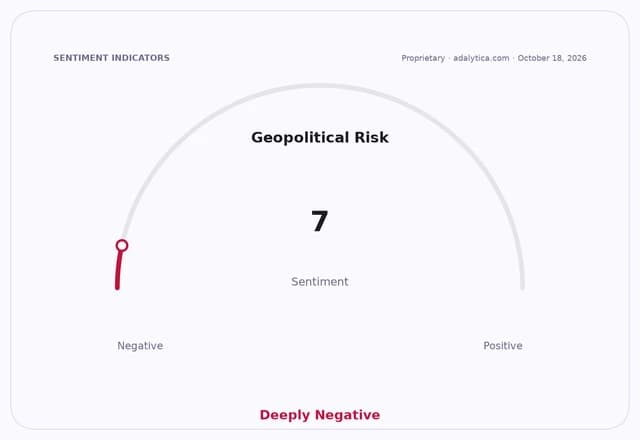
Markets are already telegraphing the stress in the broader sovereign-risk complex. Global stability sentiment tracked by Adalytica has plunged into “Extreme Fear,” while euro-area debt-rule sentiment sits at “Extreme Greed,” reflecting a market environment where fiscal strains are getting more attention, not less. For investors, that usually means higher scrutiny on Eastern European sovereign exposure, greater sensitivity to aid headlines and renewed interest in beneficiaries of reconstruction and defense spending rather than Ukraine’s balance-sheet risk itself.
The investable takeaway is that Ukraine’s debt burden is less a standalone credit event than a sustained capital-flow story. The market underestimates how long the financing overhang will last, which is why the winners are likely to be defense suppliers, infrastructure rebuild plays and lenders tied to official-sector support, while direct sovereign risk remains a waiting game. If you are positioning for the next leg of this trade, the asymmetric bet is on the companies and funds that profit from Ukraine’s prolonged funding dependence, not the debt itself.
| Entity | Gains | Losses |
|---|---|---|
| Ukraine government | ▲More aid leverage | ▼Fiscal flexibility |
| Creditors / bondholders | ▲Scheduled payments | ▼Restructuring risk |
| Defense contractors | ▲Sustained war spending | ▼None from debt strain |
| Reconstruction/infrastructure firms | ▲Future rebuilding demand | ▼Near-term budget pressure |