Ukraine’s growing drone and AI warfare capability is emerging as the only credible lever that could raise the cost of Russia’s air campaign enough to force Vladimir Putin toward talks, but the strategy still hinges on whether the U.S. and its allies supply enough missile defense and industrial backing to scale it.
Ukraine Drone War Raises Demand for Air Defense

That is the central economic and strategic takeaway from a war that has increasingly become a contest of production capacity, technology iteration and resilience rather than simply manpower. Russia’s intensified strikes on railways, ports, gas stations and the power grid are meant to break civilian morale and disrupt the logistics that keep Ukraine functioning through winter. But the more Moscow leans on cheap massed drones and ballistic missiles, the more it highlights the value of Ukraine’s faster innovation cycle and its ability to adapt weapons in real time from the front line.

The issue matters economically because sustained strikes on infrastructure raise the cost of doing business in Ukraine, endanger export routes and force a larger share of national resources into repair, air defense and emergency logistics. That is already showing up in the vulnerability of rail transport, fuel distribution and grain shipments, sectors that underpin domestic supply and foreign-exchange earnings. If the attacks continue unchecked, Ukraine’s economy faces deeper winter disruption, more capital flight risk and a heavier dependence on external financing and military aid.
For investors, the story is less about a quick battlefield shift than about the emerging industrial winners of the war. A prolonged drone war supports demand for interceptors, air defense systems, sensors, software, secure communications and joint production capacity in Europe and the U.S. It also reinforces the strategic case for firms involved in missile defense and unmanned systems, including Northrop Grumman, which builds Patriot interceptors, even as Ukraine’s own domestic technology base becomes a more important partner for Western defense contractors. At the same time, the war’s trajectory remains hostage to political decisions in Washington: without more Patriot interceptors and broader U.S. backing, Ukraine’s technological advantage may not translate into battlefield leverage.
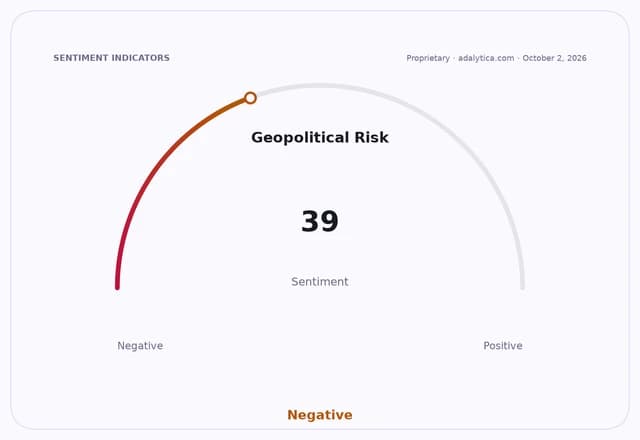
The market backdrop underlines how closely investors are watching geopolitical risk. Adalytica’s Global Stability Sentiment is in neutral territory at 39, but awareness is at an extreme-fear reading of 4, reflecting how quickly conflict escalation can spill into supply chains, defense budgets and energy markets. That is consistent with the broader investor response to a war that has moved well beyond a regional security issue and into a test case for future warfare.
The narrative connecting the facts is straightforward: Ukraine is trying to compensate for a manpower gap with speed, software and swarming drones, while Russia is trying to win by exhausting civilian infrastructure. If Kyiv can pair its innovation with enough Western interceptors and manufacturing scale, it could make the war too expensive for Moscow to sustain. If not, Russia’s air campaign may continue to grind down the economy, the power system and public patience before diplomacy ever becomes credible.
| Entity | Gains | Losses |
|---|---|---|
| Ukraine drone makers | ▲Scale-up demand | ▼Funding gaps |
| U.S./European defense firms | ▲More air-defense orders | ▼Supply bottlenecks |
| Russian military | ▲Short-term coercive leverage | ▼Rising war costs |
| Ukrainian civilians/economy | ▲Better protection if funded | ▼Infrastructure damage |