Ukraine’s fear that Russia will exploit gaps in the southeast front to push small assault groups toward Zaporizhzhia underscores a bigger risk for markets and policymakers: the war is entering another winter phase where attritional tactics, not armored breakthroughs, can still force costly redeployments and strain Kyiv’s defenses.
Ukraine Zaporizhzhia Front Supports Defense Trade
A Ukrainian commander said Moscow could use cold-weather conditions to intensify pressure around the Zaporizhzhia axis, with small infantry teams slipping through weak points near Stepnohirske and the south bank of the Dnipro River. The warning matters because it points to a familiar Russian playbook: test the line with dispersed units, lean on drones, glide bombs and artillery to sever supply routes, then force a withdrawal before a larger push.
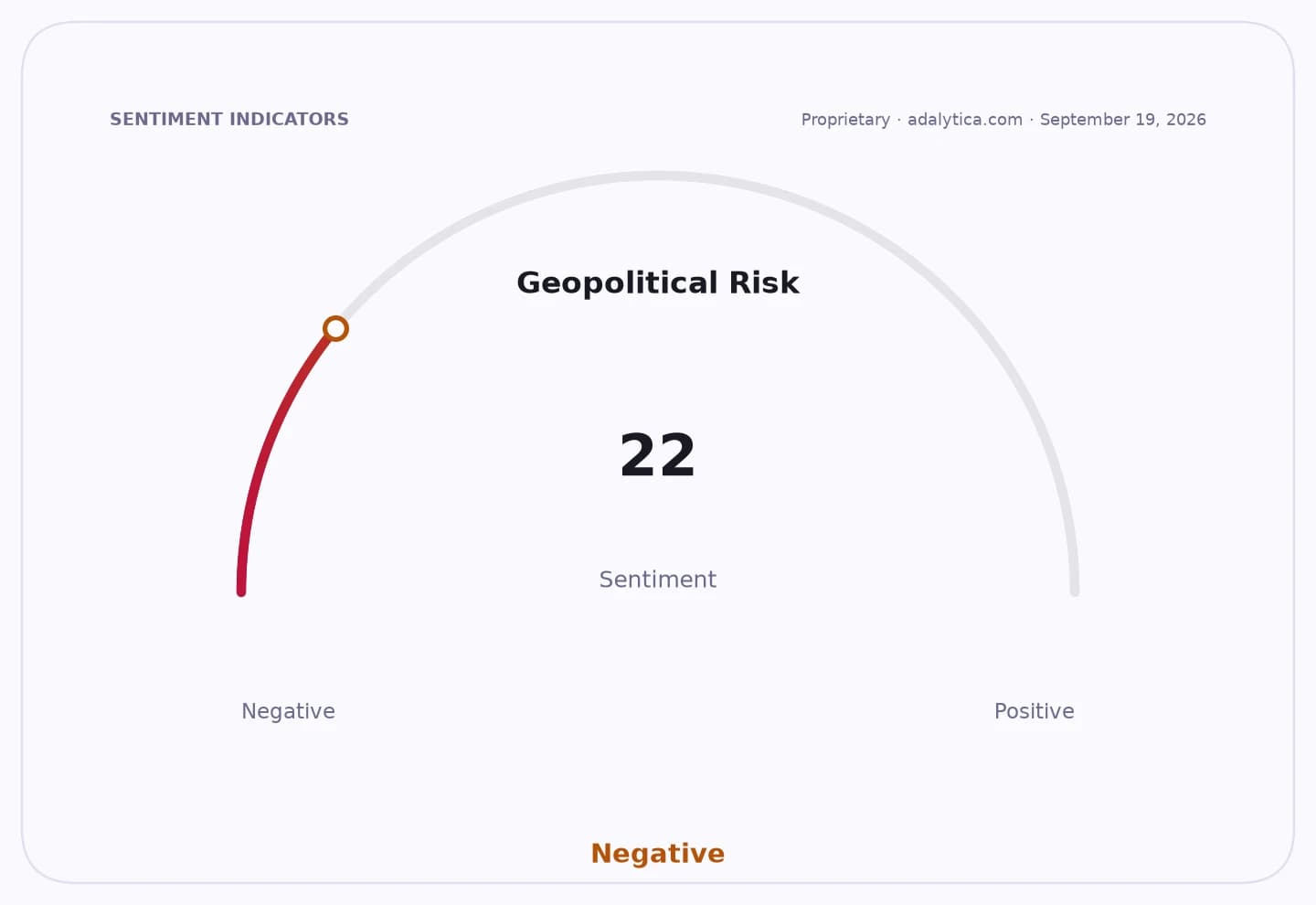
Sentiment IndicatorsⓘProprietary · adalytica.com · September 27, 2026
This is a snapshot — live sentiment, awareness and momentum for 130+ markets update continuously in the dashboard.Open AlphaPulse
That dynamic is exactly what makes the southeast front economically relevant. Zaporizhzhia is not just another battlefield. It is a major industrial center and a logistical node, and any sustained Russian advance would raise the cost of defending southern Ukraine while threatening infrastructure linked to energy self-sufficiency. Even a limited penetration could have an outsized psychological effect, forcing Kyiv to shift troops away from other pressure points in Donbass.
Ukraine’s southern command pushed back on the idea that Moscow can move directly into the city this winter, saying the front is still about 30 kilometers away and that drones are tracking Russian movements. That distance makes a stealthy advance difficult, but it does not eliminate the threat of incremental gains. Russia has repeatedly used small-unit infiltration to probe fortified lines, and this phase of the war often decides where artillery, logistics and manpower have to be concentrated next.
For investors, the message is straightforward: the market continues to underestimate how much a drawn-out war keeps demand elevated for defense systems, counter-drone technology, electronic warfare, surveillance and industrial capacity. The risk is not just a sudden breakthrough; it is the grinding, expensive need to hold lines across multiple sectors while replenishing stocks faster than they are burned.
That is why the geopolitical backdrop still supports the defense trade even when headline sentiment swings. Adalytica’s Global Stability Sentiment gauge shows extreme greed at 100, but awareness remains in extreme fear territory at 7, a combination that suggests complacency in positioning versus the operational reality on the ground. In plain terms, investors may be too relaxed about a conflict that is still capable of surprising on the downside.
The investable implication is that continued fighting around Zaporizhzhia, Donbass and the Dnipro corridor should keep the spotlight on European defense names, drone and counter-drone suppliers, and the U.S. and allied industrial firms feeding ammunition, air defense and battlefield electronics. The longer Russia can force Ukraine into a reactive posture, the more the war becomes a capital-allocation story for NATO procurement and rearmament.
EWU, which tracks U.K. equities, has also held above its 200-day moving average, with recent trading near 47.32 after a pullback from its 2026 highs. That does not make it a direct war proxy, but it reflects the broader European market’s sensitivity to defense spending, energy security and regional risk premiums as the conflict grinds on.
Our thesis is that winter will not need a dramatic Russian breakthrough to keep the defense supercycle alive. Incremental infiltration attempts, pressure on supply routes and the need to reinforce weak spots are enough to extend the cycle for months, if not years. For investors, the best positioning remains in the picks-and-shovels of modern warfare: defense primes, drone chains, secure communications and the industrial suppliers that profit every time the front line shifts, even slightly.
| Entity | Gains | Losses |
|---|---|---|
| Defense contractors | ▲More procurement demand | ▼ |
| Drone and EW suppliers | ▲Higher battlefield urgency | ▼ |
| Ukraine | ▲if fronts hold, stronger aid case | ▼Troop strain, logistics pressure |
| Russia | ▲Tactical pressure options | ▼Prolonged attrition costs |