U.S. bank stocks slipped as a firmer labor market kept the Federal Reserve on track to raise rates again, a shift that matters because the market is repricing the path of borrowing costs just as inflation worries return to center stage.
U.S. Bank Stocks Slip on Higher Rate Bets

The move hit financials first because banks are among the most rate-sensitive corners of the market. A stronger-than-expected jobs backdrop reduces the odds that the Fed will pivot quickly to easier policy, keeping pressure on funding costs and extending the period in which short-end yields stay elevated. That is bad news for rate-sensitive sectors that have been trading on the assumption that inflation would ease fast enough to allow a gentler landing.
Sentiment Indicators
Hawkish vs Dovish
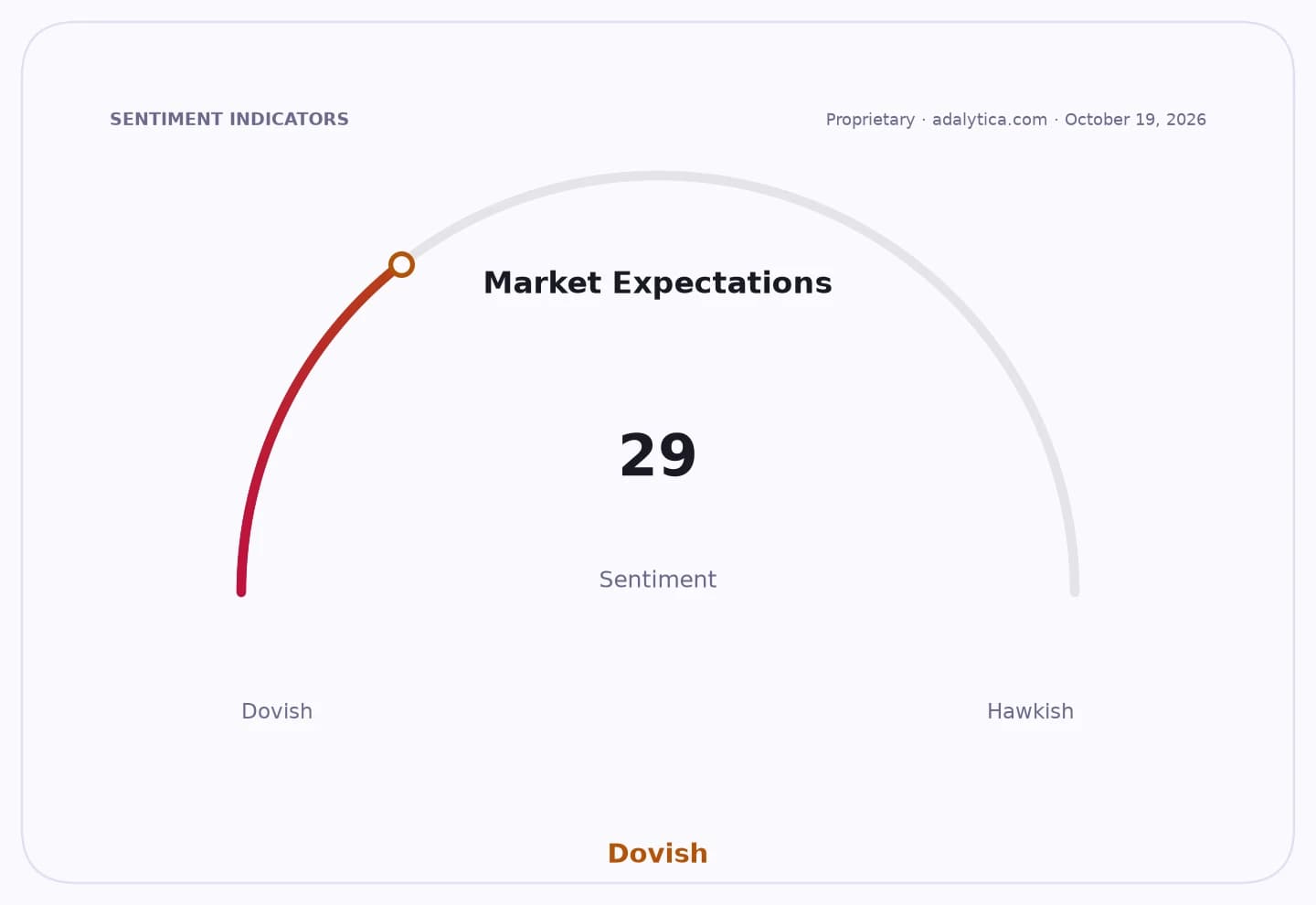
The fear is not just theoretical. Fed funds futures are now pricing an 84% chance of a December hike, with officials including Christopher Waller and Beth Hammack signaling support for another 25 or 50 basis points. The 10-year Treasury yield climbed to 4.88%, while the fed funds rate has risen to 3.88%, underscoring how quickly the market has shifted back toward a tighter-for-longer scenario. Adalytica’s Hawkish vs. Dovish Fed Policy gauge fell to 18 from 36 a day earlier, showing how sharply traders have swung toward fear of more tightening. Its Federal Reserve Forward Guidance reading is even more stressed, at 4, or “Extreme Fear.”
That matters because banks have spent the past year balancing the upside from higher interest income against the risk that deposit costs, loan demand and credit quality all deteriorate if rates stay too high for too long. JPMorgan, Bank of America and the broader XLF financial ETF all sold off in the latest move, even though their longer-term charts still show relative strength above the 200-day moving average. XLF finished at 58.51, above its 50-day average of 55.93 and 200-day average of 53.64, but the recent pullback from the highs shows how fragile the trade becomes when the Fed narrative turns hawkish again.
Hawkish vs Dovish Sentiment — 30-day sentimentadalytica.com
Explore this data interactively — full history, time series and cross-market comparisons.
Forward Guidance Interpretation
The bigger market story is that investors are no longer treating the rate path as a soft-landing victory lap. Instead, they are confronting the possibility that the Fed may need to do more work to contain sticky inflation, even at the cost of slower growth and more volatility in equities. That is why the pressure is broadening beyond banks into the parts of the market most dependent on cheap capital and easy financial conditions.
For investors, the opportunity is to separate beneficiaries of higher-for-longer rates from the names most exposed to margin compression and valuation pressure. Large banks with strong deposit franchises can still outperform if the economy holds up, but rate-sensitive growth stocks and unprofitable AI names remain vulnerable if yields keep rising. In this setup, Treasury exposure and defensive financial positioning may offer better risk-adjusted returns than chasing the most crowded growth trades.
The next catalyst is clear: incoming inflation data and Fed commentary will decide whether this is a one-day repricing or the start of a longer reset in rates, bank multiples and equity leadership. Until then, the market is signaling that the burden of proof is back on the doves.
| Entity | Gains | Losses |
|---|---|---|
| Treasury yields | ▲Higher income for savers | ▼Bond prices |
| Large banks | ▲Wider lending spreads | ▼Rate-sensitive borrowers |
| XLF financials | ▲Support from higher rates | ▼Valuation multiple |
| AI/growth stocks | ▲— | ▼Higher discount rates |