U.S. banks are entering the latest stretch of higher-for-longer rates with capital and liquidity still intact even as foreign bank debt retreats, a sign that funding pressures remain manageable for the sector and the broader financial system.
U.S. banks stay liquid as 10-year yield hits 4.61%

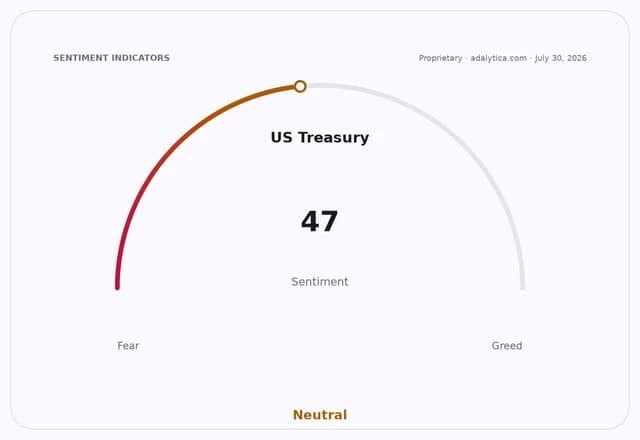
That matters because the U.S. Treasury market is still pricing in restrictive policy even after recent easing, with the 10-year yield at 4.61% and the two-year at 4.27%, levels that keep deposit costs and wholesale funding expensive. The federal funds rate is forecast at 3.63%, still high enough to squeeze net interest margins while supporting bank earnings on floating-rate assets.
Sentiment IndicatorsⓘProprietary · adalytica.com · July 30, 2026
This is a snapshot — live sentiment, awareness and momentum for 130+ markets update continuously in the dashboard.Open AlphaPulse
The setup is more favorable for the largest lenders than in past tightening cycles. JPMorgan Chase ended July 29 at $344.71, above its 50-day moving average of $324.66 and 200-day average of $308.79, while Bank of America closed at $61.07, also above its 50-day and 200-day averages. Citigroup fell to $127.13 after a recent run-up, but remains well above its 200-day average of $117.79.
Investors have mostly treated the sector as a beneficiary of resilient capital returns rather than a funding-risk story. Bank of America’s board raised its quarterly dividend to $0.32 a share from $0.28 after second-quarter net income of $9.1 billion, or $1.21 a share, and the stock has climbed sharply since early spring.
DGS10 vs DGS2 — macro contextadalytica.com
Explore this data interactively — full history, time series and cross-market comparisons.Open AlphaPulse
The more important backdrop is that banks are still showing access to diversified liquidity sources even as some foreign-bank debt issuance softens. That reduces the odds of a repeat of the kind of wholesale funding stress that hit smaller and more rate-sensitive lenders in prior cycles, and leaves the biggest U.S. banks better positioned to keep lending, buy back stock and raise dividends.
For investors, the key question is whether rising Treasury yields and still-tight policy begin to bite into credit quality or funding costs later this year. For now, the market is signaling that capital strength and liquidity buffers remain the dominant story, not stress.
| Entity | Gains | Losses |
|---|---|---|
| Large U.S. banks | ▲Strong capital returns | ▼Little immediate funding strain |
| Depositors | ▲Higher savings yields | ▼Lower bargaining power |
| Borrowers | ▲Continued credit access | ▼Higher borrowing costs |
| Foreign bank debt holders | ▲More cautious demand | ▼Weaker issuance backdrop |