The Trump administration is moving to block more indirect access to U.S. artificial-intelligence chips and servers for China, sharpening the technology confrontation just as the president heads into a summit where trade and security tensions are expected to dominate.
U.S. moves to block more AI chip access for China
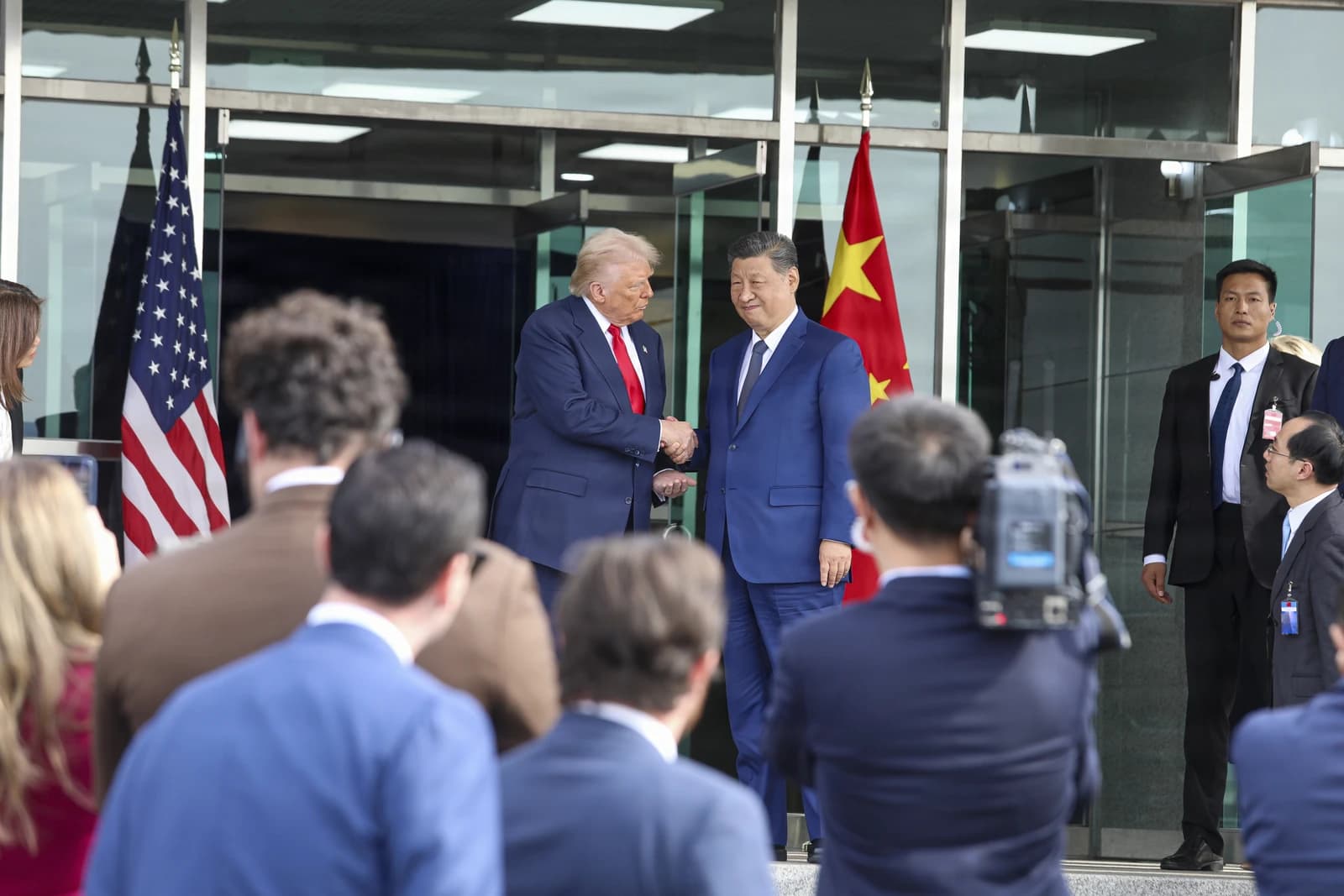
The new restrictions matter because AI computing power has become a strategic input for both economic growth and military modernization. By targeting not only direct sales but also workarounds through third countries and intermediaries, Washington is trying to slow Beijing’s ability to build advanced models and data centers even as China pushes for looser trade and AI cooperation.
Sentiment Indicators
US-China Relations
That raises the stakes for investors across the semiconductor supply chain. Nvidia, already under pressure, has fallen to $147.20 from $221.97 on Oct. 21, with its relative strength index at 16.8 and the stock trading far below its 50-day moving average of $208.88, a sign of heavy technical damage. AMD has also whipsawed, slipping to $482.55 from $552.72 on Oct. 21 after a sharp post-earnings swing, while Microsoft closed at $500.46 and remains below its recent highs.
The policy shift lands alongside an active U.S. investigation into illegal AI-chip shipments to China, underscoring how export controls are moving from broad rules to enforcement. That combination is important for chipmakers because it can reshape sales to Chinese customers, tighten compliance costs and threaten the availability of high-end accelerators in one of the world’s biggest technology markets.
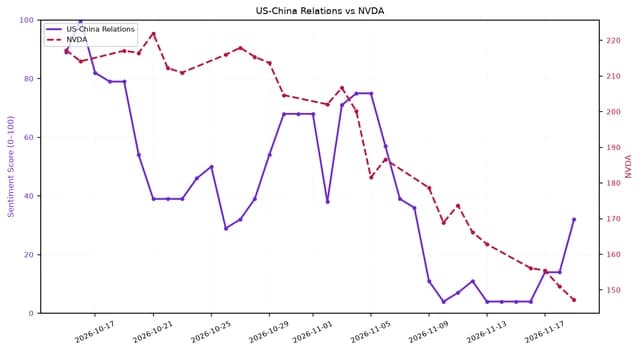
The backdrop is a market already skittish on trade and policy risk. Adalytica’s U.S.-China relations gauge shows neutral sentiment at 32, but awareness at 100, indicating the issue is fully front-of-mind for investors. The S&P 500 trade-signal snapshot shows extreme fear, while the dollar trade signal is also in extreme fear territory, suggesting investors are positioning defensively around any escalation.
For investors, the next catalysts are clear: any fresh U.S. enforcement action, Beijing’s response, and whether summit talks produce even limited guardrails on technology trade. Until then, the biggest winners are likely to be firms with less China exposure and more domestic AI demand, while the most vulnerable remain the chipmakers tied to frontier AI hardware sales into the Chinese market.
| Entity | Gains | Losses |
|---|---|---|
| U.S. policymakers | ▲Stronger leverage on China AI access | ▼Near-term trade friction |
| China tech firms | ▲Potential local chip development push | ▼Access to advanced U.S. chips |
| Nvidia / AMD | ▲Non-China demand may hold up | ▼China sales, sentiment, valuation |
| Microsoft and cloud rivals | ▲Domestic AI spending support | ▼Wider supply-chain uncertainty |