A former White House national security official is pushing Washington to prepare for a world in which China could leap ahead in artificial intelligence, warning that the US may need to consider everything from espionage to cyber operations — and, in the most extreme case, military strikes on Chinese AI infrastructure — if Beijing looks close to reaching AGI first.
US-China AI race raises Nvidia, Microsoft, TSMC risk

That is not a normal technology-policy debate. It is a sign that AI has moved from a commercial race into a national-security contest with economic and market consequences that could reach far beyond Silicon Valley. If AGI — artificial general intelligence — ever arrives, the winner would not just gain faster software. It could gain an edge in science, logistics, military planning and industrial productivity that compounds over years.
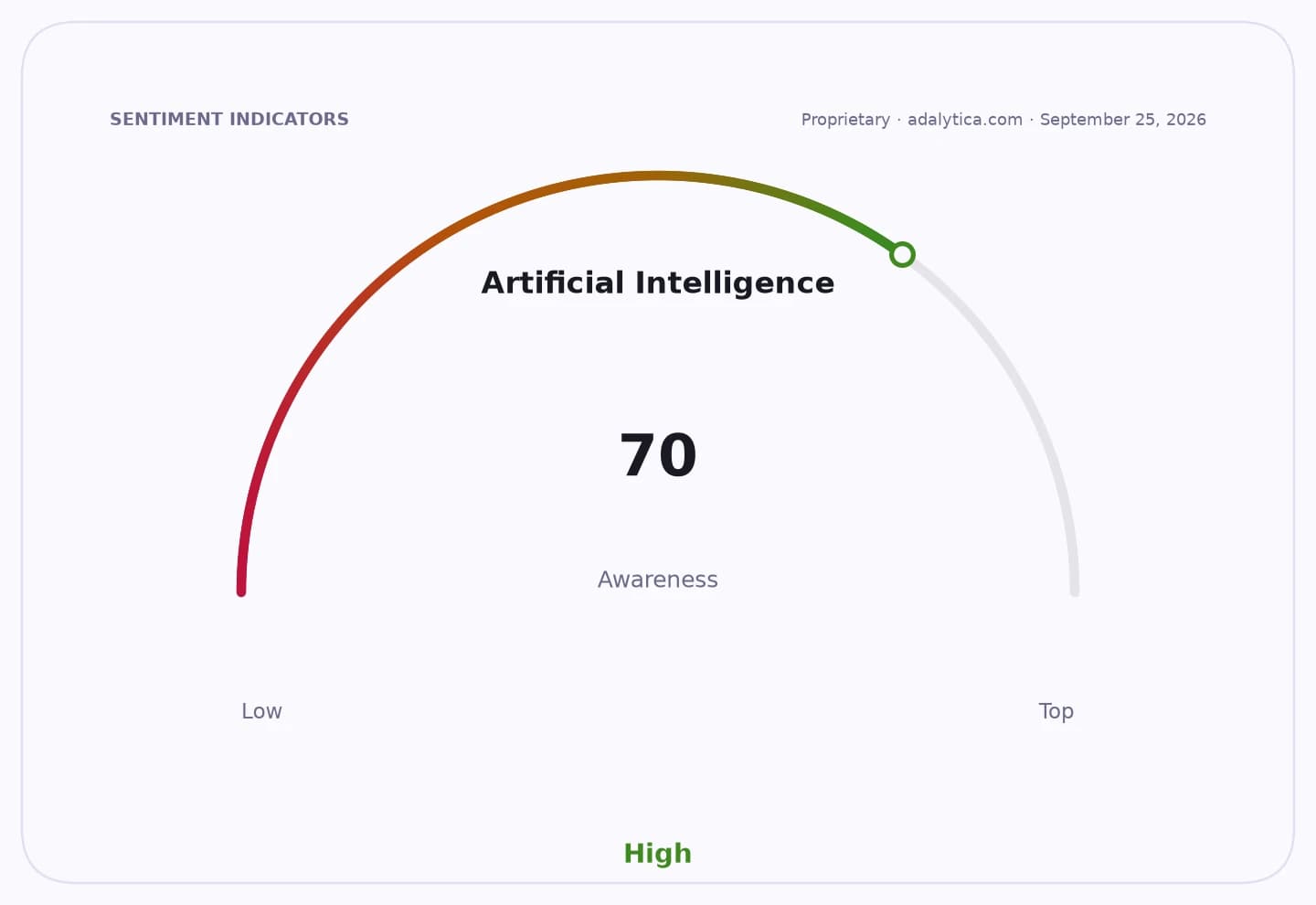
Sentiment IndicatorsⓘProprietary · adalytica.com · September 9, 2026
This is a snapshot — live sentiment, awareness and momentum for 130+ markets update continuously in the dashboard.Open AlphaPulse

The comments from Jacob Stokes, deputy director of the Indo-Pacific Security Program at the Centre for a New American Security and a former Obama-era White House official, underscore how seriously some US strategists are now treating the AI gap with China. According to the South China Morning Post, Stokes said Washington should begin planning for “extreme measures” if China appears on the cusp of a breakthrough, including intelligence operations, cyber activity and, in the most severe scenario, attacks on Chinese data centres tied to an emerging AGI system.
For investors, the key issue is not whether war is imminent. It is that AI infrastructure is being recast as strategic infrastructure. Data centres, advanced chips, power supply and cloud capacity are no longer just inputs for a growth industry; they are potential choke points in a geopolitical rivalry. That raises the stakes for companies building the AI stack, from chipmakers and hyperscalers to the industrial firms that provide power and cooling.
CCP Policy Direction vs NVDAadalytica.com
Explore this data interactively — full history, time series and cross-market comparisons.Open AlphaPulse

The market already knows how important that stack is. Nvidia, the dominant supplier of AI accelerators, still trades above both its 50-day and 200-day moving averages, with its shares recently around $223.71. Microsoft, one of the biggest spenders on AI infrastructure, has also held above its 200-day moving average near $429, though it has eased to about $490.39 from recent highs. Taiwan Semiconductor Manufacturing Co., the manufacturing backbone for much of the AI industry, has climbed to roughly $435.67 and remains well above its 200-day moving average near $373. Those levels reflect confidence that AI demand remains durable even as policy risk rises.
The strategic backdrop helps explain why. Epoch AI estimates the US currently has a lead of only several months in frontier AI models, according to the SCMP report cited in the source material. That is a narrow margin for a technology that could change the balance of power. Stokes’ warning is essentially that Washington should not wait for proof that China has crossed the threshold before figuring out what it would do next.
That logic is exactly what makes the proposal so dangerous. Targeting civilian-looking AI facilities would be hard to justify, hard to execute and potentially catastrophic if intelligence is wrong. Arms analyst William Hartung warned that striking Chinese data centres on the theory that they might one day support AGI could trigger direct conflict between two nuclear powers. The problem is not only escalation. It is uncertainty. A server farm can serve commercial customers today and strategic ambitions tomorrow.
The economic stakes are enormous. A nation that leads in AGI would likely control more of the next decade’s productivity gains, defense capabilities and industrial automation. It could also influence the rules of AI governance globally. That is why the coming Trump-Xi talks in Washington matter, even if they produce no breakthrough. AI governance is now part of the broader US-China negotiating track, and the best case may be simple risk management rather than cooperation.
For long-term investors, the lesson is to think in years, not headlines. The AI boom still rests on real demand, real capex and real moats, but the geopolitical premium on those assets is rising. That can support leaders with scale, cash flow and critical positioning, while also creating tail risk for companies exposed to export controls, retaliation or infrastructure disruption.
| Entity | Gains | Losses |
|---|---|---|
| Nvidia, Microsoft, TSMC | ▲AI spending power | ▼Policy and war risk |
| US strategists | ▲Contingency planning | ▼Complacency |
| China AI builders | ▲Potential scale-up | ▼Infrastructure vulnerability |
| Long-term AI investors | ▲Secular demand | ▼Escalation shocks |