The U.S. is pressing China to follow through on commitments around rare earths and agriculture, putting a fresh spotlight on a trade file that can move everything from industrial supply chains to the shares of miners and manufacturers dependent on critical minerals.
U.S. presses China on rare earths and agriculture
That matters because rare earths sit at the center of the electric-vehicle, defense, electronics and renewable-energy supply chains, while agricultural commitments speak to a broader trade bargain that helps determine commodity flows and farm incomes. Any sign that Beijing is slowing implementation, or that Washington is preparing to push harder, feeds directly into pricing for strategic materials and the earnings outlook for companies exposed to China-related trade friction.
Sentiment Indicators
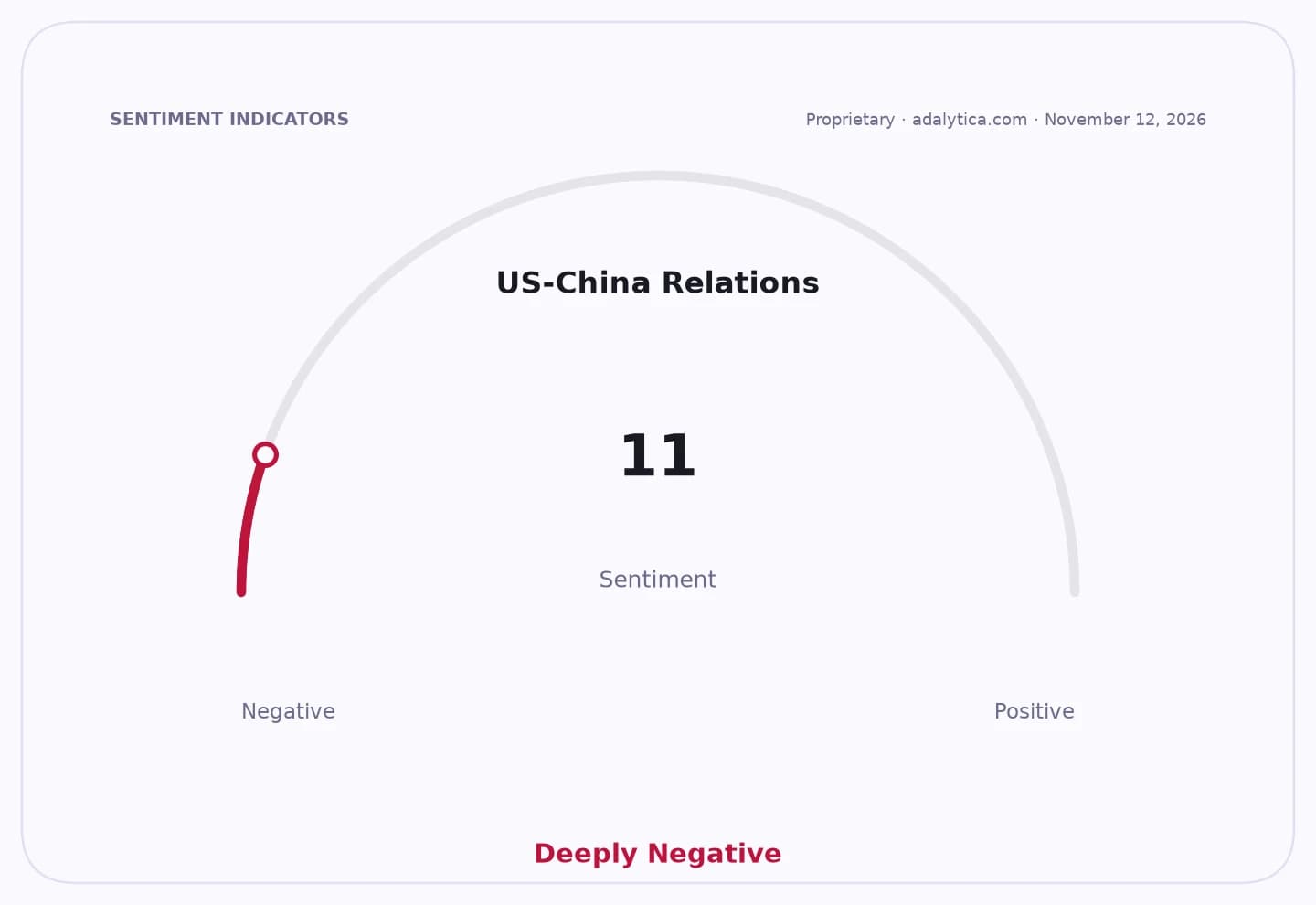
US-China Relations
Investors have already been treating the issue as market-moving. MP Materials, one of the most visible U.S. rare-earth producers, has been volatile, with its shares plunging from a 2026 high above $72 to $37.85 on Thursday. The stock remains well below its 50-day moving average of $44.24 and 200-day average of $53.84, a sign that recent gains tied to strategic-minerals optimism have not yet reversed the broader downtrend. Technical readings remain mixed, with relative strength still below overbought levels but improving from the deeply oversold conditions seen in late July.
The same trade narrative is rippling through other miners. Taseko Mines, which has a smaller but still China-sensitive commodity profile, traded at $2.03, below both its 50-day and 200-day moving averages of $2.73 and $3.62. Freeport-McMoRan, a bellwether for industrial metals sentiment, closed at $60.90, also under its 50-day average of $68.69 and 200-day average of $64.98. For investors, that combination suggests the market is pricing in weaker near-term trade confidence even as the strategic importance of critical minerals keeps the sector on watchlists.
US-China Relations — 30-day sentimentadalytica.com
Explore this data interactively — full history, time series and cross-market comparisons.
The policy backdrop is not helping. China’s extension of its suspension of rare-earth export controls has eased immediate pressure in negotiations, but it has not removed the structural risk that Beijing can still use mineral supply as leverage. Adalytica’s US-China Relations Sentiment gauge stood at 11, or “Extreme Fear,” underscoring how fragile market confidence has become around the bilateral relationship. The same dashboard shows awareness of the issue remains elevated, reflecting how quickly traders react when rare-earth policy enters the headlines.
For Washington, the message is straightforward: the trade agreement is only as good as the delivery on critical commitments. For Beijing, maintaining access to the U.S. market and avoiding a renewed tariff or export-control confrontation remains economically important at a time when China is also managing a record trade surplus and trying to keep industrial momentum intact. That tension leaves markets vulnerable to sharp moves in resource stocks, especially those tied to strategic supply chains.
The near-term investor question is whether this is a negotiating flare-up or the start of a broader reset in U.S.-China trade terms. If talks stabilize, rare-earth miners could regain some valuation support as supply-chain security remains a secular theme. If rhetoric hardens or implementation stalls, the market is likely to keep rewarding companies with direct access to non-Chinese critical-mineral supply while punishing those most exposed to trade retaliation.
| Entity | Gains | Losses |
|---|---|---|
| U.S. policymakers | ▲Leverage in trade talks | ▼Risk of slower deal progress |
| China | ▲Preserves export flexibility | ▼Faces renewed U.S. pressure |
| MP Materials | ▲Strategic-minerals attention | ▼Volatility from trade uncertainty |
| U.S. industrial buyers | ▲Short-term supply relief | ▼Ongoing policy risk |