The United States and China are considering reciprocal visits to nuclear facilities in an early-stage effort to reduce strategic mistrust, a rare diplomatic opening that could marginally lower the risk of miscalculation between the world’s two biggest nuclear powers.
US and China Discuss Reciprocal Nuclear Site Visits
Geopolitical Risk
The talks matter because the nuclear relationship is shifting fast. China’s arsenal is estimated at about 600 warheads, far below the roughly 5,000 held by the U.S., but Beijing is still expanding and is not yet willing to negotiate formal limits. That makes transparency, even in a limited form, one of the few available tools to slow a dangerous spiral in which stockpile growth, military modernization and weaker communication channels all reinforce each other.
Sentiment Indicators
For investors, the significance is not immediate treaty risk so much as tail risk. Any improvement in U.S.-China strategic visibility can ease pressure on global risk assets by reducing the probability of a sudden geopolitical shock. It also supports the case for defense spending that is increasingly driven by deterrence, surveillance and hardened infrastructure rather than legacy platforms alone.
According to the report, the proposal originated with China and could eventually include visits to laboratories and, potentially, nuclear test sites. Washington wants to take the discussion further in face-to-face meetings over the next few months. That sequencing matters: the fact that both sides are even discussing access to sensitive sites suggests a willingness to test confidence-building measures after years of deepening strategic competition.
The backdrop remains tense. China’s nuclear buildup has been a growing concern in Washington, where officials increasingly view Beijing’s modernization as a long-term challenge to deterrence stability in Asia and beyond. Yet the U.S. still retains a vastly larger arsenal, and the asymmetry itself creates an opening for selective transparency. Beijing can signal restraint without immediately agreeing to caps, while Washington can probe whether there is any path toward future arms-control-style limits.
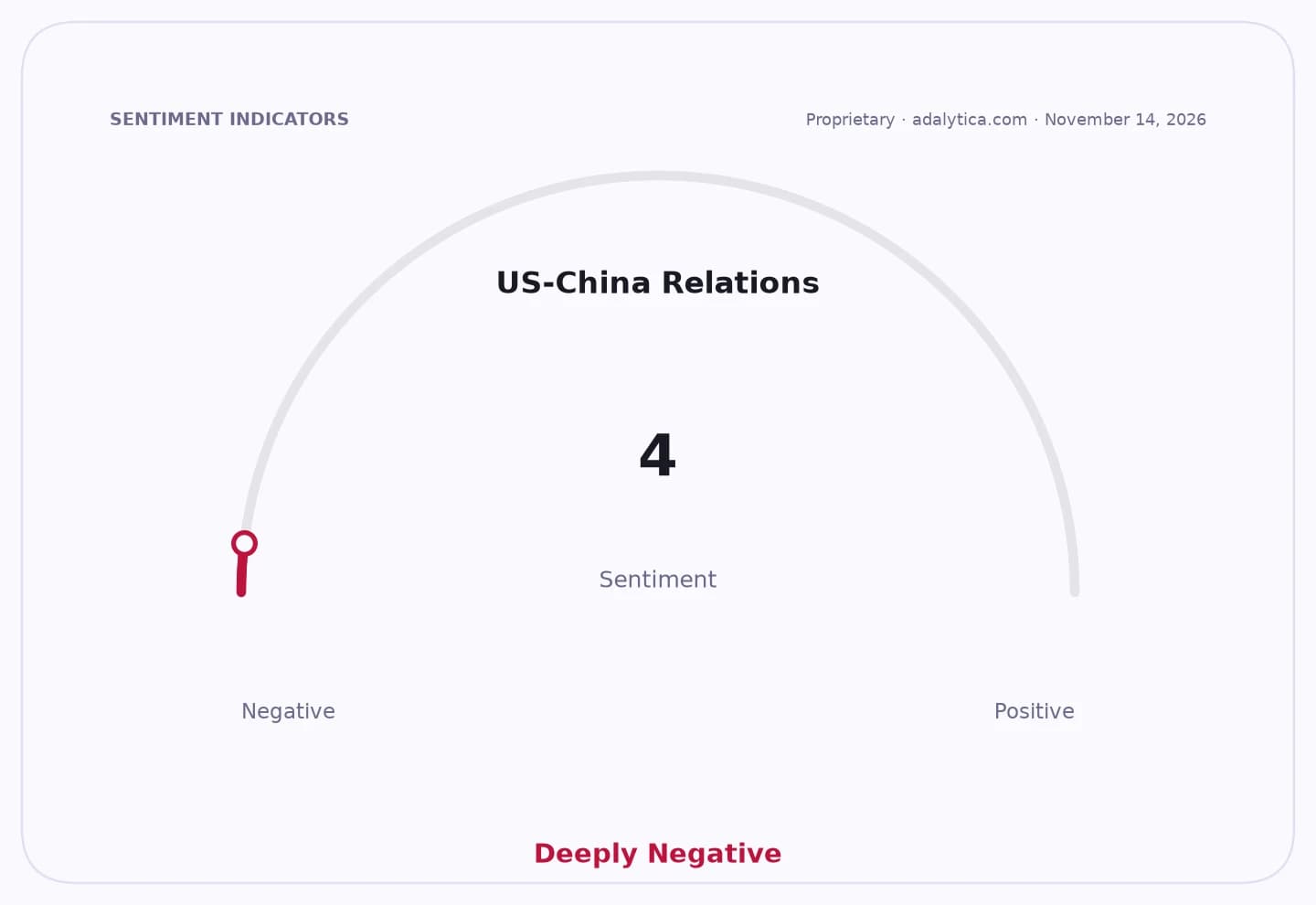
Adalytica’s US–China Relations Sentiment gauge shows extreme fear, underscoring how much geopolitical pessimism is already priced into the narrative. That is exactly why even incremental de-escalation can matter more to markets than it appears at first glance: when sentiment is this depressed, positive surprises tend to have outsized effects on risk appetite, currency volatility and cross-border capital flows.
The market implication is straightforward. Investors should keep exposure to beneficiaries of a more stable strategic backdrop — defense contractors tied to modernization, cybersecurity, satellite intelligence and dual-use infrastructure — while remaining alert to any deterioration that would revive safe-haven demand. In this environment, the asymmetric opportunity is not to bet on friendship between Washington and Beijing, but to position for a world in which even limited transparency lowers the odds of an unintended crisis.
For now, this is a cautious diplomatic probe, not a breakthrough. But in a nuclear relationship defined by opacity and mistrust, even the possibility of reciprocal site visits is a material step, and the market underestimates how much one small de-risking move can matter over time.
| Entity | Gains | Losses |
|---|---|---|
| US and China | ▲Lower miscalculation risk | ▼Hardline escalators |
| Global markets | ▲Reduced tail risk | ▼Volatility traders |
| Defense transparency efforts | ▲More dialogue | ▼Strategic secrecy |
| Arms-control skeptics | ▲Less urgency | ▼More diplomatic scrutiny |