The dollar remains broadly supported at the start of the week because investors still see the Federal Reserve as unlikely to pivot quickly, even after a softer-than-expected US jobs report briefly cooled the rally.
US Dollar Holds Near 102 as Fed Stays Cautious
That tension is the key market story. The greenback’s recent strength has been driven less by any single catalyst than by a combination of elevated Treasury yields, sticky inflation and a central bank that is still being priced as cautious. Even with the US economy adding just 29,000 jobs in September, far below expectations, the dollar index was still trading at 101.92 and had posted a third straight weekly gain, underscoring how much policy divergence and yield support continue to matter.
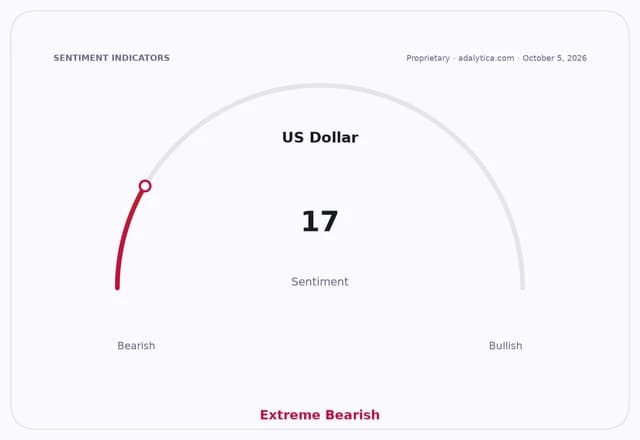
Sentiment IndicatorsⓘProprietary · adalytica.com · October 5, 2026
This is a snapshot — live sentiment, awareness and momentum for 130+ markets update continuously in the dashboard.Open AlphaPulse

For Asia currencies, including the Vietnamese dong, that has translated into stability rather than a sharp repricing. In Vietnam, the State Bank held its central rate unchanged at 25,636 dong per dollar on Oct. 5, while commercial bank quotes were little changed and the free-market rate stayed around 26,011-26,127. The message is not that the dong is under acute pressure, but that local rates are still being managed against a stronger external dollar backdrop.
The global driver remains the same: US yields are still high enough to attract capital, while oil prices above $100 a barrel keep inflation risks alive. That combination has limited how far traders are willing to push back against dollar strength. The latest payrolls number did knock some steam out of expectations for another Fed hike in October, but it did not fully unwind the market’s broader assumption that US monetary policy will stay restrictive for longer than other major central banks.
That matters for investors well beyond FX. A firmer dollar can tighten financial conditions globally, pressure emerging-market currencies and make dollar-denominated assets more attractive on a relative basis. It also weighs on commodities priced in dollars and complicates policy for economies trying to defend exchange-rate stability without choking growth. In bond markets, the moves have been equally telling: the iShares 20+ Year Treasury Bond ETF, TLT, has slumped to $77.48, with its 50-day moving average still well above the current price and RSI readings in deeply oversold territory, suggesting persistent selling pressure in duration even as some profit-taking emerges in currencies.
Adalytica’s US Dollar Trade Signals snapshot still shows a fear reading, with sentiment at 17 and awareness at 29, but the one-day improvement alongside a steep 30-day decline suggests the market is less euphoric than earlier in the rally. For now, that points to consolidation rather than a decisive reversal. The key near-term test is whether the dollar index can reclaim the 102 handle; if it does, it would reinforce the view that US yields and inflation risks still dominate. If the next round of US data shows a clearer slowdown in labor or price pressures, the case for further dollar upside will weaken quickly.
| Entity | Gains | Losses |
|---|---|---|
| US dollar | ▲Safe-haven demand | ▼Exporters in weaker-currency markets |
| Treasury yields | ▲Capital inflows | ▼Long-duration bond holders |
| Vietnamese authorities | ▲Exchange-rate stability | ▼Importers if USD rises further |
| Emerging-market borrowers | ▲Lower immediate volatility | ▼Dollar debt servicing costs |